The Henson Group is a global cloud services firm and an Azure Expert MSP that helps enterprises migrate, secure, and operate workloads on Microsoft Azure. Serving clients across multiple regions and regulated industries, Henson provides advisory services, managed operations, and platform engineering for organizations that expect enterprise grade reliability, governance, and cost control.

The Henson Group Reduces Cloud Costs by 28%
and Speeds Deployments 4X with an Azure Native
Company Brief
Overview
Henson asked us to partner on a strategic re-architecture of their internal and managed service platforms to improve performance, tighten security posture, and make operations more repeatable and cost efficient. The engagement covered landing zone design, infrastructure automation, observability, secure networking, and a DevOps toolchain aligned to Azure best practices. Our job was to produce a platform that Henson could operate and resell resilient, policy driven, and simple to extend for diverse customer needs.
- Sector: Information Technology & Cloud Services
- Project Type: Website
- Platform: WordPress CMS
Root cause analysis - why the old estate was limiting Henson
- Siloed infrastructure patterns – Different teams used inconsistent templates, resulting in drift across regions and non-standard configurations that complicated support, compliance and quality assurance.
- Manual provisioning and long release cycles – Environment builds and updates required hand-operated scripts and approvals; deployments were slow and error prone.
- Reactive security controls – Security checks were often afterthoughts or manual tasks, increasing detection times and the risk of misconfiguration.
- Limited observability and noisy alerts – Monitoring was fragmented across tools; teams lacked a consolidated view of cost, performance, and incidents.
- Unpredictable cost behaviour – Without enforced tagging and guardrails, spend spikes and orphaned resources were common, making forecasting and show back difficult.
- Difficult cross region scalability – Designs didn’t scale reliably across Azure regions, leading to inconsistent SLAs for customers operating globally.
These issues increased operational overhead, risk exposure, and limited the ability to deliver reliable enterprise software development services at scale.
Our solution - what we designed and delivered
- Azure landing zone standardization – Implemented enterprise grade landing zones aligned to Microsoft Cloud Adoption Framework principles. Each landing zone enforced naming, networking, identity, and resource segregation patterns.
- Infrastructure as Code and templates – Built parameterized Bicep modules and Terraform modules for tenant bootstrap, networking, AKS clusters, and data platforms. Modules included idempotent patterns and ready-made policy assignments.
- Policy driven governance – Deployed Azure Policy and initiatives to enforce tagging, SKU constraints, allowed regions, and security posture. Non-compliant deployments were automatically flagged or blocked.
- Modern DevOps toolchain – Created CI/CD pipelines using Azure DevOps and GitHub Actions for application delivery and platform releases, with environment promotion, automated tests, and canary rollouts.
- Secure connectivity & identity – Implemented ExpressRoute/Virtual WAN designs for hybrid connectivity, Azure AD governance with conditional access, and Privileged Identity Management for just in time admin elevation.
- Observability & incident automation – Centralized telemetry in Azure Monitor and Log Analytics, integrating business intelligence dashboards for cost, performance, and SRE runbooks. Integrated Azure Sentinel for security analytics and automated playbooks for common incidents.
- Cost management & optimization – Rolled out tagging, budgets, reserved instance commitments, and autoscaling strategies. Implemented an internal show back dashboard so teams could monitor spend by project and environment.
- Resilience patterns – Standardized backup, recovery, and cross region failover guidance. Implemented traffic manager/Front Door patterns and geo redundant storage for critical workloads.
- Operational handover & enablement – Delivered runbooks, runbook automation, and training sessions. Created a managed service playbook so Henson’s delivery teams could repeat the setup for customers.
Measured impact - outcomes after rollout
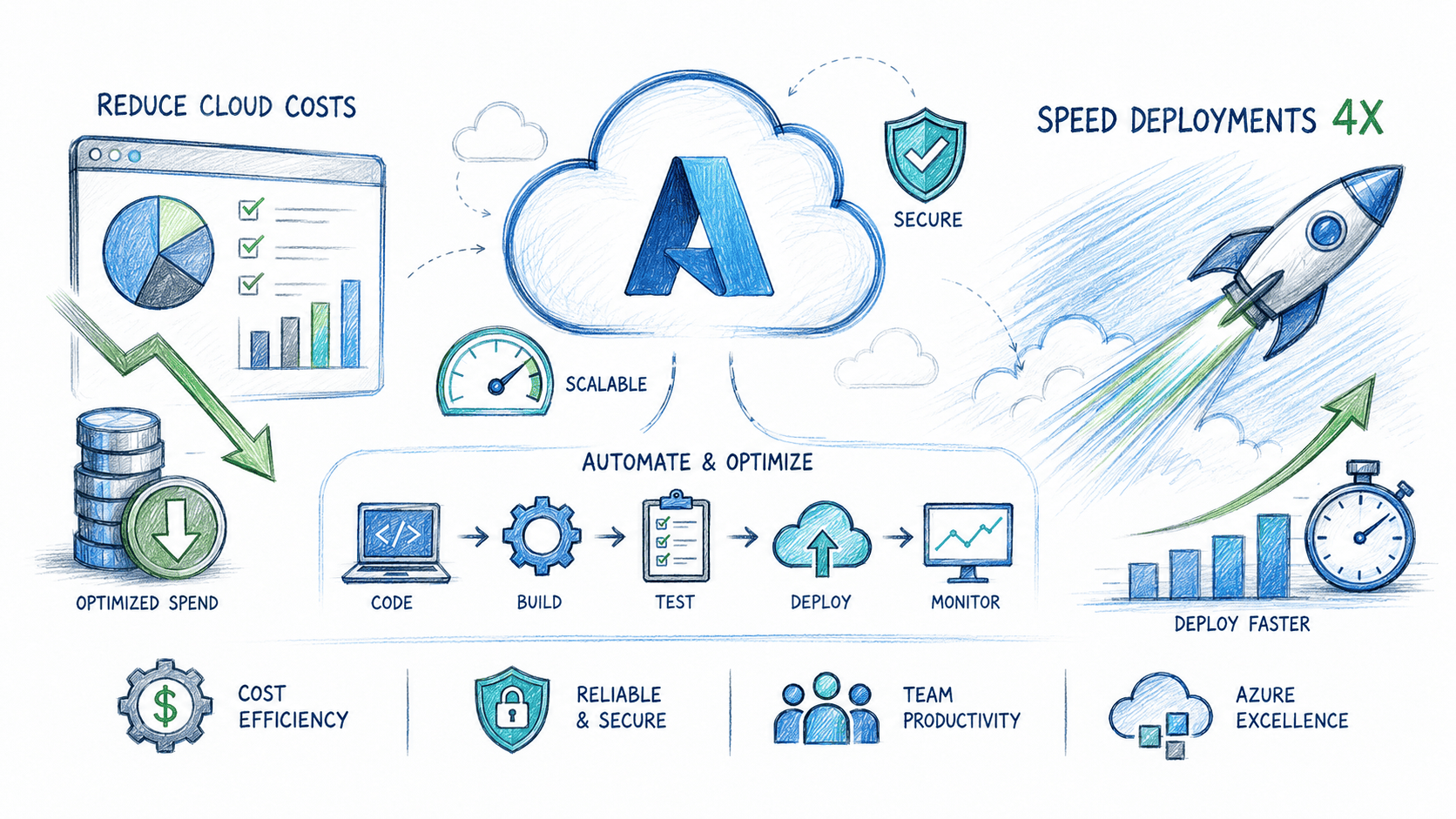
- Cloud cost reduction: 28% – Tagging, rightsizing, commitment planning, and automatic scale down saved significant monthly spend and eliminated many idle resources.
- Deployment velocity 4× increase – Release cadence rose as teams moved from manual scripts to full CI/CD; environments that once took days to provision now stand up in under an hour.
- Mean time to recovery (MTTR) reduced by 70% – Centralized observability and automated remediation playbooks shortened incident resolution time substantially.
- Security incident volume down by 62% – Policy enforcement, continuous threat detection, and automated blocking cut the number of security escalations and misconfiguration events.
- Operational efficiency 5,000 hours saved annually (2.4 FTE) – Automation of provisioning, patching, and compliance checks freed engineering and ops staff for higher value activities.
- Cross region reliability improved – Standardized templates and geo aware patterns reduced region specific configuration issues, customer SLA compliance rose across global deployments.
- Faster customer onboarding – Repeatable landing zone provisioning and a prebuilt catalogue accelerated new customer environments by 70%, enabling faster time to revenue for managed services.
- Faster feature rollouts – With automated pipelines and safe deployment gates, Henson launched platform updates more frequently with fewer rollbacks.
- Payback & ROI – Cost savings, productivity gains, and accelerated deal closures produced a typical project payback in 8–11 months, with first year ROI exceeding 150% in most scenarios.
Conclusion
The modernization effort delivered a repeatable, secure, and cost-efficient Azure platform that aligns with The Henson Group’s role as a premier Azure MSP. By codifying best practices into templates, automating governance, and centralizing observability, Henson gained the ability to operate at scale while reducing risk and cost. The outcome positioned them to serve multinational customers more effectively and to accelerate product led growth in their managed services portfolio.
Client Says
The demo has proved to be a powerful tool in investor meetings, garnering encouraging reactions. Ansi ByteCode excelled at collaboration, responding quickly and integrating all requested changes.

Greg Foster
GM & Founder of Vizen Analytics LLCAcross all of their projects, Ansi ByteCode has helped to realize efficiencies in processes and technologies, as well as increase ROI. Their flexibility and willingness to go above and beyond project scope sets them apart from other offshore vendors.

Andrew Martins
Former Executive, Manufacturing CompanyAnsi ByteCode has been conscientious and reliable since our initial project 4 years ago. They do not over promise or under deliver. We continue to work with them and will for some time.

Eddie Allen
Co-Owner with my wife Lori Allen at BBL Systems, IncAnsi ByteCode is reliable and diligent software development company. They can project manage themselves and ultimately create the software as the design requirements are given to them.

Jonathan Spence
Chief Executive Officer at XtractaI really enjoy working with this company. They follow up regularly on developments and they work well. We don't have to explain 50 times for them to understand the idea of development.

Cdric Boivin
Président - CEO at Secure ExchangesAnsi ByteCode LLP successfully reached its goal. The project management was professional and structured. Their team was very good at listening to the customer.

Christoffer Stub Michelsen
CEO, StubTEC

