JSB Insurance Group is a small to mid-sized regional insurer with 220 employees, servicing retail and SME customers across personal and commercial lines. The company handles a high volume of paper and digital documents daily policy files, claim forms, medical reports, underwriting attachments, legal notices and correspondence while needing tight controls for compliance, auditability, and data privacy.

JSB Insurance Cuts Document Retrieval Time by 86%
and Slashes Compliance Prep by 75% with AI-Enabled Document Management
Company Brief
Overview
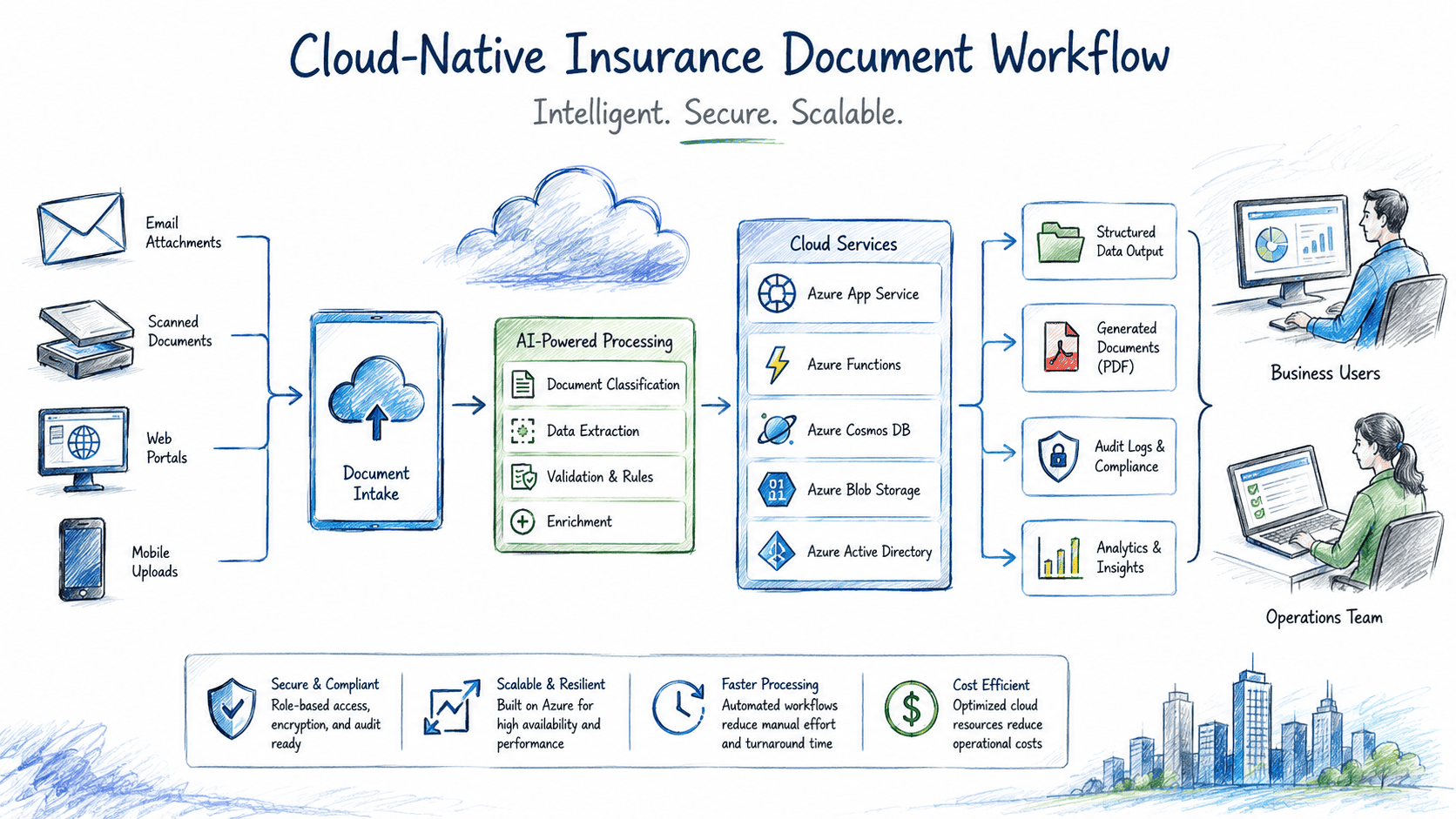
JSB implemented an AI Enabled Document Management System (DMS), a cloud native platform that combines OCR, NLP classification, metadata extraction, automated workflows, role based access, and audit trails. The objective was to convert a fragmented, manual document lifecycle into a fast, structured, auditable process that improves operational speed, reduces risk, and enables smarter decisions.
- Sector: Legal, Financial Services, Corporate Operations
- Project Type: Automated, Intelligent Document Storage, Search, and Review System
- Platform: React | .NET 8 | CosmosDB | Document Intelligence | Blob Storage | Azure AI Search | Azure Function
Root Cause Analysis: Bottlenecks of JSB
- Slow, manual search and retrieval – Document lookups required staff to drill through multiple network folders, scanned PDFs, and shadow inboxes. Average time to find a single customer file was long (tens of minutes), creating delays in customer calls and claim processing.
- Unstructured and inconsistent metadata – Files arrived in different formats with missing or inconsistent tags. Manual indexing by multiple teams created human error and fragmentation, making downstream automation unreliable.
- Cumbersome compliance and audit preparation – Preparing for regulatory audits required pulling documents from disparate systems and manually redacting or aggregating records an error prone, labour intensive task that consumed significant person hours every quarter.
- High operational overhead for claims and underwriting – Critical documents (medical reports, invoices, inspection notes) were not surfaced reliably at decision time, slowing claim adjudication and increasing turnaround times.
- Version control and access risk – Multiple copies of documents lived in different places; tracking the authoritative version and enforcing access controls was difficult, increasing exposure to compliance and privacy risk.
- Storage inefficiency and duplicate records – Repeated scans and attachments caused duplicate storage, pushing up costs and making lifecycle management harder.
Solution - What We Delivered
- Enterprise OCR + NLP ingestion pipeline – Using Azure AI Services, scanned documents were converted into searchable text. An NLP layer parsed content to extract structured metadata (policy number, claim ID, dates, claim amounts, provider names).
- Automated classification and tagging – AI models categorized documents (policy, claim form, medical record, invoice, correspondence) on ingest. Each document received standardized metadata and a confidence score, eliminating the need for routine manual indexing.
- Smart search (semantic + field search) – Full text and semantic search allowed users to locate documents by phrase, numeric fields (policy/claim IDs), or even by intent (e.g., “open injury reports for claim X”), cutting lookup time dramatically.
- Workflow automation & case routing – Documents that matched claim thresholds or risk flags auto routed to the correct adjuster or underwriter with prefilled case context and next step tasks.
- Access control, redaction & audit trails – Role based permissions, automated PII redaction on exports, and immutable audit logs ensured regulatory compliance and simple, defensible audit preparation.
- De-duplication & lifecycle management – Duplicate detection, compression, and tiered storage moved cold files to archival layers automatically, reducing active storage footprint and monthly storage costs.
- Integration with policy & claims systems – Two way connectors synchronized extracted metadata with JSB’s core enterprise software systems claim handlers had immediate document context appeared within case records (no more hunting through folders).
- Dashboarding & dynamic risk scoring – Real time operational dashboards built with Azure analytics and Power BI surfaced document backlogs, SLA breaches, and AI flagged risk indicators to support management decisions and targeted process fixes.
Measured Impact - Operational Outcomes
- Document retrieval time reduced by 86% – Average lookup time fell from 28 minutes to 4 minutes per file. Faster retrieval led to shorter call handling times and quicker decisions on claims and policy changes.
- Classification accuracy increased to 98% – AI tagging reduced miss indexing and subsequent rework. Manual corrections fell by 92%, freeing up staff time for exceptions handling.
- Compliance & audit preparation time down 75% – Quarterly audit preparation that previously consumed 400 staff hours was reduced to 100 hours due to unified search, automated redaction, and preassembled audit packs.
- Claim adjudication cycle improved by 38% – With relevant documents surfaced automatically and workflows routed to right owners, average claim decision time dropped (e.g., from 8 days to 5 days for straightforward claims).
- Operational hours saved 3,000 annually (1.4 FTE equivalent) – Time reclaimed from searching, manual indexing, audit prep and rework equated to roughly 3,000 hours per year the equivalent of 1.4 full time employees.
- Duplicate documents reduced by 62% – Deduplication removed repeated scans and attachments, improving data quality and search performance.
- Active storage costs decreased by 28% – Tiered lifecycle policies and deduplication cut monthly storage and retrieval expenses; archival retrieval remained available but infrequent.
- Faster escalations and better SLA compliance – Auto routing and SLA dashboards reduced missed SLAs for document driven tasks by over 50%.
- Security & compliance posture strengthened – Automated PII redaction and role based access controls reduced exposure windows and simplified regulatory attestations.
- Payback & business value – The efficiency gains produced measurable time and cost savings, delivering a rapid operational payback.
Conclusion
By implementing the AI Enabled Document Management System, JSB Insurance transformed a fractured document landscape into a single, searchable, and secure knowledge layer. The program delivered an 86% reduction in document retrieval time, a 75% reduction in audit preparation effort, a 38% improvement in claim turnaround for routine cases, and annual labour savings equivalent to about 1.4 FTE. Those operational efficiencies improved customer response times, lowered storage and rework costs, and significantly strengthened JSB’s compliance posture all while laying a foundation for automated risk assessment and future AI driven underwriting improvements.
Client Says
The demo has proved to be a powerful tool in investor meetings, garnering encouraging reactions. Ansi ByteCode excelled at collaboration, responding quickly and integrating all requested changes.

Greg Foster
GM & Founder of Vizen Analytics LLCAcross all of their projects, Ansi ByteCode has helped to realize efficiencies in processes and technologies, as well as increase ROI. Their flexibility and willingness to go above and beyond project scope sets them apart from other offshore vendors.

Andrew Martins
Former Executive, Manufacturing CompanyAnsi ByteCode has been conscientious and reliable since our initial project 4 years ago. They do not over promise or under deliver. We continue to work with them and will for some time.

Eddie Allen
Co-Owner with my wife Lori Allen at BBL Systems, IncAnsi ByteCode is reliable and diligent software development company. They can project manage themselves and ultimately create the software as the design requirements are given to them.

Jonathan Spence
Chief Executive Officer at XtractaI really enjoy working with this company. They follow up regularly on developments and they work well. We don't have to explain 50 times for them to understand the idea of development.

Cdric Boivin
Président - CEO at Secure ExchangesAnsi ByteCode LLP successfully reached its goal. The project management was professional and structured. Their team was very good at listening to the customer.

Christoffer Stub Michelsen
CEO, StubTEC

