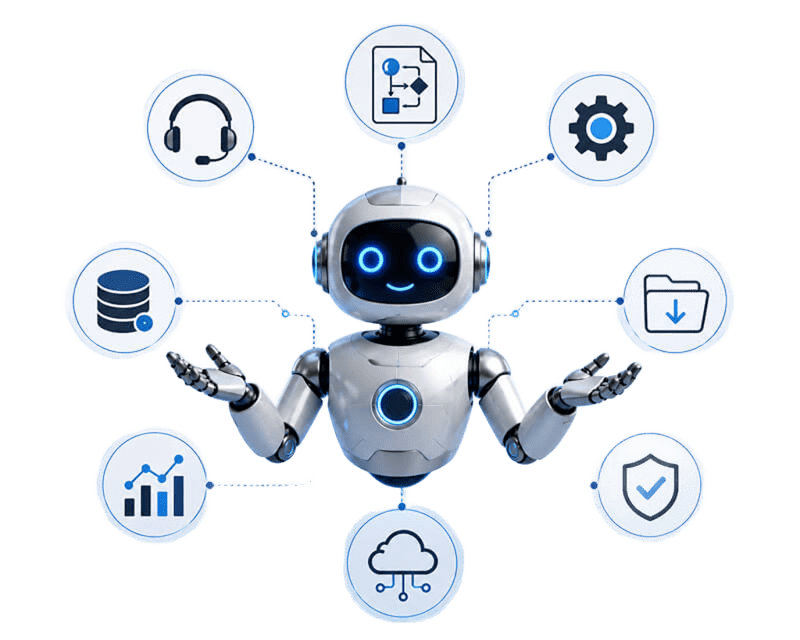
Computer vision development services enable software to interpret images and videos as humans do. Across industries, businesses use it to automate inspections, flag anomalies, verify identities, and streamline operations. At Ansi ByteCode LLP, we have built computer vision services since 2014. We are a Microsoft Solutions Partner with deep expertise in Azure AI. Our team covers the full delivery cycle, from early discovery to post-launch support. We bring technical expertise and business context to every project we take on.

Computer Vision
Development Services
Turn visual data into decisions.
Partner with Ansi ByteCode to build computer vision development
services that work in the real world.
+
Years in AI & Software Development
+
AI & Software Projects Delivered
+
Certified AI & Technology Experts
%
Client Retention Rate
Trusted By


Computer Vision Services We Offer
We cover every phase of custom computer vision development services. From the first scoping/discovery call to long-term support. Here is what we deliver.
Computer Vision Consulting
You may know you need computer vision, but are unsure where to start. We help you figure that out. Our consultants review your current workflows and data environment. They identify where visual AI can add the most value. You get a clear roadmap with realistic timelines and cost estimates so that you can move forward with confidence.
Custom Computer Vision Software Development
Off-the-shelf tools rarely fit complex business problems. We design and build customized computer vision software tailored to your processes. Whether you need a defect detection system for a factory floor or a video analytics platform for a retail chain, we build it to your exact requirements. Every solution is designed for reliability and scale.
Computer Vision Model Optimization
A model that performs well in a lab can still underperform in production. We audit existing models for accuracy, speed, and resource consumption. We apply techniques like pruning, quantization, and data augmentation to improve accuracy and performance. The result is a leaner model that delivers consistent, real operational efficiency.
Computer Vision System Integration
A vision model only delivers value once it runs inside your existing environment. We integrate vision models with ERP systems, IoT devices, cloud platforms, and enterprise applications. Our team handles APIs, data pipelines, and middleware so everything communicates cleanly. You do not have to disrupt what already works.
Computer Vision Data Services
Model data quality depends entirely on the quality of the training data. We help you collect, clean, label, and manage the visual datasets your models need to perform. Our data team follows strict annotation standards and quality checks. We also handle data augmentation strategies to improve model generalization across varied conditions.
MVP and POC Development
Before investing in a full build, it often makes sense to validate the concept. We build fast, functional prototypes that test core assumptions. You see how the computer vision technology behaves in your environment before committing to full-scale development. This reduces risk and gives stakeholders something concrete to evaluate early.
Quality Assurance and Testing
We put every computer vision solution through rigorous testing before it ships. Our QA process covers model accuracy, edge cases, performance under load, and integration behavior. We use both automated test suites and manual validation to catch issues early. You receive a documented test report before each release milestone.
Ongoing Support and Maintenance
Visual environments change over time. Lighting shifts, product lines evolve, camera hardware gets upgraded. We provide continuous monitoring, model retraining, and performance tuning after deployment. Our computer vision developers are available to respond quickly when something needs attention. You stay covered well beyond go-live.
Ready to Put Computer Vision to Work?
We build custom computer vision solutions that detect, classify, and analyze visual data at scale. Let us show you what is possible for your business.
Industries We Serve
At Ansi ByteCode LLP, our computer vision work spans a wide range of sectors. Each industry below presents a distinct set of visual challenges, and we bring domain knowledge to each one.
Manufacturing and Quality Control
Production lines move faster than manual inspection can keep up with. We develop computer vision systems that catch defects a human inspector would miss, deployed on assembly lines, in packaging, and across finished-goods areas. They reduce scrap rates and improve product consistency. Teams get dashboards with inspection logs to track quality and report on compliance.
Retail and Ecommerce
Retailers apply computer vision for customer behavior analysis, inventory optimization, and streamlined store operations. Our solutions include foot traffic analysis, shelf inventory monitoring, and automatic identification of pricing differences. In ecommerce, we develop visual search tools and product classification engines. As a result, customers have a smoother experience and better data to make merchandising decisions.
Healthcare and Medical Imaging
Computer vision is revolutionizing the detection and diagnosis of disease. We enable the healthcare sector to gain valuable insights into medical images quickly and accurately. Radiology teams use our models to detect abnormalities in X-rays and CT scans. Pathologists use them to examine hundreds of tissue specimens. We develop tools that enable the clinical workflow without changing the defined standard. All computer vision services comply with HIPAA standards and integrate with existing hospital IT systems.
Financial Services and Fintech
Financial institutions handle a large volume of documents and identity requests every day. We develop computer vision tools for automatic document processing, data abstraction from forms, and identity (face) verification tasks. These are computer vision systems that minimize manual review time and processing errors. They seamlessly support compliance and KYC processes, ensuring regulatory needs are met.
Logistics and Supply Chain
Speed and accuracy are key to a successful warehouse or distribution center. Our computer vision systems monitor loading bays, read barcodes, and verify packages and shipments. They minimize mis-picks, prevent mis-labeling, and provide real-time facility visibility. The whole team has to do less manual checking and focus more on what needs to be done.
Insurance
Insurers process thousands of claims and supporting images every week. We build computer vision systems that assess vehicle and property damage from photos, classify severity, and flag inconsistencies that point to fraud. We also automate extraction from claim forms and identity documents, so adjusters spend less time on data entry and more on decisions. The result is faster claim cycles, more consistent estimates, and fewer fraudulent payouts.
Computer Vision Capabilities We Deliver
Our engineering team builds across a broad range of computer vision techniques. Here is what we deploy in production environments
Object Detection and Classification
We build models that identify and categorize objects in images and video feeds in real time. Common real-world applications include inventory tracking, vehicle detection on roads, and identifying specific product types on a factory line.
Image Segmentation
Segmentation goes beyond detection by isolating individual regions within an image at the pixel level. We apply this in surgical imaging, satellite analysis, and material inspection, where precise boundary identification matters.
Facial Recognition
Our facial recognition systems verify identities and manage access control with high accuracy. Financial services clients use them for customer onboarding. Data security applications use them for physical access management in controlled environments.
OCR and Intelligent Character Recognition (ICR)
Structured document data extraction from printed and handwritten documents. These systems are used by clients in industries that retain significant paper records to scan and automatically fill in data-entry invoices.
Object Tracking
Our anomaly detection models learn what normal looks like and automatically flag deviations. Manufacturing clients use this for predictive maintenance. Security operations apply it to monitor unusual activity across surveillance networks.
Anomaly Detection
Our anomaly detection models learn what normal looks like and automatically flag deviations. Manufacturing clients use this for predictive maintenance. Security operations apply it to monitor unusual activity across surveillance networks.
Real-Time Image and Video Data Processing
We engineer pipelines that process high-resolution video streams with low latency. Clients in retail analytics, traffic management, and live monitoring rely on these systems for decisions that cannot wait.
Computer Vision Development Process at Ansi ByteCode LLP
All projects follow a 7-step process. There are specific review checkpoints and deliverables for each phase. This keeps the project on schedule and gives you a clear view of progress at every stage.
Step 1: Discovery and Feasibility Assessment
We start by understanding the problem and your existing environment. Our team assesses your data sources, infrastructure, and constraints, then determines whether computer vision is a fit and where it can deliver the most value. You receive a feasibility report with technical recommendations and the initial project scope
Step 2: Data Collection and Annotation
Ensuring high-quality data is the basis of good model performance. We source, collect, and prepare the visual data for your project. We tag images and video frames to the training standard. Several quality checks are performed throughout to reduce noise and maintain consistency before model training.
Step 3: Model Architecture and Design
The model architecture is designed based on your use case, latency requirements, and deployment environment. The team reviews methods that are based on convolutional neural networks, transformers, or hybrid systems. We keep a record of the design rationale to ensure a clear understanding amongst your own teams of what you built and why.
Step 4: Model Training and Validation
We train the model on your annotated datasets against verified benchmarks. During training, the team assesses accuracy, precision, recall, and other metrics. We make multiple experiments to find the optimum configuration. We validate against held-out data that mirrors real-world conditions, confirming the model behaves as expected before deployment.
Step 5: Integration and Deployment
Our computer vision developers deploy a trained model in your current system and infrastructure. It’s deployed in the cloud on Azure, on-premises servers, and edge devices. We develop the APIs, data pipelines, and monitoring hooks for production operations. Deployments are automated via CI/CD to minimize manual steps and risk.
Step 6: Testing and Quality Assurance
Each solution undergoes structured QA before going live. We test model accuracy on edge cases, system performance under load, and integration behavior. Our team documents every issue and resolves it before launch. You receive a test summary report with pass or fail results against each defined acceptance criterion.
Step 7: Monitoring, Support, and Optimization
We continuously monitor system health and model performance after the deployment. Retraining & recalibrating occur when data drift and/or environmental changes affect accuracy. Our support staff is quick to respond to incidents and attend to routine maintenance. We stay engaged after go-live as a long-term partner, not a one-time vendor that hands over documentation and disappears.
Industry Recognition

































Why Businesses Choose Ansi ByteCode LLP for Computer Vision Development Services
Most computer vision development companies offer AI development services. Here is what sets us apart, specifically in computer vision work.
Microsoft Solutions Partner with Certified Azure AI Expertise
Microsoft has awarded us Data and AI Solutions Partner status. That gives you verified expertise across Azure Machine Learning, Azure AI services, and the wider Azure AI ecosystem, plus direct access to Microsoft resources throughout your project.
End-to-End Delivery from Strategy to Deployment
We cover everything from pre-scoping through to post-launch support. Design, development, data work, and testing are handled by the same computer vision team. This removes handoff gaps and keeps accountability clear, so everyone knows who owns what at every stage.
Deep Experience with Enterprise-Grade AI Projects
Since 2014, we have been carrying out AI/ML projects. We know the difference between a working prototype and a production-ready system. We build for reliability, scalability, and performance from day one. Enterprise clients trust us with business-critical workloads.
Cross-Industry Domain Knowledge
We’re in healthcare, manufacturing, retail, logistics, financial services, and insurance. We are not only strong engineers; we understand how these industries actually operate. We’re familiar with your industry’s operational requirements, compliance standards, and the need for an enhanced user experience.
Security, Compliance, and Scalable Architecture
We design security and compliance into our work, not on the side. Computer vision solutions are purpose-built to comply with applicable data protection regulations such as HIPAA for healthcare use and SOC 2 for enterprise customers. Scalability is considered when making infrastructure choices to ensure the infrastructure scales with your needs.
Dedicated Teams with Transparent Communication
Special teams and a point of contact are provided for each project. We are straightforward in our communications, no jargon. You get regular updates, sprint reviews, and honest status reports. No surprises regarding timelines, budget, and scope changes.
Proven Track Record and Client Retention
We have a 95% client retention rate because our work is good and we deliver what our clients want. Clients often begin with one project and gradually move into a larger project with the computer vision development company. We define ‘success’ based on what outcomes our computer vision solutions achieve for your business, not the number of things delivered.
Computer Vision Technology Stack
As a computer vision development services company, we use modern, proven tools across the full delivery stack. Here is what we work with.

Azure OpenAI

Meta

Mistral AI


Hugging Face

Grok

MongoDB
Meta

Qdrant

Pinecone

Milvus

LangChain

LlamaIndex

Haystack

Microsoft

NVIDIA

Vertex AI

Kubernetes

Hugging Face,
Docker
Case Studies
See how we’ve helped businesses across industries solve real challenges with AI, from strategy and integration to full-scale deployment and measurable results.
What our Clients say About us
Don't just take our word for it. Here's what businesses across the US say about working with Ansi ByteCode LLP as their AI consulting partner.
The demo has proved to be a powerful tool in investor meetings, garnering encouraging reactions. Ansi ByteCode excelled at collaboration, responding quickly and integrating all requested changes.

Greg Foster
GM & Founder of Vizen Analytics LLCAcross all of their projects, Ansi ByteCode has helped to realize efficiencies in processes and technologies, as well as increase ROI. Their flexibility and willingness to go above and beyond project scope sets them apart from other offshore vendors.

Andrew Martins
Former Executive, Manufacturing CompanyAnsi ByteCode has been conscientious and reliable since our initial project 4 years ago. They do not over promise or under deliver. We continue to work with them and will for some time.

Eddie Allen
Co-Owner with my wife Lori Allen at BBL Systems, IncAnsi ByteCode is reliable and diligent software development company. They can project manage themselves and ultimately create the software as the design requirements are given to them.

Jonathan Spence
Chief Executive Officer at XtractaI really enjoy working with this company. They follow up regularly on developments and they work well. We don't have to explain 50 times for them to understand the idea of development.

Cdric Boivin
Président - CEO at Secure ExchangesAnsi ByteCode LLP successfully reached its goal. The project management was professional and structured. Their team was very good at listening to the customer.

Christoffer Stub Michelsen
CEO, StubTECFAQs About Computer Vision Development Services
Have questions about our computer vision development services? We have answered the most common ones below.

Computer vision is a branch of artificial intelligence that enables machines to interpret visual information from images and videos. It uses deep learning models, primarily convolutional neural networks, trained on labeled image datasets. These models learn to detect patterns, classify objects, and make predictions based on what they see. The trained model is then deployed within a software system, where it processes new visual input in real time or in batch mode.
Project cost depends on scope, complexity, and the type of data involved. A focused proof of concept typically costs less than a full enterprise deployment. Key factors include dataset size and annotation effort, model complexity, integration requirements, and diverse business needs. We provide detailed project estimates after an initial discovery session. Most clients find that the ROI from industrial automation and accuracy gains quickly justifies the investment.
A proof of concept can be ready in four to six weeks. A production-ready solution typically takes three to six months, depending on data availability, integration complexity, and testing requirements. Projects with clean, well-labeled data move faster. We share a detailed timeline during scoping so you have a clear picture before development starts.
Manufacturing, healthcare, retail, logistics, financial services, and insurance see the most direct benefits today. Manufacturing uses it for quality control. Healthcare applies it in diagnostic imaging. Retail uses it for inventory and customer analytics. Logistics relies on it for package tracking and warehouse automation. Any industry that handles visual data at scale has strong potential for computer vision adoption.
Accuracy starts with high-quality training data. We enforce strict annotation standards and run multiple validation rounds during model development. We test across diverse conditions, including edge cases and low-quality inputs. Post-deployment, we monitor for data drift and schedule retraining when model performance drops below defined thresholds. Accuracy is not a one-time milestone. It requires ongoing attention.
Yes. Integration is a core part of our development process. We build REST APIs and data connectors that link computer vision models to your ERP, WMS, cloud platforms, and other enterprise systems. We work with your IT team to map out integration requirements early, so there are no surprises during implementation. Most of our clients operate in hybrid cloud environments, and we have extensive experience working within those constraints.
Image processing applies mathematical operations to modify or extract basic features from images, such as adjusting brightness or detecting edges. It does not involve learning from data. Computer vision goes further. It uses trained artificial intelligence models to analyze image content, classify objects, and make decisions. Image processing is often a preprocessing step within a broader computer vision pipeline.
Our Blogs
Explore our latest insights, guides, and expert perspectives on AI. This will help you stay informed and make smarter business decisions.
What Is Predictive Maintenance? How It Works and Why It Matters
Critical equipment doesn’t fail on schedule. A motor overheats without warning.
Agentic AI vs Generative AI: Which One Is Right Fit for You?
If you’ve been comparing Agentic AI vs Generative AI, you’re probably wondering which one can actually make a bigger difference to your business
How to Use AI in Software Development: A Complete Guide
Enterprise leaders face growing pressure in 2026


