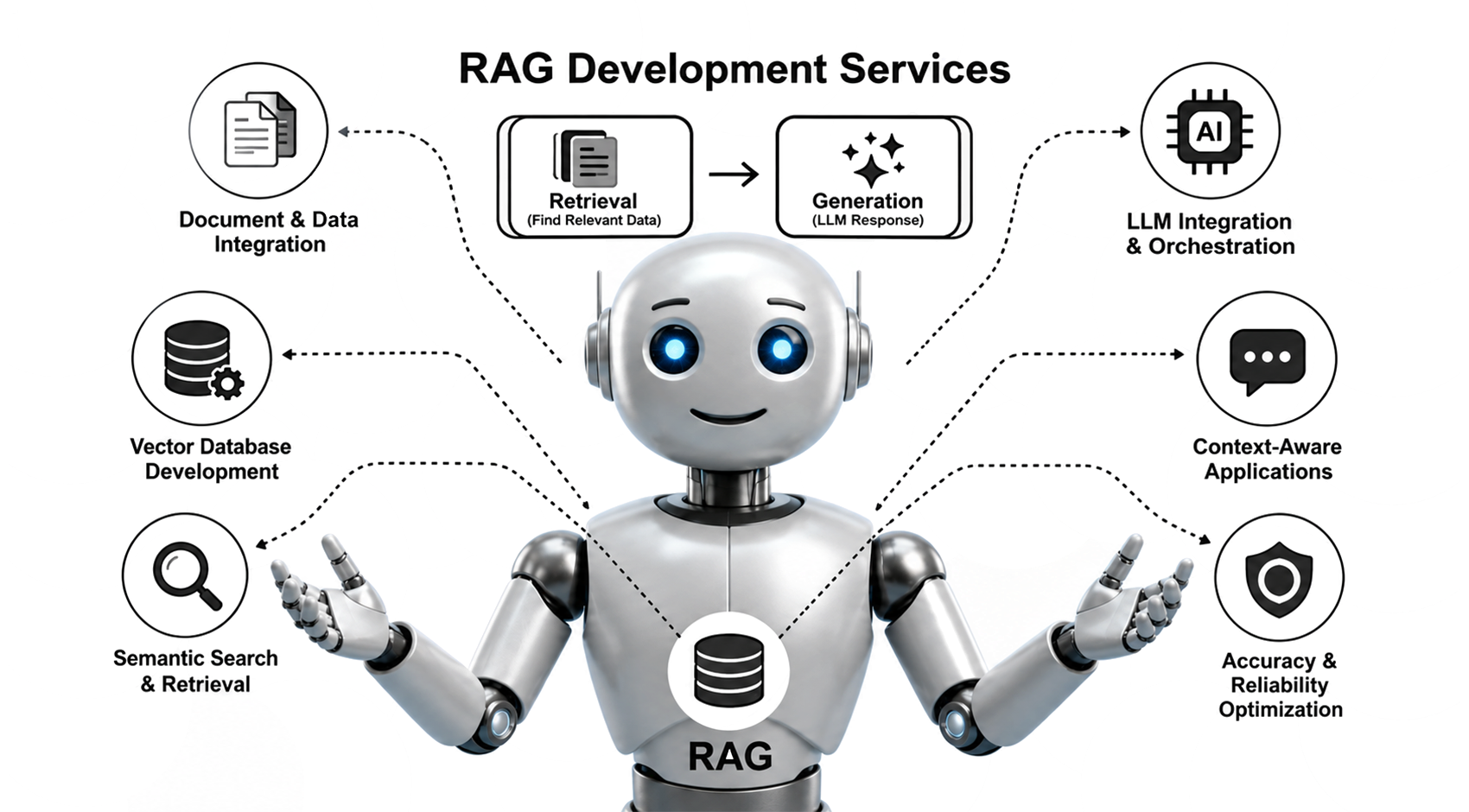
RAG Development Services

Give your AI systems access to your own data, so every answer
comes from something you can verify.

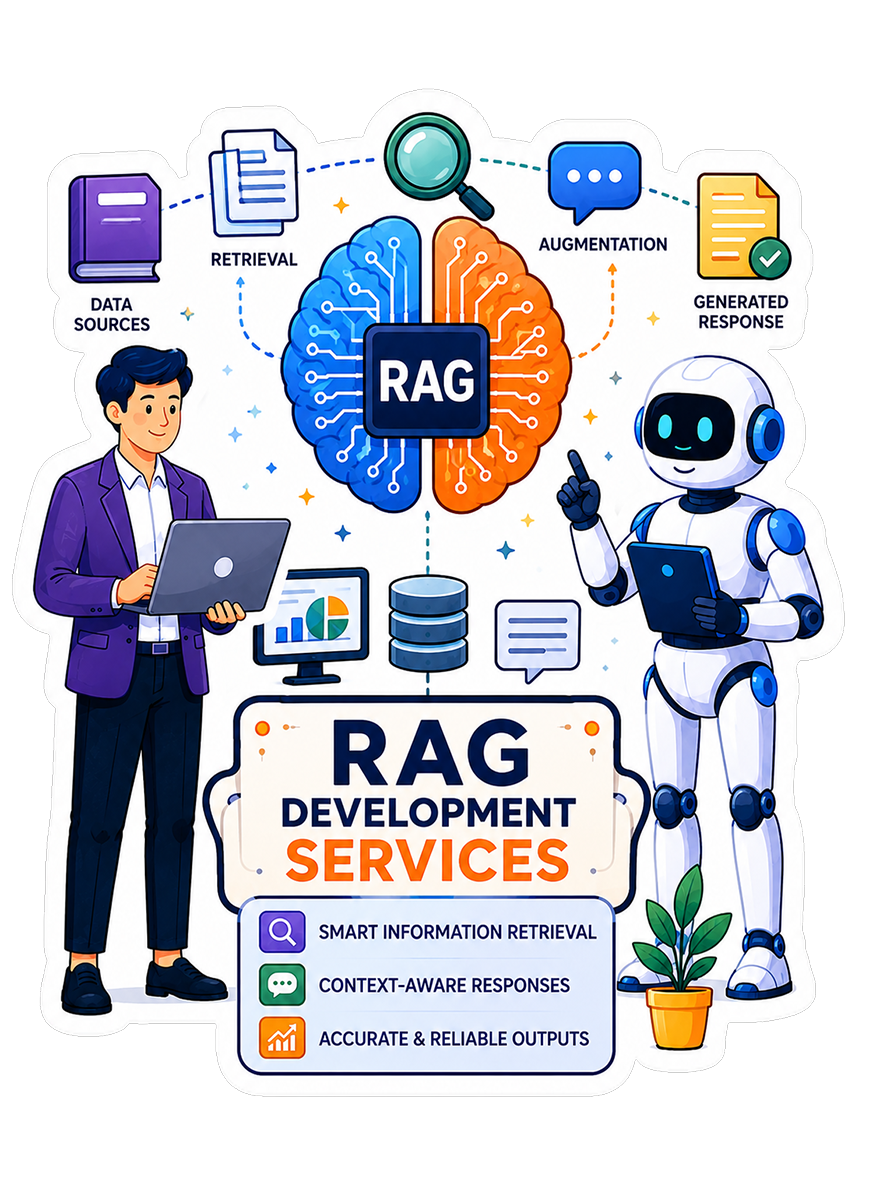
General-purpose LLMs can hallucinate, cannot see your internal data, and can become outdated. That is why most enterprise AI pilots never reach rollout. Retrieval-Augmented Generation (RAG) solves this by connecting a language model to your own documents, so answers come from verified content rather than model memory. 

Ansi ByteCode LLP builds those systems end-to-end. As a Microsoft Solutions Partner for Data & AI, Infrastructure Azure, and Digital & App Innovation Azure, we deliver custom RAG development services for US enterprises.
+
Years in AI & Software Development
+
AI & Software Projects Delivered
+
Certified AI & Technology Experts
%
Client Retention Rate

Why Enterprises Invest in RAG Development?

Most AI tools cannot see your company’s data, so the answers stay generic. RAG closes that gap, and enterprises invest for more than one reason.

Answers Grounded in Your Own Data

A general model answers from static training data. A RAG system works differently. It first finds the relevant facts and data in your domain-specific data, then answers based on what it retrieved. That makes AI usable internally.

Fewer Hallucinations and Traceable Sources

Every answer cites the source passage behind it, and when retrieval finds nothing relevant, the system says so instead of guessing. Grounding lifts answer quality because a wrong answer becomes checkable rather than invented.

Current Information Without Retraining

Update the knowledge base and the system reflects that change immediately, with no retraining. Employees get answers from this week's policies and procedures rather than from static training data fixed at the model's cutoff.

Domain Knowledge at a Fraction of Fine-Tuning Cost

RAG gives models working access to domain-specific data without repeated retraining. Improving what the retrieval pipeline returns is faster and cheaper than running fine-tuning cycles every time the underlying knowledge changes.

Permission-Aware Access to Sensitive Content

RAG applies your existing document permissions and role-based access controls at retrieval, so users only receive content they are cleared to see. This is how sensitive data stays governed through security review.

Faster Onboarding and Less Time Spent Searching

Staff lose hours locating the right document or asking a colleague. A grounded assistant compresses knowledge access into a single question, shortening onboarding and returning that time to operational efficiency.

Our Comprehensive RAG Development Services

We offer RAG development services across the full lifecycle, from architecture decisions to production support. Bring a use case and a document set, and we handle the rest.

RAG Consulting and Strategy

Not every AI problem needs RAG. We assess your use case, data readiness, and document quality before recommending RAG, fine-tuning, or prompt engineering. You get a practical architecture, technology recommendations, and a cost roadmap before committing to development.

Custom RAG Application Development

We build the application around your retrieval layer, including chat and search interfaces, conversation handling, source citations, and feedback capture. Our RAG application development services also connect the system into intranets, customer portals, and the tools your teams already use daily.

Data Preparation and Ingestion Pipelines

Good retrieval starts with good data. We connect your source systems and parse difficult formats, including scanned PDFs, tables, and slide decks. Then we normalize structured data, remove duplicates, enrich metadata, map permissions, and automate the refresh. Most failed pilots break in the RAG pipeline, not the model.

Retrieval Architecture and Vector Database Engineering

This layer decides between the right passage and a plausible wrong one. We design the chunking strategy, select and benchmark the embedding model, and size the vector store. Hybrid retrieval then combines semantic search with keyword matching, supported by metadata filtering and reranking.

LLM Integration and Prompt Augmentation

We select and integrate models across Azure OpenAI and open-weight options, then handle context window optimization, grounding instructions, citation formatting, and refusal behavior. Cost and latency are tuned through caching and model routing so the system stays affordable at production volume.

Multimodal RAG Development

Business knowledge is not always stored as plain text. We build RAG systems that read images, diagrams, tables, scanned documents, audio transcripts, and video. Teams working with technical drawings or recorded calls can retrieve answers from those sources the same way they would from a document.

Agentic RAG Development

Build RAG systems that can refine search queries, retrieve information in multiple steps, and use tools or APIs when needed before generating an answer. The focus stays on smarter retrieval behavior, while broader autonomous task execution belongs within our AI Agent Development Services.

RAG Evaluation, Accuracy and Hallucination Control

We test every build against a golden question set. The evaluation suite measures retrieval precision, answer relevance, and faithfulness. Regression testing runs before each release, and guardrails force the system to refuse when evidence is missing. We also rescue existing RAG systems where answer quality has slipped.

RAG Deployment, Security and Managed Support

We deploy production-grade RAG systems on Azure, private cloud, or on-premises. Document and row-level permissions control who retrieves what. PII redaction, 100% audit log coverage, and monitoring are built in for GDPR, HIPAA, and SOC 2. Managed RAG services keep the system accurate after launch.
Create AI Solutions That Understand Your Business

Build custom RAG solutions that connect with your business knowledge and generate accurate, context-aware responses every time.

Industries We Serve

RAG development plays out differently depending on the documents, regulations, and risk tolerance of your industry. Here is how it applies across the sectors we work with most.

Healthcare

Help clinical and administrative teams quickly find relevant guidelines, protocols, and medical information. RAG solutions can also support prior authorization workflows while keeping access controlled and answers traceable.

Finance and Banking

Make policies, regulations, filings, and internal research easier to navigate. Teams can quickly find relevant information and verify answers against the source documents.

Insurance

Reduce the time spent searching through policy documents, claims handbooks, and underwriting guidelines. RAG solutions help teams find the right information faster and apply it with greater consistency.

Legal and Professional Services

Make contracts, precedents, case materials, and past work easier to search. Teams can quickly locate relevant clauses and prior work while keeping each answer connected to its source.

Manufacturing

Give teams faster access to equipment manuals, SOPs, technical specifications, and engineering documentation. RAG solutions can help technicians troubleshoot issues without searching through scattered technical resources.

Retail and Ecommerce

Help store and support teams find accurate product, merchandising, and policy information quickly. AI assistants can provide answers based on current catalogs, return policies, and internal knowledge.

Logistics and Supply Chain

Make carrier contracts, tariffs, compliance documents, and operating procedures easier to access. RAG-powered assistants help teams find the information they need while working with constantly changing operational documentation.

SaaS and Technology

Help engineering, support, and product teams work more efficiently with technical documentation, code, product knowledge, and internal resources. RAG makes relevant information easier to find across growing knowledge bases.
RAG Solutions Built for Your Business

Your business already has valuable knowledge across documents, systems, and repositories. We turn that information into practical AI solutions that help teams work faster, find answers, and make informed decisions.
Enterprise Knowledge Assistant

Give employees one place to find answers across company policies, internal documents, wikis, and past tickets. Reduce time spent searching for information or interrupting colleagues for answers.
Customer Support Automation

Intelligent customer support that answers from current product documentation and policy, with citations, and escalates rather than guessing when the evidence is not there.

Document and Contract Intelligence

Retrieve and compare clauses across contracts, statements of work, and agreements. Every obligation the system surfaces comes attached to the source paragraph it was found in.

Regulatory and Compliance Research

Make regulatory research less time-consuming by helping teams find answers across approved regulations and internal policies. Every response can be traced back to the document and version it came from.

Clinical and Medical Knowledge Search

Help medical teams find relevant information across clinical guidelines, formularies, and internal protocols. Responses stay grounded in approved, up-to-date sources so teams can verify the information they receive.

Technical Documentation and Code Search

Give engineering teams a faster way to find answers across technical documentation, runbooks, architecture decisions, and code repositories without relying on outdated pages or scattered information.

Automated Research and Report Generation

Systems that gather evidence across internal and external data sources and draft first-pass reports, with every claim linked to the source paragraph it came from.

RAG Development Process at Ansi ByteCode LLP

Every RAG system is different because every organization’s data is different. This is the sequence we follow to get from raw documents to a production RAG system, typically 8 to 14 weeks from discovery to launch.

Step 1: Discovery and Data Audit

We review your use case, data sources, and document quality, and map what is realistic to retrieve well. You get a scoped plan and an honest read on whether RAG fits before build work starts.

Step 2: Data Preparation and Chunking Strategy

We connect your source systems and clean the content. Then we design a chunking strategy suited to your document types, whether those are dense contracts, support tickets, or scanned manuals with tables.

Step 3: Retrieval Architecture and Indexing

We select and benchmark an embedding model, then set up the vector database. Semantic and keyword search work together, so the system finds the right passage even when the wording does not match.

Step 4: LLM Integration and Prompt Design

We wire the chosen model to the retrieval layer. Grounding instructions, citation formatting, and refusal behavior go into the prompt, tuned against real questions from your team rather than generic test cases.

Step 5: Evaluation, Guardrails and Security Hardening

We run the system against a golden question set and measure retrieval precision and faithfulness. Permission enforcement, PII handling, and audit logging all go in before production users get access.

Step 6: Deployment, Monitoring and Optimization

The system goes live on Azure, private cloud, or on-premises. We monitor for retrieval drift and usage patterns worth acting on, and a support plan covers everything that follows launch.

Industry Recognition

Why Businesses Choose Ansi ByteCode LLP for RAG Development Services

Model access is easy to buy. What decides whether a RAG system works is data engineering, security, and honest evaluation. Every point below is something a generic generative AI vendor cannot put on the table.

Microsoft Solutions Partner

As a Microsoft Solutions Partner for Data & AI, Infrastructure Azure, and Digital & App Innovation Azure, we bring independently validated delivery capabilities to enterprise RAG projects, not just a self-declared certification.

Azure Native RAG Architecture

We build RAG solutions with Azure OpenAI, Azure AI Search, and Azure AI Foundry, allowing your AI workflows to operate within the Azure environment and security controls your organization already uses.
Accuracy Measured, Not Claimed

Every build ships with an evaluation suite and golden question set, so retrieval quality and answer quality are reported as numbers your team can audit, not claimed.

Data Engineering Depth Behind the Model

With more than a decade of experience in data and enterprise software delivery, we address the data quality, ingestion, and document challenges that often determine whether a RAG system actually performs well.

Security and Permissions Enforced at Retrieval

We build in document-level permissions, role-based access controls, PII handling, and audit logging from the first sprint, aligned to GDPR, HIPAA, and SOC 2 requirements.

You Own the Pipeline

You receive the ingestion pipeline, prompts, evaluation suite, and infrastructure code at handover. Your team controls the system, with no lock-in on the retrieval layer.

Scoped Pilot Before Full Build

Start with a focused pilot using a defined document set and agreed accuracy target. This gives your team measurable results and practical validation before investing in a full-scale RAG deployment.

Technologies That Power Our RAG Solutions

We combine advanced retrieval, models, data processing, evaluation, and infrastructure into a tech stack matched to your data, security needs, and scale.

Azure OpenAI Service

GPT-X

Anthropic Claude

Llama

Mistral

Phi

Azure OpenAI text-embedding-3

Cohere Embed

Sentence Transformers

BGE

Azure AI Search

Pinecone

Weaviate

Qdrant

Milvus

pgvector

Chroma

Elasticsearch

LangChain

LlamaIndex

Semantic Kernel

Haystack

Azure AI Foundry

LangGraph

Azure AI Document Intelligence

Unstructured.io

Apache Tika

Azure Data Factory

Databricks

Microsoft Fabric

RAGAS

TruLens

LangSmith

Azure AI Evaluation SDK

Phoenix

Azure Kubernetes Service

Azure Container Apps

Azure Functions

Docker

Terraform

GitHub Actions

Microsoft Entra ID

Azure Key Vault

Microsoft Purview

Azure AI Content Safety

Private Endpoints

Case Studies

See how we’ve helped businesses across industries solve real challenges with AI, from strategy and integration to full-scale deployment and measurable results.

What our Clients say About us

Don't just take our word for it. Here's what businesses across the US say about working with Ansi ByteCode LLP as their AI consulting partner.

FAQs About RAG Development Services

RAG development raises practical questions about cost, accuracy, security, and how it compares with other approaches. Here are direct answers to what businesses ask before starting.
RAG development services cover building retrieval-augmented generation systems that fetch relevant passages from your business data and pass them to a language model before it answers. A RAG development company handles ingestion, retrieval, evaluation, and deployment.
Most RAG projects cost between $15,000 and $50,000, and complex enterprise builds run higher. Data volume, document complexity, integrations, and security requirements drive the figure. A single-source internal assistant sits well below a multi-source build with role-based access controls.

RAG gives a model access to external information at the time it generates an answer, while fine-tuning changes the model itself through additional training. RAG is generally better when information changes frequently or needs to remain traceable to specific sources.

No, RAG does not completely eliminate hallucinations. However, grounding responses in relevant source material can reduce unsupported answers. A well-designed system can also use citations, confidence checks, and refusal behavior to avoid answering when sufficient evidence is not available.

Yes. RAG can work with private, on-premise, or cloud-hosted data, depending on the organisation’s security and infrastructure requirements. Access controls can also be applied during retrieval so users only receive information they are authorized to see.

RAG quality can be measured across several areas, including retrieval accuracy, answer relevance, faithfulness, and citation quality. A golden question set and evaluation suite can be used to test these metrics and catch performance regressions before they affect users.

Our Blogs

Explore our latest insights, guides, and expert perspectives on AI. This will help you stay informed and make smarter business decisions.

What Is Predictive Maintenance? How It Works and Why It Matters

Critical equipment doesn’t fail on schedule. A motor overheats without warning.

Agentic AI vs Generative AI: Which One Is Right Fit for You?

If you’ve been comparing Agentic AI vs Generative AI, you’re probably wondering which one can actually make a bigger difference to your business

How to Use AI in Software Development: A Complete Guide

Enterprise leaders face growing pressure in 2026

Let’s build your dream together.