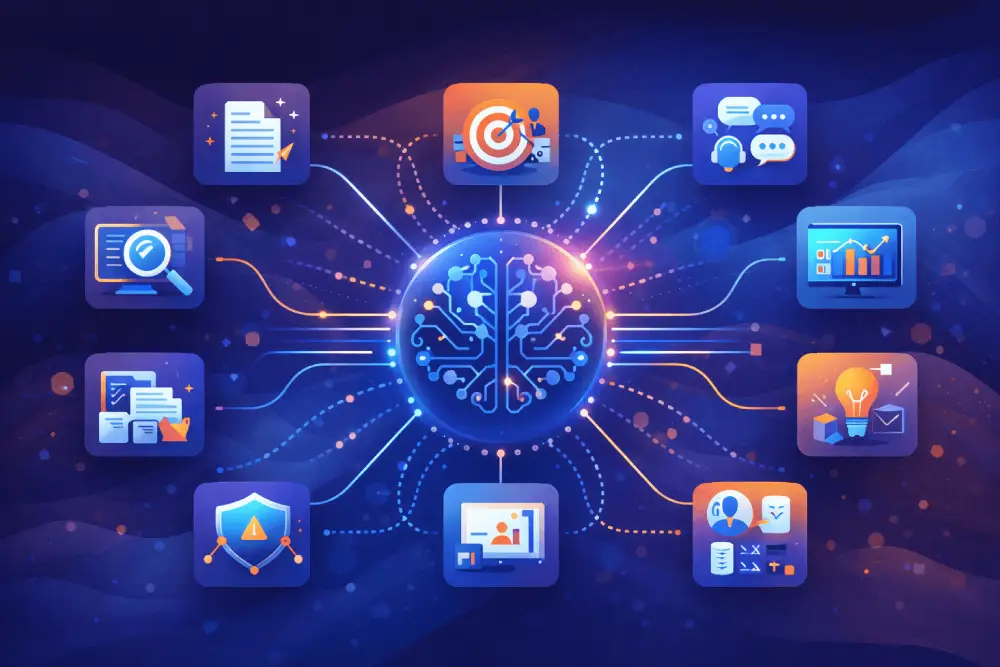
Enterprises are adopting AI faster than ever before. GenAI helps simplify work and unlock new value. Business leaders are now focused on generative AI use cases that deliver tangible outcomes. Companies no longer treat AI as a lab experiment. They expect tangible business impact from deployment.
In early 2024, according to the McKinsey report, 65% of companies reported regular use of generative AI enterprise use cases. Adoption nearly doubled from the prior year. GenAI is reshaping how work gets done. Executives pursue efficiency, speed, and innovation at scale. This article highlights practical, real-world enterprise applications driving value now.
Table of Contents
- What Is Generative AI?
- Top 10 Generative AI Enterprise Use Cases
- Generative AI Business Use Cases Across Industries
- How Ansi ByteCode LLP Can Help Unlock the Power of Gen AI for Your Enterprise?
- FAQs on Use Cases related to Generative AI
What Is Generative AI?
Generative AI is a class of artificial intelligence that creates new content. It produces text, images, code, audio, or insights from learned patterns. Unlike traditional AI, it generates original outputs, not predictions only. Businesses use it to automate tasks and support decision-making.
How GenAI Differs From Traditional Artificial Intelligence?
Traditional AI tools focus on classification and prediction. GenAI creates new material from existing data. This capability extends enterprise use beyond analytics and enables enterprise use cases for generative AI across many functions.
Why Are Enterprises Adopting Generative AI?
Generative AI produces multiple output types. These include text, code, images, and structured data insights. Organizations adopt it to improve speed and productivity. They also reduce costs and scale innovation. These benefits drive widespread use cases of generative AI today.
Top 10 Generative AI Enterprise Use Cases
GenAI is transforming how businesses operate, innovate, and scale by enabling automation, personalization, and faster decision-making across core business functions.
1. Automated Content Creation
Enterprises use GenAI to create large volumes of consistent content across marketing, operations, and internal communications.
- Marketing copy and campaign assets
- Technical documentation and user guides
- Internal emails, policies, and reports
- Sales collateral and proposals
- Brand tone and messaging consistency
This use case reduces content turnaround time and improves quality across GenAI use cases.
2. Personalized Marketing Campaigns
Gen AI enables enterprises to deliver highly personalized marketing experiences across channels and customer segments.

- Real-time customer data segmentation
- Personalized email and ad creatives
- Dynamic messaging based on behavior
- Automated content testing and optimization
- Cross-channel campaign coordination
These outcomes represent high-impact generative AI business use cases for revenue growth.
3. Customer Support and Virtual Assistants
Enterprises deploy generative AI technologies to manage customer behavior across digital and voice channels efficiently.
- AI-powered tools like chat and voice assistants
- 24/7 customer support availability
- Faster issue resolution
- Reduced human agent workload
- Consistent service responses
This remains one of the most mature GenAI use cases for enterprise environments. It enables businesses to analyze customer sentiment.
4. Knowledge Management and Enterprise Search
GenAI improves how employees access, search, and use internal enterprise knowledge and documents.
- Natural language search across repositories
- Automated document summarization
- Faster access to policies and procedures
- Reduced information silos
- Improved decision support
These GenAI cases significantly improve productivity and knowledge reuse.
5. Software Development and Code Generation
Generative AI model accelerates enterprise software development and improves developer efficiency.
- Code suggestions and generation
- Automated testing assistance
- Faster development cycles
- Reduced repetitive coding tasks
- Improved code quality
These capabilities define core generative AI enterprise use cases in engineering teams.
6. Data Analysis and Automated Reporting
Gen AI enables business users to interact with data using natural language rather than technical AI-powered tools.
- Natural language data queries
- Automated dashboards and reports
- Faster insight generation
- Reduced dependency on analysts
- Improved decision speed
These are practical enterprise use cases for generative AI across data-driven organizations.
7. Product Design and Innovation
Gen AI studio supports product teams by accelerating ideation, design exploration, and early-stage prototyping.
- Concept and idea generation
- Rapid design iteration
- Constraint-based design suggestions
- Faster innovation cycles
- Reduced time-to-market
Product teams are increasingly adopting GenAI use cases to innovate faster.
8. Human Resources and Talent Management
Enterprises use GenAI to streamline hiring, learning, employee engagement, and other complex processes.
- Resume screening and ranking
- Job description creation
- Personalized learning content
- Faster recruitment workflows
- Workforce analytics insights
These are widely adopted use cases of generative AI within HR functions.
9. Fraud Detection and Risk Management
Generative AI offers enterprise risk management by identifying anomalies and supporting proactive decision-making.
- Pattern and anomaly detection
- Real-time fraud alerts
- Risk scenario analysis
- Reduced financial exposure
- Improved compliance monitoring
These are critical generative AI enterprise use cases for regulated industries.
10. Training, Upskilling, and Learning Content
GenAI enables scalable, personalized training programs for large and diverse enterprise workforces.
- Role-based learning content
- Adaptive training modules
- Faster skill development
- Automated content updates
- Enterprise-wide training scalability
These use cases support continuous workforce development.
GenAI is poised to deliver substantial economic value globally. McKinsey research estimates that GenAI could deliver annual economic benefits of $2.6 trillion to $4.4 trillion when applied across key business functions and employment tasks.
Generative AI Business Use Cases Across Industries
GenAI adoption varies by industry, but enterprises consistently apply it to improve efficiency, reduce risk, enhance decision-making, and scale operations across core business functions.
Generative AI Use Cases in Finance and Banking
Financial institutions use generative AI to strengthen fraud detection, risk management, forecasting, and regulatory operations.
- Fraud detection through anomaly and pattern analysis
- Risk profiling using behavioral and lifestyle data
- Financial forecasting and revenue prediction
- Market trend analysis using news and sentiment data
- Automated underwriting and claims assessment
- Synthetic data generation for fraud simulation
These GenAI enterprise use cases improve security, accuracy, forecasting reliability, and regulatory compliance across financial services.
Generative AI Use Cases in Healthcare and Life Sciences
Healthcare organizations use GenAI to reduce clinician workload and accelerate research activities.
- Clinical documentation and medical summaries
- Research data analysis and insight generation
- Patient communication and engagement AI tools
- Trial design and reporting support
These enterprise use cases for GenAI improve care delivery, accelerate research, and enhance the patient experience.
Generative AI Use Cases in Legal and Compliance
Legal and compliance teams use generative AI to manage risk, reduce manual effort, and improve regulatory response times.
- Contract drafting and clause analysis
- Legal document summarization
- Regulatory compliance monitoring
- Policy review and interpretation
- Litigation research support
These capabilities improve accuracy, reduce legal workload, and strengthen compliance governance across regulated enterprise environments.
Generative AI Use Cases in Retail and Ecommerce
Retailers adopt GenAI to improve demand planning and personalize customer experiences.
- Demand forecasting and market trends analysis
- Personalized product recommendations
- Automated marketing content creation
- Inventory planning and optimization
These use cases help retailers increase conversions and reduce inventory inefficiencies.
GenAI Use Cases in Manufacturing and Supply Chain
Manufacturers use GenAI to optimize operations and strengthen supply chain resilience.
- Predictive analytics maintenance planning
- Supply and production forecasting
- Process optimization insights
- Quality issue detection support
These use cases reduce downtime, improve operational efficiency, and support continuity.
Across industries, GenAI delivers measurable impact by automating workflows, strengthening insights, and improving operational resilience, enabling enterprises to achieve faster outcomes and sustained competitive advantage.
How Ansi ByteCode LLP Can Help Unlock the Power of Gen AI for Your Enterprise?
GenAI is reshaping how enterprises operate, compete, and innovate. It improves efficiency by automating repetitive tasks and accelerating decision-making. It supports innovation by enabling new AI capabilities at scale. Well-defined generative AI use cases help enterprises convert technology investments into measurable business value.
Ansi ByteCode LLP helps enterprises plan, build GenAI solutions, and scale effectively. The team supports strategy design, implementation, and production deployment. Their approach focuses on reliability, governance, and long-term scalability. With generative AI services, Ansi ByteCode enables generative AI use cases for enterprise environments with confidence.
FAQs on Generative AI Use Cases
The following FAQs address common enterprise questions around adoption, value, industry relevance, and security considerations for GenAI initiatives.
1. What are the most common GenAI enterprise use cases?
Every day, use cases of generative AI include content creation, customer support automation, enterprise search, software development assistance, data analysis, and personalized training. These applications focus on improving productivity, reducing operational costs, and enabling faster decision-making across core business functions.
2. How do enterprises benefit from generative AI?
Enterprises benefit through improved efficiency, faster execution, and scalable innovation. GenAI business use cases help automate manual work, enhance customer experiences, reduce operational risk, and support data-driven decisions, leading to measurable gains in productivity and return on investment.
3. Which industries use generative AI the most?
Industries with high historical data intensity adopt Gen AI fastest. Financial services, healthcare, retail, and manufacturing lead adoption. These sectors apply use cases to manage risk, personalize experiences, optimize operations, and accelerate research and innovation outcomes.
4. Is generative AI secure for enterprise use?
GenAI can be secure when deployed with proper controls. Enterprises must implement strong, relevant data governance, access management, model monitoring, and compliance practices. Security depends on responsible implementation, not the technology itself, within regulated enterprise environments.