
Enterprises now operate in highly data-driven environments. Data volumes grow across systems, applications, and end customer channels. Leaders struggle to unify reporting and analytics across departments. A strong business intelligence architecture provides structure to this complexity. It connects data sources, storage layers, and reporting systems. Without architecture, insights remain fragmented and unreliable.
McKinsey’s 2024 Global Survey shows that 65% of enterprises regularly use AI in at least one business function. This trend increases the need for a scalable foundation of BI architecture. Enterprises need structured data systems to support the growth of analytics. This guide explains components, layers, diagrams, and modern frameworks.
Table of Contents
- What Is Business Intelligence Architecture?
- Key Components of Business Intelligence Architecture
- Business Intelligence Architecture Diagram
- Types of Business Intelligence Architecture
- Top Business Intelligence Architecture Tools to Look For
- Why Business Intelligence Architecture Matters for Modern Enterprises?
- How to Build a Scalable BI Architecture?
- Real-World Business Intelligence Architecture Examples
- Why Ansi ByteCode LLP Is Your Strategic Partner for Business Intelligence?
What Is Business Intelligence Architecture?
Business intelligence architecture is the structured framework that organizes data collection, integration, storage, and reporting systems within an enterprise. It defines how data moves from source systems to analytics tools. It exists to ensure reliable insights. This business intelligence data architecture supports consistent, governed decision-making across departments.
BI architecture transforms raw enterprise data into trusted insights. It integrates systems, standardizes KPIs, and enforces governance controls. A clear business intelligence architecture diagram improves transparency, scalability, and long-term operational stability across reporting and analytics environments.
Key Components of Business Intelligence Architecture
BI-based architecture relies on interconnected key components that manage data flow, integrity, and reporting. Each layer plays a distinct role in transforming raw enterprise data into trusted insights.
1. Data Sources
Every BI system begins with reliable data inputs. Enterprises collect information from multiple operational platforms. These inputs form the foundation of a modern BI architecture.
- Internal systems such as ERP, CRM, and HRMS
- Finance, supply chain, and sales platforms
- External APIs and third-party data feeds
- Market data and partner systems
- Structured and unstructured data sources
Structured data includes transactional databases and spreadsheets. Unstructured data includes emails, logs, and documents. A strong source layer ensures completeness and accuracy.
2. Data Integration Layer (ETL / ELT)
The data integration layer connects raw data to storage systems. It manages transformation and movement across systems. This layer defines the critical BI architecture.
- Data extraction from source systems
- Transformation rules and logic
- Data cleaning and validation processes
- Batch processing pipelines
- Real-time streaming integrations
ETL transforms data before loading and loads relevant data before transformation. Both ensure consistency and reliability across reporting systems.

3. Data Storage Layer
The storage layer organizes data for efficient access. It centralizes information into structured and secure repositories. This layer is a core component of the business operations and BI architecture.
- Enterprise data warehouses
- Data lakes for large-scale storage
- Departmental data marts
- Cloud-based storage platforms
- On-premise database systems
Warehouses store structured, curated datasets. Lakes store raw and large-scale data. Cloud systems improve scalability and flexibility.
4. Semantic Layer
The semantic layer translates technical data into business language. It defines metrics and ensures consistency across reports. This layer strengthens the overall reliability of the business intelligence architecture.
- Business logic definition
- KPI standardization across teams
- Data abstraction for non-technical users
- Consistent reporting definitions
- Centralized metric governance
It prevents conflicting calculations. It aligns reporting with enterprise definitions.
5. Analytics and Reporting Layer
This layer delivers insights to end users. It allows data transformation of processed data into actionable outputs, operating within the broader BI architecture framework.
- Interactive dashboards
- Self-service BI tools
- Advanced data analytics capabilities
- Ad hoc reporting features
- Role-based data access
Users explore trends and monitor performance. Advanced analytics enables forecasting and scenario analysis.
6. Governance, Security, and Compliance
Governance ensures data trust and regulatory alignment. Security controls protect sensitive enterprise information. Strong governance is a key factor in successful business intelligence architecture examples.
- Access control policies
- Data privacy protections
- Role-based permissions
- Regulatory compliance monitoring
- Audit and lineage tracking
These controls reduce risk. They ensure enterprise-wide accountability and compliance.
Business Intelligence Architecture Diagram
A typical BI architecture follows a layered and structured flow. Each layer processes data before passing it forward. Governance operates across all layers to ensure control.
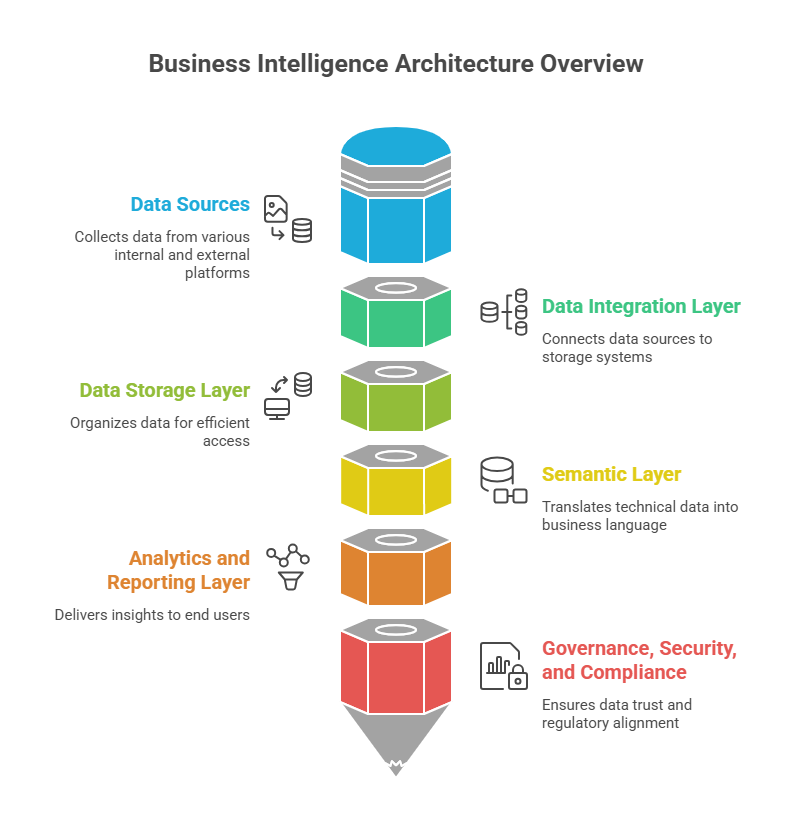 This model shows controlled data movement from the multiple data sources to the sunlight.
Types of Business Intelligence Architecture
Organizations adopt different BI models based on governance needs, scale, and agility requirements. Each architecture type balances control, flexibility, and performance differently across enterprise environments.
1. Centralized BI Architecture
Centralized models place full control under IT teams. A single enterprise warehouse supports all reporting within the robust business intelligence architecture.
- Single centralized BI data warehouse
- IT-controlled governance policies
- Standardized KPI definitions
- Controlled user access
- Enterprise-wide reporting consistency
This model ensures accuracy and strong compliance oversight.
2. Self-Service BI Architecture
Self-service models allow business users to explore data independently. They often evolve from a traditional business intelligence architecture diagram.
- Direct business user access
- Decentralized analytics capabilities
- Interactive dashboard tools
- Faster insight generation
- Reduced dependency on IT
This model improves agility but requires governance safeguards.
3. Hybrid BI Architecture
Hybrid models combine centralized data control with flexible access to analytics. This balanced approach strengthens the overall business intelligence structure.
- Centralized data governance
- Shared semantic layer definitions
- Flexible departmental reporting
- Approved self-service analytics
- Scalable enterprise deployment
Hybrid models are now common in modern enterprises.
Market research projects that the global business intelligence (BI) software market will grow from approximately $36.6 billion in 2023 to $86.7 billion by 2030, reflecting sustained enterprise investment in scalable data and analytics systems.
Top Business Intelligence Architecture Tools to Look For
Business intelligence architecture depends on a stack of tools that support data integration, storage, analytics, governance, and data visualization. Choosing the right mix improves performance, reliability, and decision speed across enterprise use cases.
Data Integration Tools
Data integration tools extract, transform, and load enterprise data into analytical systems.
They ensure consistency, quality, and readiness for downstream processing.
- Apache NiFi: scalable flow management for data ingestion
- Talend: enterprise ETL and data governance
- Fivetran: automated connectors to cloud and on-prem systems
- Informatica PowerCenter: rule-based transformation and quality checks
These tools support schema mapping, deduplication, and pipeline scheduling.
Data Storage Technologies
Storage systems sit at the heart of a BI architecture. They store both structured and unstructured data for analysis.
- Microsoft Fabric: unified data platform combining lakehouse, warehouse, & real-time analytics
- Snowflake: cloud data warehouse with elastic scaling
- Google BigQuery: serverless analytics at scale
- Amazon Redshift: managed petabyte-scale data warehouse
Strong storage tech enables fast queries and efficient indexing. You may explore enterprise-ready BI and analytics technologies here.
Data Visualization and BI Tools
These tools turn processed data into insights via dashboards and interactive reports.
- Microsoft Power BI: enterprise reporting with natural language insights
- Tableau: visual analytics with drag-and-drop charts
- Looker: semantic layer and embedded analytics
- Qlik Sense: associative exploration and guided analytics
BI tools deliver executive dashboards, self-service analytics, and KPI tracking.
Governance and Monitoring BI Tools
Governance tools manage data quality, lineage, and compliance. They make analytics trustworthy and auditable across teams.
- Collibra: enterprise data governance platform
- Alation: metadata catalog with lineage tracking
- Apache Atlas: open governance and classification framework
- Data.world: collaborative data catalog
These tools enforce access controls and maintain audit trails.
Together, these technologies form the backbone of a resilient business intelligence architecture. They enable enterprises to integrate systems, govern data, deliver analytics, and generate trusted insights with speed and accuracy.
Why Business Intelligence Architecture Matters for Modern Enterprises?
A strong BI architecture drives enterprise performance, agility, and control. It enables scalable data systems, trusted reporting, and faster insights across complex organizational environments.
Scalability and Performance
Enterprises generate growing volumes of operational and customer data. Systems must handle scale without degrading performance. Strong business intelligence architecture components support this growth.
- Distributed data processing
- Elastic cloud infrastructure
- Parallel query execution
- Optimized storage performance
Scalable systems prevent bottlenecks during peak usage.
Data Consistency and Accuracy
Enterprises require a single source of truth. Conflicting reports reduce trust and accountability. A structured business intelligence architecture framework enforces consistency.
- Standardized KPI definitions
- Centralized semantic models
- Data validation rules
- Controlled transformation logic
This structure improves reporting accuracy across departments.
Faster Decision-Making
Modern enterprises demand real-time visibility. Delayed reporting slows competitive response. Strong examples of BI architecture show how layered systems enable speed.
- Real-time data ingestion
- Automated dashboard refresh
- Event-driven analytics
- Self-service reporting tools
Faster insights improve operational agility.
Security and Compliance
Sensitive data requires strict protection. Architecture must enforce access boundaries.
- Role-based access control
- Data encryption standards
- Audit logging
- Regulatory compliance tracking
These controls reduce legal and operational risk.
Cost Efficiency
Well-designed systems reduce redundant tools and storage waste.
- Consolidated data platforms
- Optimized compute usage
- Reduced manual reporting
- Automated workflows
According to Deloitte’s 2024 Global Data and Analytics Trends report, organizations with mature data architectures report stronger operational performance and improved decision speed.
How to Build a Scalable BI Architecture?
Building scalable BI systems requires disciplined planning and technical alignment. Each step must support long-term performance, governance, and business value.
Step 1: Define Business Objectives
Start by defining measurable business outcomes. BI must align directly with strategic goals and KPIs. Identify reporting needs and decision workflows: map analytics initiatives to revenue, cost, or operational impact. Clear objectives prevent fragmented implementation.
Step 2: Collaborate with BI Experts
Scalable architecture requires experienced guidance. BI specialists design structured, future-ready systems. Their business intelligence services support data modeling, tool selection, and deployment planning. The business intelligence team and its expertise reduce integration risks and performance failures.
Step 3: Audit Existing Data Systems
Assess current data systems before redesigning architecture. Review integration pipelines and reporting processes. Identify gaps in data quality and governance controls. Document inefficiencies and redundant tools. This evaluation defines realistic modernization priorities.
Step 4: Choose the Right Technology Stack
Technology selection impacts scalability and cost efficiency. Evaluate cloud and on-premise trade-offs carefully. Ensure compatibility between storage, integration, and reporting tools; test performance under projected data growth conditions. Scalable systems must support future expansion.
Step 5: Implement Governance and Security
Governance ensures reliability and compliance. Define clear access control policies. Establish monitoring and audit mechanisms. Protect sensitive data through encryption and role-based permissions. Strong governance sustains long-term system trust.
Real-World Business Intelligence Architecture Examples
Retail Use Case
Retail enterprises rely on centralized reporting systems. A unified warehouse supports sales and inventory analytics.
- Centralized data warehouse consolidating POS and ecommerce data
- Sales dashboards tracking revenue, margins, and trends
- Customer segmentation insights
- Inventory performance monitoring
This architecture improves demand planning and pricing decisions.
Healthcare Use Case
Healthcare organizations require secure and integrated data systems. Clinical and operational data must align under strict governance.
- Integrated clinical and patient data platforms
- Compliance layer for regulatory requirements
- Standardized reporting for care outcomes
- Secure access controls for sensitive records
This model improves visibility into patient care and readiness for compliance.
Manufacturing Use Case
Manufacturers depend on operational performance tracking. Integrated systems support production and supply chain insights.
- IoT integration from factory equipment
- Real-time monitoring dashboards
- Predictive maintenance analytics
- Supply chain performance reporting
This architecture enhances efficiency and reduces downtime.
Why Choose Ansi ByteCode LLP as Your Strategic Partner for Business Intelligence?
A well-designed BI architecture connects data sources, integration layers, storage systems, and reporting tools. Each layer supports accuracy, scalability, and performance. Enterprises rely on this structure to ensure trusted insights. Without architectural discipline, reporting becomes inconsistent and fragmented. Strong architecture drives governance, agility, and competitive advantage.
Ansi ByteCode LLP helps enterprises design and implement scalable BI architecture solutions. The team delivers end-to-end architecture planning and deployment. We specialize in data modeling, dashboard development, and governance frameworks. Our approach ensures secure, high-performance analytics environments. Explore enterprise-ready business intelligence solutions here.