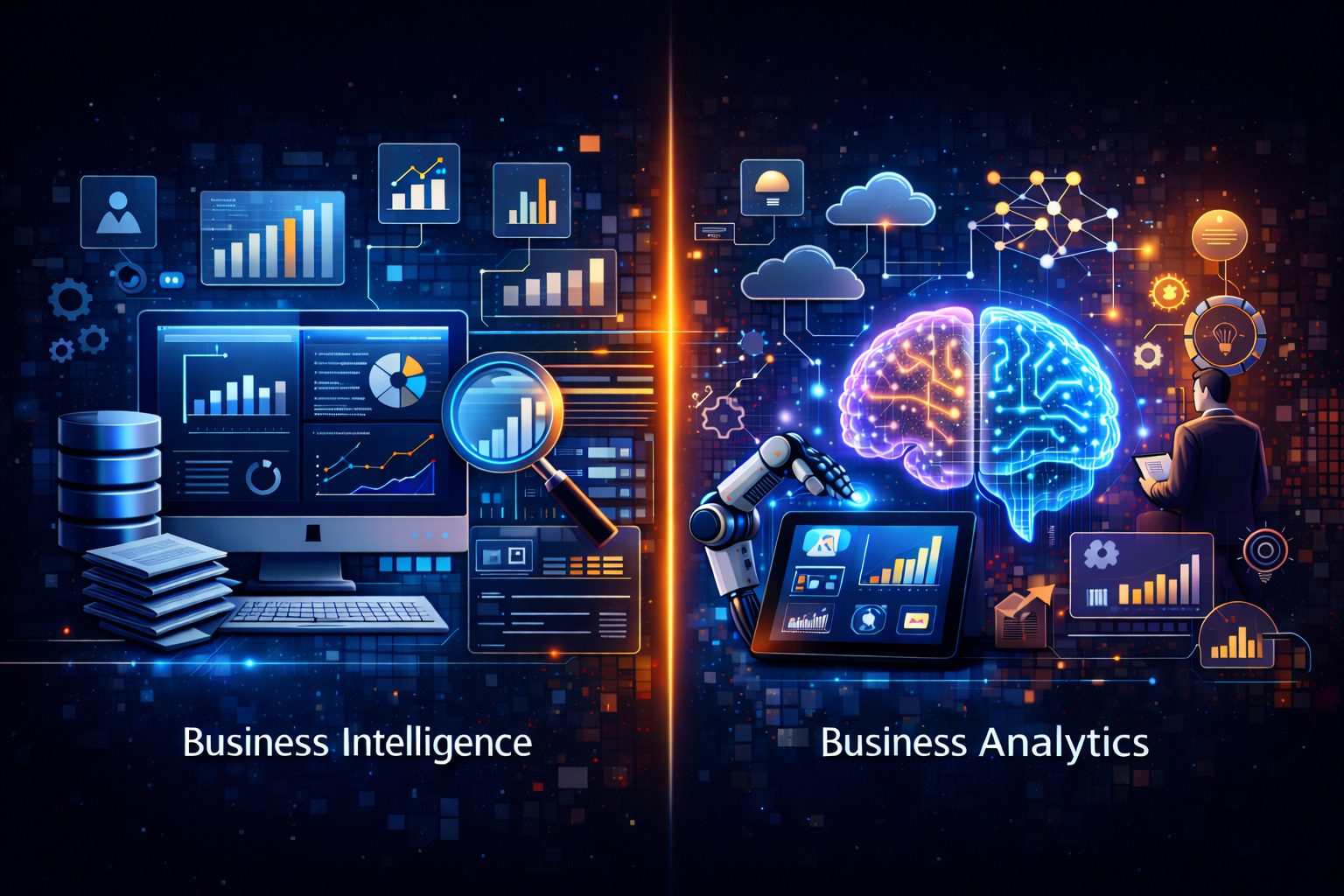
Data-driven decision-making now shapes how enterprises compete and grow. Organizations rely on data to improve performance and accountability. However, confusion remains around business intelligence vs business analytics. One focuses on reporting and visibility. The other supports deeper analysis and forward-looking decisions. Understanding this distinction helps leaders use data more effectively.
McKinsey research shows that most organizations now embed analytics and AI across core business functions, signaling mature data-driven practices. Clarity around business intelligence and business analytics enables better tool selection. It improves strategic and operational outcomes. This article explains definitions, key differences, and when enterprises should use each approach.
Table of Contents
- What Is Business Intelligence?
- What Is Business Analytics?
- Business Intelligence vs Business Analytics: Understanding the Primary Differences
- Key Differences Between Business Intelligence and Business Analytics
- How Ansi ByteCode Helps Enterprises with BI and Business Analytics
What Is Business Intelligence?
Business intelligence is a technology-driven approach for collecting, processing, and presenting business data. Its core purpose is to support informed decision-making. BI focuses on visibility into performance and business operations. It helps organizations understand what is happening now and what happened before. In discussions about business analytics vs. business intelligence, BI serves as the foundation for reporting and monitoring.
Core Capabilities of Business Intelligence
Business intelligence primarily works with historical and current data. It converts raw data into structured, usable, and actionable insights.
- Analysis of historical and business real-time data
- Standardized reports, dashboards, and scorecards
- Tracking of KPIs and operational metrics
- Scheduled and ad hoc performance reporting
- Data consistency across departments
Typical BI outputs include executive dashboards and operational reports. These outputs support day-to-day operational decisions. They also enable faster issue identification. A well-defined business intelligence strategy ensures data reliability. It aligns reporting with business goals and accountability.
What Is Business Analytics?
Business analytics is the practice of data analysis to predict outcomes and guide future actions. Its purpose is to explain why results occur and what may happen next. Business analytics supports planning, optimization, and strategy. It helps leaders make proactive decisions. In comparisons of business intelligence vs business analytics, analytics focuses on insight and foresight.
How Business Analytics Supports Strategic Decisions?
Business analytics relies on advanced analytical methods and data science techniques. It goes beyond reporting to influence strategic direction.
- Predictive and prescriptive analytical approaches
- Analytical modeling and scenario analysis
- Forecasting demand, revenue, and risk
- Optimization of processes and resources
- Evaluation of future business outcomes
These techniques support long-term planning. They improve competitive positioning. Business analytics enables smarter investments. It helps organizations adapt to change.
Business Intelligence Vs. Business Analytics: Understanding the Primary Differences
1. Purpose and Focus
The core purpose differs clearly between reporting and advanced analysis in business intelligence and business analytics. Each serves a distinct role in enterprise decision-making.

BI focuses on operational visibility and performance tracking. It helps organizations understand current business conditions.
- Monitoring business performance
- Tracking KPIs and metrics
- Standardized operational reporting
- Day-to-day data management support
BA focuses on generating insights, predicting, and optimizing. It helps organizations improve future decisions.
- Identifying patterns and drivers
- Predicting future outcomes
- Optimizing processes and strategies
- Supporting strategic planning
2. Type of Questions Answered
The two approaches differ in the types of business questions they address, clarifying business intelligence vs business analytics in practice.
Business Intelligence answers descriptive questions about performance. It explains what has already occurred or is currently happening.
- What happened last quarter
- What is happening right now
- Which metrics met targets
- Where performance gaps exist
Business Analytics answers diagnostic and predictive questions. It explores causes and future outcomes.
- Why results occurred
- What may happen next
- How outcomes could change
- Which actions may improve results
3. Time Orientation
Time perspective is a key distinction between Business Intelligence and Business Analytics.
BI focuses on the past and present. It supports understanding historical trends and the current status.
- Historical performance analysis
- Current operational monitoring
- Periodic reporting cycles
- Short-term decision support
BA focuses on the future. It supports forecasting and long-term planning.
- Future trend forecasting
- Scenario planning
- Long-term optimization
- Proactive decision-making
4. Data Usage
The type and scope of data used differ, reflecting business analytics vs business intelligence approaches.
BI relies on structured and validated data. Data is typically stored in enterprise systems.
- Structured historical datasets
- Cleaned and standardized data
- Internal enterprise sources
- Consistent data models
BA uses broader and more diverse data. It combines multiple data types to provide deeper insight.
- Structured and unstructured data
- External and alternative sources
- Large-scale datasets
- Experimental data inputs
5. Analytical Methods
Each approach, including BI and BA, applies different analytical techniques.
BI uses descriptive data analysis to summarize, visualize, and analyze data for understanding.
- Aggregation and summarization
- Descriptive statistics
- Trend visualization
- Performance comparisons
BA uses advanced analytical methods. It applies statistical models to predict and prescribe actions.
- Predictive analytics
- Prescriptive analytics
- Statistical modeling
- Optimization techniques
6. Tools and Technologies
The tools supporting BI and BA vary by complexity and purpose, aligning with business intelligence vs business analytics needs.
Business Intelligence tools prioritize accessibility and reporting. They support self-service insights.
- Dashboards and scorecards
- Reporting platforms
- Data visualization tools
- Self-service BI solutions
Business Analytics tools support advanced computation. They enable modeling and experimentation.
- Statistical analysis tools
- Machine learning platforms
- Data mining and modeling frameworks
- Advanced analytics environments
7. Users and Skill Requirements
User profiles and required skills differ across BI and BA functions, reflecting the use of business intelligence and business analytics.
A wide range of businesses use BI. It requires minimal technical expertise.
- Managers and executives
- Business operations and finance teams
- Business intelligence analysts and business users
- Basic analytical skills
Specialized roles use BA and data analytics. It requires strong analytical expertise.
- Data and business analysts
- Data scientists
- Quantitative specialists
- Advanced statistical skills
8. Business Outcomes
The outcomes delivered by BI and BA differ in scope and impact, highlighting the benefits of business analytics vs. business intelligence.
Business Intelligence improves operational awareness. It supports consistent and informed daily decisions.
- Better performance visibility
- Faster issue identification
- Improved operational control
- Consistent reporting
Business data analytics enables strategic decision-making. It drives long-term value creation.
- Improved forecasting accuracy
- Better strategic planning
- Optimized resource allocation
- Competitive advantage
Key Differences Between Business Intelligence and Business Analytics
The table below highlights core differences across key dimensions, helping enterprises choose the right approach for reporting or strategic insight.
| Dimension | Business Intelligence | Business Analytics |
| Purpose | Supports operational visibility and performance tracking | Enables insight, prediction, and optimization of future outcomes |
| Time focus | Past and present data for reporting and monitoring | Future-oriented for forecasting and planning |
| Data types | Primarily structured, validated enterprise data | Structured and unstructured data from diverse sources |
| Methods | Descriptive statistics and summarization | Predictive modeling and prescriptive analysis |
| Data tools | Dashboards, reports, and KPI tracking platforms | Statistical tools, machine learning, analytical environments |
| Users | Business users and managers | Data analysts and data scientists |
| Outputs | Dashboards, scorecards, and visual reports | Forecasts, trend models, and optimization recommendations |
| Business value | Improves operational clarity and responsiveness | Enhances strategic decisions and competitive advantage |
Investing in both BI and BA delivers stronger enterprise outcomes. According to Deloitte research, 67% of companies using advanced data analytics report improved workforce productivity, showing analytics’ broad business impact.
How Ansi ByteCode Helps Enterprises with BI and Business Analytics?
Business intelligence focuses on reporting and operational visibility. Business analytics focuses on prediction and optimization. Enterprises need to make informed decisions. Together, they connect past performance with future planning. Understanding business intelligence vs business analytics helps leaders build a balanced data strategy. An integrated approach improves accuracy, speed, and business impact. It also aligns data analysis with strategic goals.
Ansi ByteCode LLP helps enterprises design and deliver end-to-end BI and analytics solutions. The team supports data strategy, dashboards, and the implementation of advanced analytics. They ensure scalability, governance, and measurable outcomes. Through business intelligence services, Ansi ByteCode LLP enables seamless adoption of business intelligence and business analytics across enterprise environments.