
Business Intelligence vs Data Analytics: Key Differences
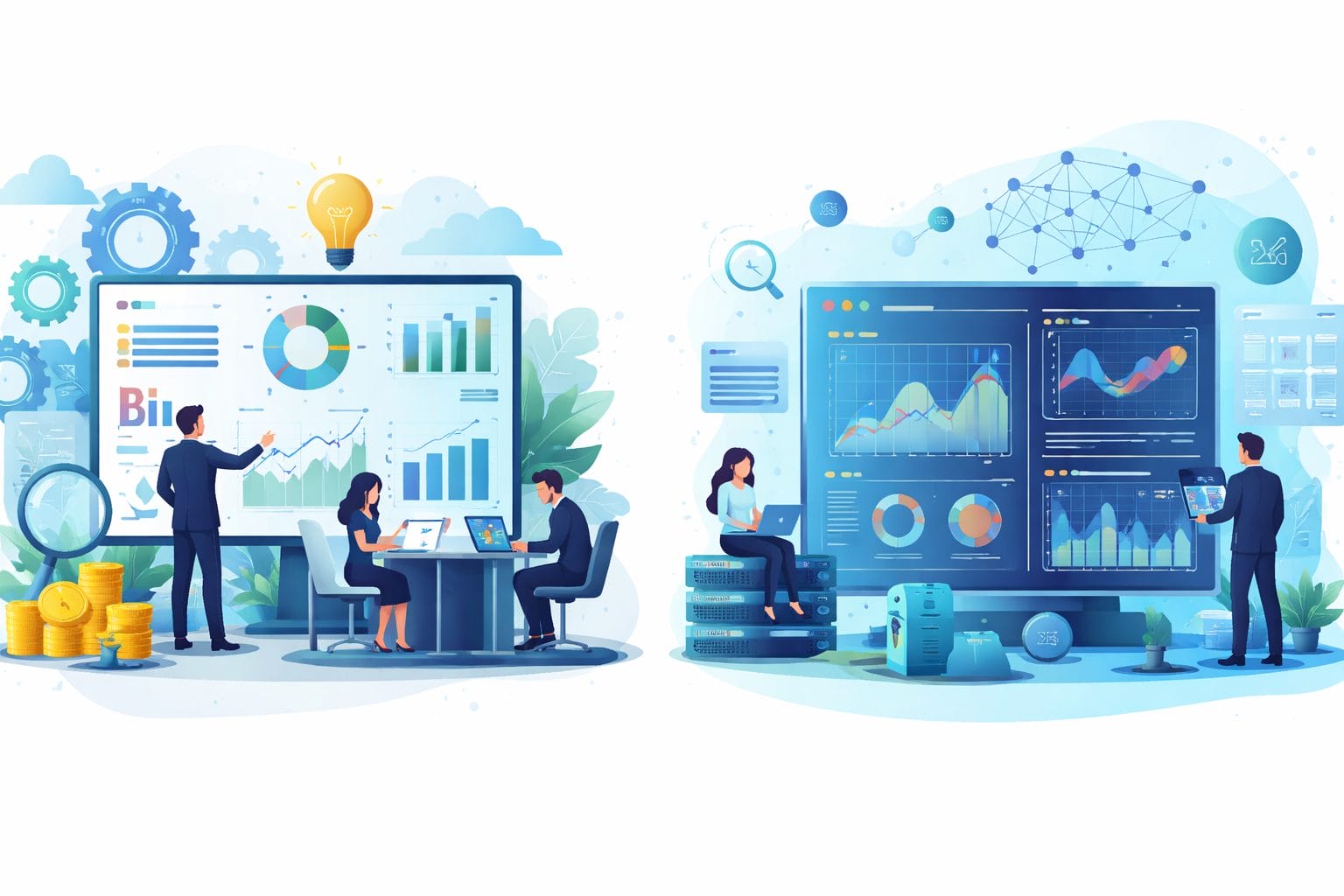
Today’s organizations collect vast amounts of data through customer engagement, daily operations, or market movements. Yet unprocessed data brings no edge: value comes when it’s turned into useful insights. In this field, two main methods stand out: business intelligence alongside data analytics. Though people often use these labels the same way, they differ in purpose, techniques used, and results achieved.
Let’s explore the key differences between business intelligence and data analytics, covering their scope, use cases, and value to businesses.
Table of Contents
What Is Business Intelligence?
Business intelligence means the methods, software, and processes companies use to collect, analyze, and present business data for informed decision-making. BI transforms raw data from daily operations into insights through reporting, dashboards, and charts that help stakeholders to understand past performance and current operational status.
Key BI Functions
BI tools handle key tasks to support decisions based on data:
Data Integration: BI systems pull data from multiple sources such as CRM tools, ERP systems, spreadsheets, and databases, then bring everything into a single, reliable location like a data warehouse. This removes data silos and ensures teams work with one consistent version of the truth.
Data Visualization: Raw numbers can be overwhelming. BI tools turn complex datasets into easy-to-read charts, graphs, and dashboards using platforms like Tableau and Microsoft Power BI. Visual formats help users quickly spot trends, patterns, and performance gaps.
Reporting Features: BI enables automated and on-demand reporting so teams can track KPIs, monitor performance, and review progress regularly. These reports reduce manual work and keep stakeholders aligned with up-to-date insights.
Query and Analysis Tools: Self-service query tools allow users to filter data, drill into specific details, and explore insights without advanced technical knowledge. This empowers teams to answer questions faster without relying heavily on IT support.
Who Uses BI
Business intelligence supports various decision makers and C-suite leaders who need daily operational insights and performance visibility:

- C-Suite Executives: Monitor organizational output and make strategic decisions based on factual data.
- Department Managers: Track team performance and resource utilization, and ensure the budget stays on track.
- Business Analysts: Identify trends and derive insights for future planning and strategy.
- Operational Leaders: Access real-time data to respond quickly to emerging issues.
Goals of BI
Business intelligence services help organizations perform more effectively by offering clearer views of operations, along with informed decision-making based on data analysis.
- Operational Visibility: Provides real-time monitoring of business operations, helping leaders to track KPIs and respond quickly to new challenges.
- Data-Driven Decision-Making: Replaces intuition and guesswork with factual data using historical and current data.
- Enhanced Operational Efficiency: Identifies bottlenecks, redundancies, and opportunities for process improvement across departments.
- Competitive Benchmarking: Evaluates how a company performs relative to sector norms using rival data to uphold its standing in the marketplace.
What Is Data Analytics?
Data analytics is the technical process of examining raw datasets to uncover patterns, draw conclusions, and extract valuable insights using statistical analysis, machine learning, and computational methods. Data analytics uses advanced techniques to answer specific business questions, check assumptions, and forecast results through rigorous data exploration and modeling.
Types of Data Analytics
Data analytics includes four separate kinds, each addressing unique business needs:
- Descriptive Analytics: Summarizes historical data to understand what happened through aggregation and visualization.
- Diagnostic Analytics: Investigates why specific events occurred by identifying root causes and correlations.
- Predictive Analytics: Uses statistics and machine learning to forecast future outcomes and trends.
- Prescriptive Analytics: Recommends specific actions by evaluating scenarios and suggesting optimal strategies.
Who Uses Data Analytics
Data analytics gets used by experts who know stats and coding well. They handle complex info using specific tools; their skills help turn numbers into useful insights through careful analysis:
- Data Analysts: Collect, clean, and analyze data using Python, R, C#, SQL, and Excel
- Data Scientists: Develop machine learning models and create predictive algorithms
- Technical Professionals: Handle complex analyses requiring specialized programming expertise
- Business Stakeholders: Leverage self-service analytics tools for data exploration
Goals of Data Analytics
Data analytics aims for full potential through thorough examination or complex simulations
- Spot Hidden Patterns: Reveals correlations and insights that aren’t immediately apparent through standard reporting or BI dashboards.
- Enable Predictive Capabilities: Forecasts customer behavior, market trends, and operational outcomes using statistical modeling and machine learning.
- Support Hypothesis Testing: Validates business assumptions and measures intervention effectiveness through scientific experimentation.
- Drive Innovation: Identifies new product opportunities, market segments, and revenue streams through comprehensive data exploration beyond surface-level reporting.
What Is the Difference Between Data Analytics and Business Intelligence
Business intelligence differs from data analytics mainly in method and focus. While BI focuses on describing past events, it uses existing and historical data to show what occurred or is occurring now. In contrast, data analytics looks ahead by applying forecasting methods to explore future outcomes. Instead of just reporting results, it suggests actions using recommendation strategies.
| Aspect | Business Intelligence | Data Analytics |
| Primary Focus | Historical and current operational data | Predictive modeling and future forecasting |
| Questions Answered | What happened? How did it happen? | What will happen? What should we do? |
| Time Orientation | Past and present performance | Future trends and outcomes |
| Data Types | Structured data from operational systems | Structured and unstructured data from diverse sources |
| Tools & Techniques | Dashboards, reports, OLAP, data warehouses | Statistical analysis, machine learning, algorithms |
| Primary Users | Executives, managers, business decision makers | Data scientists, analysts, tech professionals |
| Output Format | Visual dashboards, KPI reports, interactive charts | Statistical models, predictive scores, recommendations |
| Scope | Big-picture operational and tactical decisions | Narrow focus on specific problems or questions |
| Complexity | User-friendly interfaces for non-technical users | Requires statistical and programming expertise |
| Report Frequency | Historically one-off questions, now automated | Regular, repeatable automated analyses |
BI platforms work with structured data from operational systems, presenting insights through dashboards designed for non-technical users. Data analytics handles diverse data sources, requiring technical expertise to clean, transform, and model data using programming languages and statistical software.
When to Use Business Intelligence
Business intelligence works best when organizations need clear insights into daily operations and reports:
- Real-Time Performance Monitoring: When you need to track established KPIs, sales performance, financial metrics, or operational efficiency against defined targets
- Uniform Departmental Report: When decision-makers require quick access to consolidated data from multiple systems without technical expertise.
- Monthly/Quarterly Business Reviews: When decision makers need detailed performance summaries presented in simple, visual dashboard formats.
- Breaking Down Data Silos: When your organization experiences scattered data across departments, it combines into useful insights.
- Automated Reporting Needs: When you have established processes and well-defined metrics that benefit from automated report generation instead of manual entry.
When to Use Data Analytics
Data analytics becomes essential when organizations need deep insights, forecasting capabilities, and complex problem-solving:
- Complex Business Challenges: When you need to answer questions like “why are customers not returning?” or “which factors most influence sales performance?”
- Predictive Forecasting: When you must forecast product demand, predict customer behavior patterns, or anticipate market changes for competitive advantage
- New Market Exploration: When launching new products or services that require detailed customer segmentation, targeting optimization, and behavioral analysis
- Advanced Optimization: When implementing personalized marketing campaigns, dynamic pricing strategies, or recommendation systems.
- Risk Management: When you need fraud detection, spot anomalies, or pattern recognition to prevent losses and identify operational risks
- Strategic Innovation: When exploring new revenue streams, market opportunities, or business models that require comprehensive data exploration beyond standard reporting
How BI and Data Analytics Work Together
Business intelligence and data analytics are complementary and create a powerful impact. BI establishes the data foundation through infrastructure and governance that enables analytics teams to access clean data for advanced modeling. Data analytics enhances BI by identifying which data matter most and sending insights back into BI dashboards for proactive decision-making.
Successful organizations use BI for daily operation monitoring while implementing analytics for long-term planning. BI tools provide accessible interfaces where business users explore data, then analytics teams conduct deeper analyses and present findings through those same dashboards. This collaborative approach ensures data drives decisions at every organizational level.
Transform Your BI & Analytics Strategy with Ansi ByteCode LLP
Knowing how business intelligence differs from data analytics helps companies choose better tech tools. Although BI offers insight via reports and dashboards, data analytics enables forecasting with models. Despite their contrasts, each supports smarter choices based on information. Together, they boost performance in a competitive environment.
At Ansi ByteCode LLP, we help organizations build solid data strategies leveraging both business intelligence and advanced data analytics. Our expert team specializes in delivering customized business intelligence services that integrate seamlessly with advanced analytics. Whether you need BI dashboards, predictive models, or a hybrid approach, we provide the expertise and support to transform your data into a competitive asset.
FAQs on Data Analytics Vs Business Intelligence
Companies usually wonder whether to pick business intelligence or data analytics, yet some want to know how both can fit together well. These frequently asked questions address common concerns and provide clarity for strategic decision-making.
Which is better, business intelligence or data analytics?
Neither. In fact, they complement each other in purposes within comprehensive data strategies that drive business success. BI works well at operational monitoring and standardized reporting for business users, while data analytics provides predictive capabilities and deep statistical insights.
What are the four types of business intelligence?
Business intelligence includes four analytical capabilities: descriptive analytics, which summarize historical data patterns; diagnostic analytics, which explain why events occurred; operational intelligence, providing real-time monitoring; and collaborative BI, enabling teams to share insights and make collective decisions.
What is the most popular business intelligence tool?
Microsoft Power BI and Tableau are the most popular BI tools because of their comprehensive features, easy interactive interfaces, and compatibility. While Power BI works best within Microsoft environments, Tableau excels at advanced visual analytics. Tools like Qlik Sense or Looker also hold notable positions in this space.
What is the most popular data analytics tool?
Python, C# or R lead in data analysis because they offer strong stats tools alongside ML support. In business settings, solutions such as SAS, SPSS, TensorFlow, scikit-learn, Power BI and Apache Spark allow large-scale processing tailored to intricate company demands.
Can one tool do both BI and analytics?
Today’s systems combine these functions more frequently, delivering BI interfaces together with deeper analytical tools. Solutions such as Tableau, Power BI, or Qlik include forecasting models and ML, not just standard reports. Still, intricate data work usually depends on dedicated coding setups.

At Ansi ByteCode LLP, a visionary leader spearheads our journey from dream to reality. Soft-spoken yet immensely powerful, he embodies effective leadership, leveraging his developer background to navigate complexities effortlessly.


