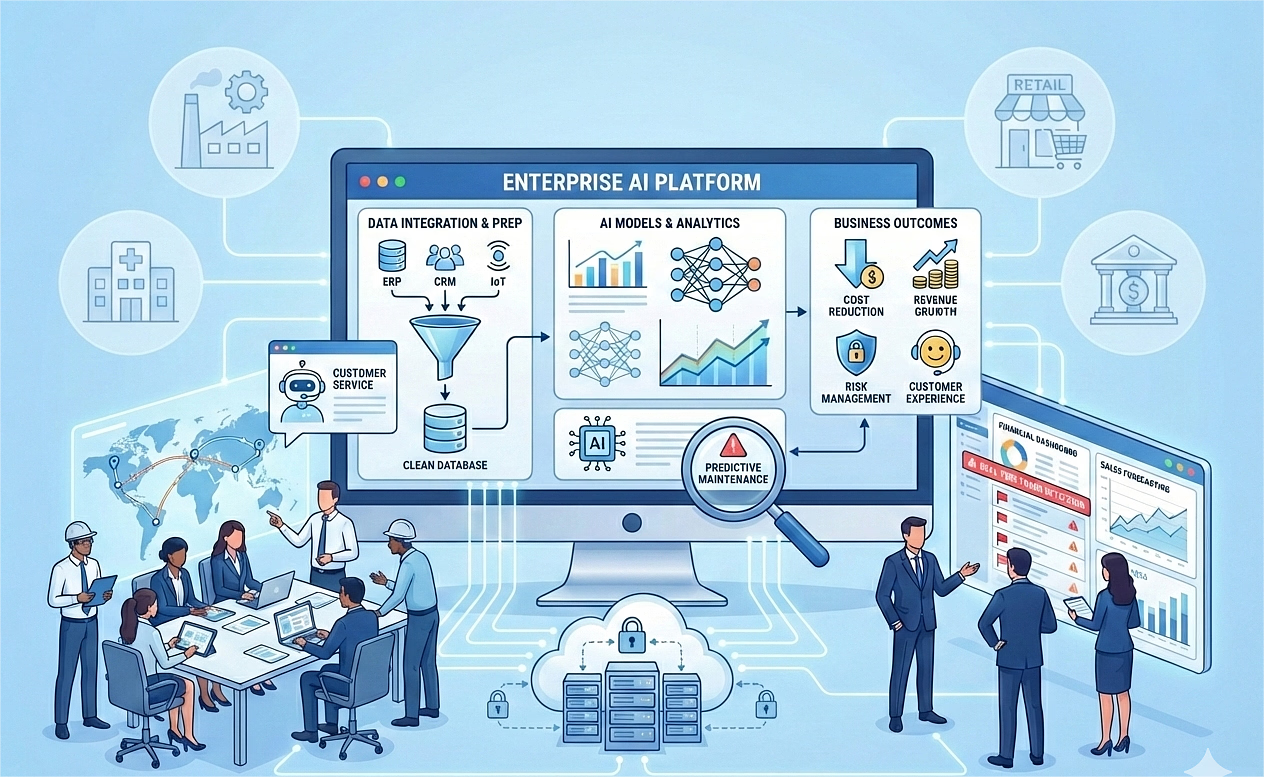
Organizations have rapidly accelerated AI adoption in recent years, driven by the belief that skipping AI could mean falling behind competitors. It has triggered FOMO (Fear of Missing Out). However, not all AI tools are built for enterprise scale, and choosing the wrong one can drain budgets faster than expected.
Large organizations use Enterprise AI far beyond simple chatbots. These enterprise-grade AI systems have an inbuilt capability to connect the dots while handling massive volumes of data, integrate seamlessly with legacy systems, comply with stringent regulations, and scale securely across departments without incurring additional costs. Companies that implement Enterprise AI correctly aren’t just automating tasks; they’re transforming how work gets done, reducing operational costs, and uncovering new revenue opportunities they hadn’t previously identified.
In this article, you’ll learn what Enterprise AI is, how it differs from traditional AI tools, its key benefits and challenges, real-world use cases, and how businesses can successfully implement enterprise-grade AI solutions.
Table of Contents
- What is Enterprise AI?
- Importance of Enterprise AI for Businesses
- Benefits of Implementing Enterprise AI
- Key Capabilities of Enterprise AI Platforms
- Enterprise AI Development Process
- Enterprise AI Use Cases
- Enterprise AI Examples
- Enterprise AI Challenges and How to Overcome Them
- Why Choose Ansi ByteCode LLP for Enterprise AI Solutions
- FAQs on Enterprise AI
What is Enterprise AI?
Enterprise artificial intelligence refers to AI systems designed to solve complex business problems, automate processes, and support informed decision-making at scale. These applications power critical operations where accuracy, compliance, and security are non-negotiable.
What makes AI truly enterprise-grade is its ability to scale reliably, from hundreds to thousands of users, integrate with existing systems like ERPs, and embed strong security and data governance from day one. Most importantly, it delivers measurable business outcomes, not just impressive demos.
Enterprise AI typically combines machine learning, natural language processing, computer vision, and predictive analytics to extract insights, automate workflows, and anticipate risks before they impact the business.
Importance of Enterprise AI for Businesses
Organizations adopting enterprise AI are already saving employees’ 40–60 minutes per day, but efficiency gains are only the starting point. The real value lies in how these advantages compound over time.
With a well-defined enterprise AI strategy, businesses can manage high volumes of customer interactions, automate routine processes, and enable predictive decision-making without increasing operational burden.
Enterprise AI systems also strengthen resilience by delivering consistent performance during peak demand and reducing reliance on manual intervention. This reliability is critical in regulated industries such as healthcare, finance, and manufacturing. Beyond operations, AI-driven insights help organizations respond faster to change and make data-backed decisions that improve overall business outcomes.

Benefits of Implementing Enterprise AI
Enhanced Decision-Making
Enterprise AI platforms analyze large volumes of data faster than manual analysis. Marketing teams can predict campaign performance before allocating budgets, while operations leaders optimize resource allocation based on data-driven insights rather than intuition.
Cost Reduction
Smart process automation reduces operational costs significantly. Customer service centers using AI chatbots handle more inquiries. Manufacturing facilities using predictive maintenance reduce breakdowns considerably.
Improved Customer Experience
AI delivers personalized experiences even when you are dealing with millions of people. The recommendation system understands buying patterns. Virtual assistants resolve issues 24/7 without making anyone wait. Result? Happier customers and the cost of getting new customers also reduce.
Competitive Innovation
Companies using AI tools aren’t just doing things better; they are implementing completely new ways to operate. Some retailers ditched checkout lines entirely. Insurance companies quote policies in seconds instead of making you wait days. Doctors catch diseases earlier using AI diagnostics.
Risk Management
Fraud detection catches suspicious transactions instantly. Cybersecurity sees threats by noticing patterns that no human analyst would ever catch. Compliance teams track thousands of regulations and flag problems before auditors even show up.
Key Capabilities of Enterprise AI Platforms
Scalable Infrastructure
A cloud system that grows during busy times without you manually doing anything. GPU acceleration, distributed computing, and smart resource management; these aren’t extras; they’re must-haves.
Advanced ML Capabilities
Good platforms come with ready-made models for everyday problems and have room to build custom ones. Natural language processing, computer vision, forecasting, and optimization are easy to work with, even for non-tech team members.
Data Integration
Your important data is everywhere: CRM, ERP, databases, and old databases. AI needs access to all these places, combines them, and keeps the quality high. Without solid data, even the best AI will produce bad results.
Security and Governance
Encryption, role-based access controls, audit for every decision, and compliance for GDPR, HIPAA, and SOC 2 need to be followed. You need explainable AI so you can actually understand how it’s making choices.
Model Lifecycle Management
You need versioning as models improve, watching how they perform in the real world, catching when accuracy starts dropping, and automatic retraining with fresh data. Model lifecycle management brings an actual engineering discipline to AI work.
User-Friendly Tools
Business analysts should build models without coding. Drag-and-drop builders, visual workflows, and ready templates make AI accessible while keeping flexibility for the technical and non-technical folks.
Enterprise AI Development Process
1. Strategic Planning
Pick 2-3 high-impact business problems where AI can deliver clear, measurable results. Define success metrics and secure executive buy-in.
2. Data Foundation
Collect and clean data from all sources. Establish ownership, security protocols, and regulatory compliance. Choose your cloud infrastructure.
3. Model Development
Select algorithms, train models on historical data, and validate accuracy. Ensure models are both accurate and explainable.
4. Pilot Testing
Start small. Test performance, gather feedback, and measure against your KPIs before scaling.
5. Integration
Connect AI models to business systems via APIs. Ensure real-time data flow, error handling, and train teams on new processes.
6. Deployment
Roll out gradually across the organization. Monitor system performance, manage infrastructure costs, and maintain accuracy at scale.
7. Continuous Optimization
Monitor model performance regularly, retrain with fresh data, and expand capabilities based on user feedback and business impact.
Enterprise AI Use Cases
Customer Service Automation
AI chatbots can handle a majority of regular questions anytime, day or night. Palo Alto Networks handles 60-80% of queries using AI assistants.
Predictive Maintenance
Factories reduce breakdowns as sensors collect equipment data, AI spots failure patterns, and maintenance gets scheduled proactively.
Fraud Detection
Financial institutions analyze millions of transactions, flag suspicious activities, and block fraudulent charges. AI detects fraud types that traditional systems miss.
Supply Chain Management Optimization
AI platform predicts demand better, optimizes inventory level everywhere, highlights supplier problems early, and suggests smart routing. Retailers cut overstock while having fewer out-of-stocks.
HR and Talent Management
Screen resumes, match candidates to jobs, predict risks, and personalize training. Recruiting teams hire faster with AI help.
Marketing Personalization
Deliver custom content at a huge scale, predict responses, optimize ad spending in real-time, and make recommendations. Customers get what they actually want instead of random spam.
Enterprise AI Examples by Use Case
AI Personalization Engines
Amazon uses AI-driven recommendation engines to analyze browsing behavior, purchase history, and context, predicting what customers want before they actively search for it, driving higher engagement and conversion rates.
AI Contract & Document Intelligence
JPMorgan’s contract intelligence system uses natural language processing to review loan agreements and extract key clauses. Tasks that earlier took lawyers thousands of hours each year are now completed in seconds with higher accuracy.
AI Predictive Maintenance
Siemens applies predictive maintenance AI to monitor factory equipment health in real time. In wind turbine operations, this reduces unexpected downtime and extends equipment lifespan.
AI Inventory & Demand Planning
Walmart uses AI to forecast demand by store, location, and season, optimizing inventory allocation. This has significantly reduced out-of-stock situations while minimizing excess inventory.
AI Virtual Assistants for IT & Operations
Procore leverages Moveworks AI to automate employee IT support requests. Issues that previously took days to resolve are now handled automatically in under a minute, saving substantial operator hours.
AI Sales Forecasting
Enterprise AI analyzes pipeline data and historical sales trends to predict revenue outcomes and deal risks, helping leadership teams avoid last-minute surprises at quarter end.
AI Fraud Detection
AI systems monitor transactions in real-time, identifying suspicious patterns and flagging potential fraud before financial damage occurs, which is critical for banking, fintech, and e-commerce enterprises.
Enterprise AI Challenges and How to Overcome Them
- Data Quality Issues: Enterprise data is scattered and messy.
- Solution: Audit everything first, then build something that is clean as they go, and implement compliance rules early before chaos takes over.
- Talent Shortage: AI experts are rare and expensive.
- Solution: Pair AI specialists with folks who know your business functions. Train people you’ve already got. Use platforms that require little to no coding knowledge so non-technical people can also contribute.
- Security and Compliance: Data breaches can break everything.
- Solution: Build security from day one. Encryption, control who sees what, track every decision, and pick certified platforms.
- Resistance to Change: Employees fear job loss.
- Solution: Be upfront that AI helps people, doesn’t replace them. Get employees involved, train them properly, and celebrate wins publicly.
Why Choose Ansi ByteCode LLP for Enterprise AI Solutions
AI’s not a competitive edge anymore. It’s about surviving. Companies using AI are racing ahead, while those hesitant to adopt it fall behind in ways that become increasingly difficult to rectify every quarter. The question isn’t “should we do AI” anymore. It’s “How fast can we do this right without wasting money on stuff that doesn’t work?”
Ansi ByteCode LLP specializes in enterprise software development that delivers AI solutions working in real business environments. We’ve implemented enterprise AI platform implementations across finance, healthcare, manufacturing, and retail that solve the exact challenges discussed in this guide. Our approach prioritizes measurable ROI from day one. Small pilots prove value fast before scaling big. Security, compliance, and governance are the base foundation of every solution we build. Whether you need intelligent automation, predictive analytics, natural language processing, or custom machine learning models, we have the expertise to deliver AI for enterprises that transform operations.
FAQs on Enterprise AI
Here are quick answers to common questions about enterprise AI:
What is the difference between Generative AI and enterprise AI?
Generative AI creates new content, while enterprise AI implements various AI technologies across business operations to solve problems at scale.
What are the trends in enterprise AI?
Agentic AI systems, real-time decision-making, no-code platforms, and edge AI for IoT devices are current trends in enterprise AI.
What is an enterprise AI platform?
A suite of tools and technology enabling organizations to develop, implement, and manage AI applications at enterprise scale.