
Microsoft’s Agentic AI Frameworks: Building Smarter Multi-Agent Apps
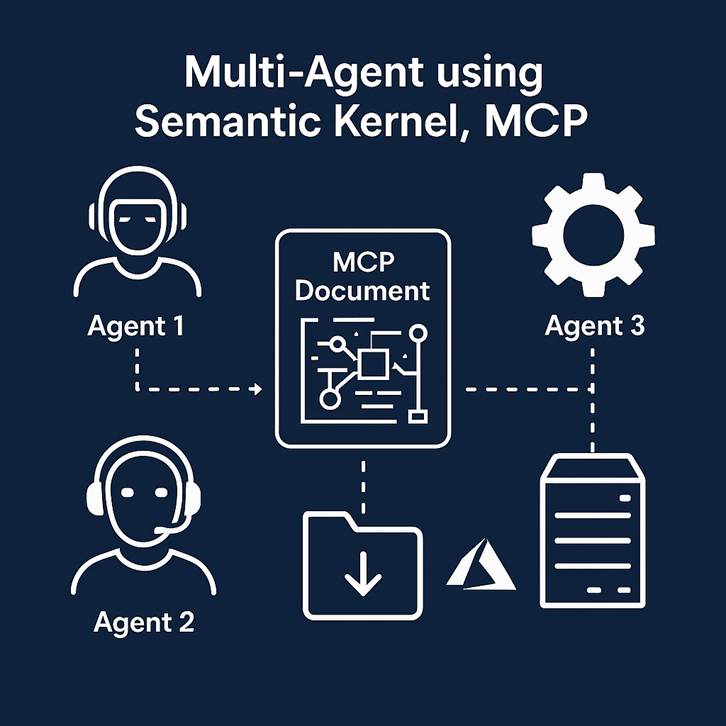
AI isn’t just about making things smarter anymore. It’s about building systems that can work together like a well-coordinated team. Think less about one super-smart assistant, and more about a group of specialized agents that collaborate, adapt, and execute complex tasks. That’s the power behind Microsoft’s Agentic AI frameworks and trust me, it’s a game changer.
Let’s dig into what makes this framework special and how you can start building with it today.
What is Agentic AI, and Why Should You Care?
Here’s the thing, traditional AI apps are great at doing one task at a time. But what if your application needed to do five things in sequence, adapt based on results, and make decisions on the fly?
Agentic AI is the answer. It’s a design pattern where your system is made up of autonomous software agents. These agents are like little teammates each one with a specific job, the ability to communicate, and the freedom to figure out how to get their job done.
Here’s what Agentic AI enables:
- Breaking down complex workflows into smaller, manageable parts
- Enabling agents to call APIs, access tools, or analyze data independently
- Facilitating communication between agents to meet shared goals
If you’ve ever tried to automate a process that involved decision making and hand-offs, Agentic AI is exactly what you’ve been missing.
Enter Microsoft’s Semantic Kernel (SK)
At the center of this entire agentic ecosystem is Semantic Kernel, an open-source SDK by Microsoft that combines traditional software development with the power of large language models (LLMs) like GPT-4.
Think of SK as the brain that connects all the moving parts.
What makes Semantic Kernel powerful?
- You can embed LLMs directly into your C# apps
- You build modular “skills” and “functions” that agents can reuse
- It supports memory, task chaining, and agent orchestration
- It integrates with the Model Context Protocol (MCP) for multi-agent collaboration
With SK, you’re not just calling an LLM, you’re creating intelligent agents that can reason, plan, and coordinate.
What is Model Context Protocol (MCP)?
Imagine this:
- AgentOne generates a blog.
- AgentTwo needs to know that blog’s title and content before summarizing it.
That communication needs to be structured, secure, and contextual.

That’s what MCP (Model Context Protocol) is for.
MCP handles:
- Transferring intent and context between agents
- Structured task hand-offs
- Shared memory and goal state synchronization
This protocol ensures agents don’t just work independently but also work together intelligently. For enterprise-grade systems, that structure is gold.
Let’s Build a Multi-Agent App in C#
So what does this look like in practice? Let’s build a real-world example using C#, Semantic Kernel, and MCP. You’ll see just how clean and scalable this approach can be.
Use Case: Smart Content Automation Workflow
Here’s a practical scenario: You want to automate the creation of content for your website and LinkedIn.
You’ll build:
- Agent One – Writes a blog based on a topic.
- Agent Two – Summarizes the blog into a professional LinkedIn post.
Each agent handles a specialized task. You’ll orchestrate their collaboration using MCP.
Step 1: Define Your Agents in C#
Each agent inherits from KernelAgent and includes a skill a reusable prompt logic.
public class AgentOne : KernelAgent
{
   public const string AgentName = "AgentOne";

   public AgentOne(Kernel kernel) : base(kernel, AgentName)
   {
      AddSkillFromPrompt("WriteBlog", "Write a blog post about the topic: {{topic}}");
   }
}

public class AgentTwo : KernelAgent
{
   public const string AgentName = "AgentTwo";
   public AgentTwo(Kernel kernel) : base(kernel, AgentName)
   {
      AddSkillFromPrompt("GeneratePost", "Summarize the blog content for a LinkedIn audience: {{blog}}");
   }
}
Step 2: Create the Agent Orchestrator Class
This is where the agents get wired together using Semantic Kernel’s orchestration capabilities.
public class AgentGroupOrchestrator
{
   private readonly Kernel _kernel;

   public AgentGroupOrchestrator(Kernel kernel)
   {
       _kernel = kernel;
   }

   public async Task OrchestrateAsync(string topic)
   {
       var agentOne = new AgentOne(_kernel);
       var agentTwo = new AgentTwo(_kernel);
       var blog = await agentOne.InvokeSkillAsync("WriteBlog", new() { ["topic"] = topic });
       var linkedInPost = await agentTwo.InvokeSkillAsync("GeneratePost", new() { ["blog"] = blog });
       Console.WriteLine("Final LinkedIn Post:\n" + linkedInPost);
   }
}
Step 3: Run the Multi-Agent Workflow
Here’s how you run everything from a main function:
var builder = Kernel.CreateBuilder();
builder.AddOpenAIChatCompletion("gpt-4", "your-openai-key");
var kernel = builder.Build();
var orchestrator = new AgentGroupOrchestrator(kernel);
await orchestrator.OrchestrateAsync("Microsoft’s Agentic AI Frameworks")
Just like that, you’ve got two intelligent agents collaborating and you didn’t write a single if/else to manage the workflow. The orchestration is handled through context, not code spaghetti.
Why This Matters
Here’s what this really enables:
- You break complex problems into modular parts
- Each agent can evolve independently
- You can reuse logic across different domains
- You get natural scalability and testability
You’re no longer building massive monoliths, you’re assembling smart systems from composable, communicative blocks.
Where to Go from Here
Once you get the basics down, you can add more agents:
- One for generating SEO metadata
- Another for creating images based on the blog content
- Even one for posting directly to LinkedIn or WordPress
And with tools like Azure OpenAI, Semantic Memory, and external skill plug-ins, the possibilities are endless.
Final Thoughts
If you’re a C# developer looking to explore what’s next in AI this is it.
Microsoft’s Agentic AI Frameworks give you the power to design applications that aren’t just smart, they’re intelligent collaborators. With Semantic Kernel, you embed reasoning into your codebase. With MCP, you give that reasoning structure, memory, and shared goals.
You’re not just writing functions anymore.
You’re building teams.
You’re scaling intelligence across your app.
So what are you waiting for?
Conclusion After the Conclusion
Let’s be real, AI is shifting from standalone assistants to full-on collaborators. And the developers who understand how to architect intelligent, multi-agent systems are going to be way ahead of the curve.
Start simple. Build a two-agent pipeline. Then layer in more agents as your needs grow.
You don’t need a PhD or a big team, you just need Semantic Kernel, a few prompts, and a willingness to think like a systems architect.
This isn’t the future of development. It’s the present. And it’s yours to build.
Do feel free to Contact Us or Schedule a Call to discuss any of your projects
Author

Hinal Kaneriya
Hinal brings a cheerful, vibrant, & energetic vibe to the workplace, making her a joy to work with. Her infectious enthusiasm uplift the team’s spirits and foster a collaborative atmosphere. With a positive attitude, boundless creativity, & a knack for thinking outside the box, Hinal is always ready with a smile & a witty comment. She adds a unique spark to our projects, contributing to a lively, engaging, & dynamic work environment.


