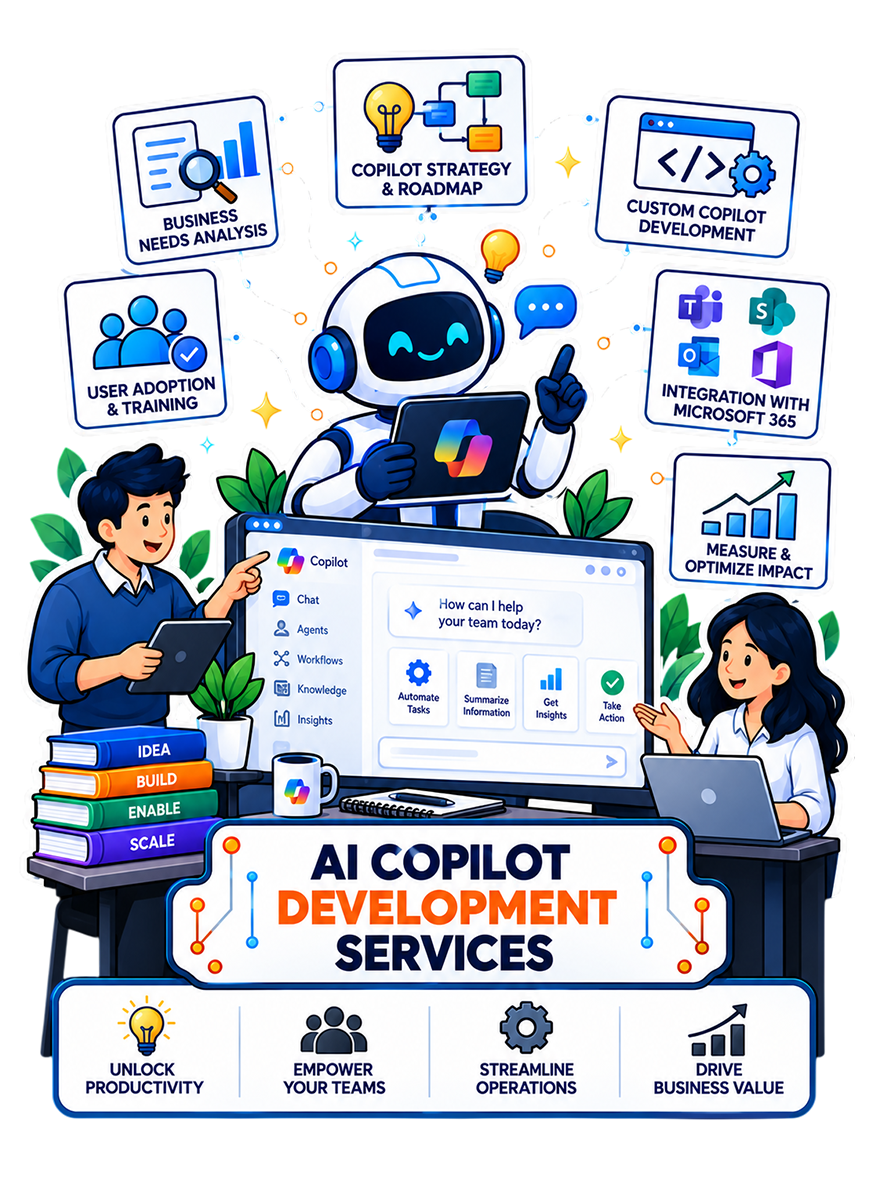
AI Copilot Development Services

Give your teams an assistant that works with approved business data and systems.

Employees often search multiple documents and applications for one task. General assistants lack access to internal context and business systems. A custom copilot retrieves approved information and performs permitted actions. It works within the tools employees already use.

Ansi ByteCode LLP provides AI copilot development for global enterprises. Services include connecting knowledge sources and integrating business applications. Engineers test accuracy and security before release. We bring 12+ years of enterprise software experience. Our Microsoft Solutions Partner designations cover Data & AI, Infrastructure (Azure), and Digital & App Innovation (Azure).

+
Years in AI & Software Development
+
AI & Software Projects Delivered
+
Certified AI & Technology Experts
%
Client Retention Rate

Why Do Businesses Struggle With AI Copilot Projects?

A successful demonstration does not prove a copilot can handle daily work. Real documents, existing permissions, and requests outside the demo set expose gaps in data access, adoption, and security that can delay rollout.

The Copilot Cannot Find the Right Information

A small demo document set rarely reflects working content. File shares contain scanned PDFs, outdated policies, and competing versions. If ingestion cannot handle those sources and permissions, the copilot returns incomplete or unreliable answers.

It Sits Outside the User’s Workflow

Employees will rarely leave Teams, Outlook, or their business application for a separate assistant. Even a useful answer loses value when it cannot help them continue the task where the request began.

Security Review Exposes Design Gaps

A pilot may retrieve information users should not see or expose personal data. Without permission checks at retrieval and usable audit logs, security review can halt rollout and require substantial changes to the design.

Our AI Copilot Development Services

The right starting point depends on the task, available data, and existing systems. Our services cover use case selection, development, integration, validation, and managed support after launch.

AI Copilot Consulting and Strategy

A broad request to add AI leaves decisions unresolved. We map users, tasks, information sources, and actions. We assess data readiness and compare extending Microsoft 365 Copilot with building a custom solution. You receive an architecture and model recommendation, PoC and MVP scope, and a cost roadmap.

Custom AI Copilot Development

Packaged assistants do not always fit a role’s workflow. Our custom AI copilot development services build around a defined role and its tasks. Development covers the interface, task handling, context and memory, citations, feedback, and human approval. The resulting copilot can be tested against work your team recognizes.

Microsoft 365 Copilot and Copilot Studio Development

Your organization may already have the platform needed for an extension. We configure Copilot Studio agents, declarative agents, and plugins for Microsoft 365 Copilot. Microsoft Graph connectors bring approved internal content into scope. We also develop copilots for Dynamics 365 and Power Platform workflows inside your tenant.

AI Copilot Integration With Enterprise Systems

Answers are less useful when the next step requires manual system searches. We connect copilots to CRM, ERP, ITSM, HR, and document systems, including Dynamics 365, Salesforce, SAP, ServiceNow, and SharePoint. APIs also let users work with the copilot inside Teams, Outlook, portals, or customer applications.


RAG Development and Knowledge Grounding Architecture

A model needs relevant business context to answer organizational questions. Retrieval-augmented generation, or RAG, supplies source material before it responds. We select chunking and embedding approaches, configure vector storage, and combine semantic and keyword search. Metadata filters, reranking, and source citations help users check each answer.

AI Agents and Workflow Automation

Some requests need an action rather than an explanation. An agent inside the copilot can interpret the request, retrieve context, and call an approved tool or API. It can complete defined steps and write results back to a business system. Permissions and approval gates control sensitive actions.

Data Preparation and Knowledge Base Engineering

Retrieval cannot correct an outdated or duplicated source on its own. We connect source systems, parse scanned PDFs, tables, and slide decks, and identify competing versions. Metadata enrichment and permission mapping make content easier to find and control. Scheduled refreshes help the copilot use current material.

Copilot Security, Governance, and Compliance

The copilot must respect the access rules governing your data. We enforce identity and document permissions during retrieval and control tool access. PII redaction, prompt-injection checks, content filters, and audit logging support internal review. We document controls relevant to HIPAA, SOC 2, and GDPR without implying automatic compliance.

Copilot Optimization, Support, and Managed Services

An underperforming pilot or live copilot needs focused improvement. We review questions, feedback, retrieval results, latency, and usage. Prompt and retrieval changes improve answer quality; caching and model routing can manage cost. Managed support also covers monitoring, fixes, and enhancement requests after launch.

Give Your Teams An AI Advantage

Create AI copilots that work alongside your employees, automate routine tasks, and help them make better use of their time.

Industries We Serve

The useful knowledge, actions, and controls differ by industry. We shape each copilot around the records and workflows its users actually handle.

Healthcare

Care teams can retrieve approved clinical information with a traceable source. Copilots can support documentation, prior authorization, and claims lookup while respecting healthcare access controls.

Finance and Banking

Analysts and relationship managers can retrieve policies, filings, and account history in one workflow. Source citations and retrieval logs support review when an audit trail is required.

Retail and Ecommerce

Store and support teams can answer product, pricing, and returns questions using current information. Merchandising teams can explore sales data without searching across separate reports.

Insurance

Underwriters and claims specialists can locate relevant policy clauses and draft assessment notes from approved material. A reviewer checks the source and makes the final decision.

Manufacturing

Technicians can retrieve equipment manuals, procedures, and work order history during troubleshooting. Source citations help them check instructions before acting on a copilot’s answer.

Logistics and Supply Chain

Operations teams can find carrier terms, tariffs, procedures, and shipment status for an exception. The copilot can draft an update for staff to review before sending. This is just one of the several tasks that can be handled.

AI Copilot Solutions for Specific Roles

These solutions show what a team could use after deployment. Each copilot serves a defined role, draws on approved sources, and supports work inside existing systems.

Enterprise Knowledge Copilot

Employees ask questions that policies, wikis, file shares, or ticket histories already answer. A knowledge copilot retrieves relevant passages and cites the source. Permission-aware access keeps restricted content out of responses to unauthorized users.

Sales and CRM Copilot

Sellers need account context before calls and accurate records afterward. A sales copilot can assemble account and pipeline history, support quote drafting, and prepare CRM updates. Record changes can use defined actions and approval rules.

Customer Support Copilot

Support staff often search product documents and past resolutions while a customer waits. A support copilot can retrieve relevant guidance and draft a sourced reply. When the available information doesn't resolve the issue, it can route the case for escalation.

Operations and Analytics Copilot

Managers can ask questions about reporting and operational data in plain language. The copilot returns relevant figures, context, and sources for review without a separate analyst request.

HR and Employee Service Copilot

An employee service copilot answers policy, benefits, leave, and onboarding questions inside Teams, with permission checks on sensitive records. Our HR Buddy build cut routine HR query workload by 78%.

Document and Contract Copilot

A document copilot retrieves and compares clauses across agreements, then summarizes relevant obligations. It shows the source passage so reviewers can verify the wording before making decisions.

AI Copilot Development Process at Ansi ByteCode LLP

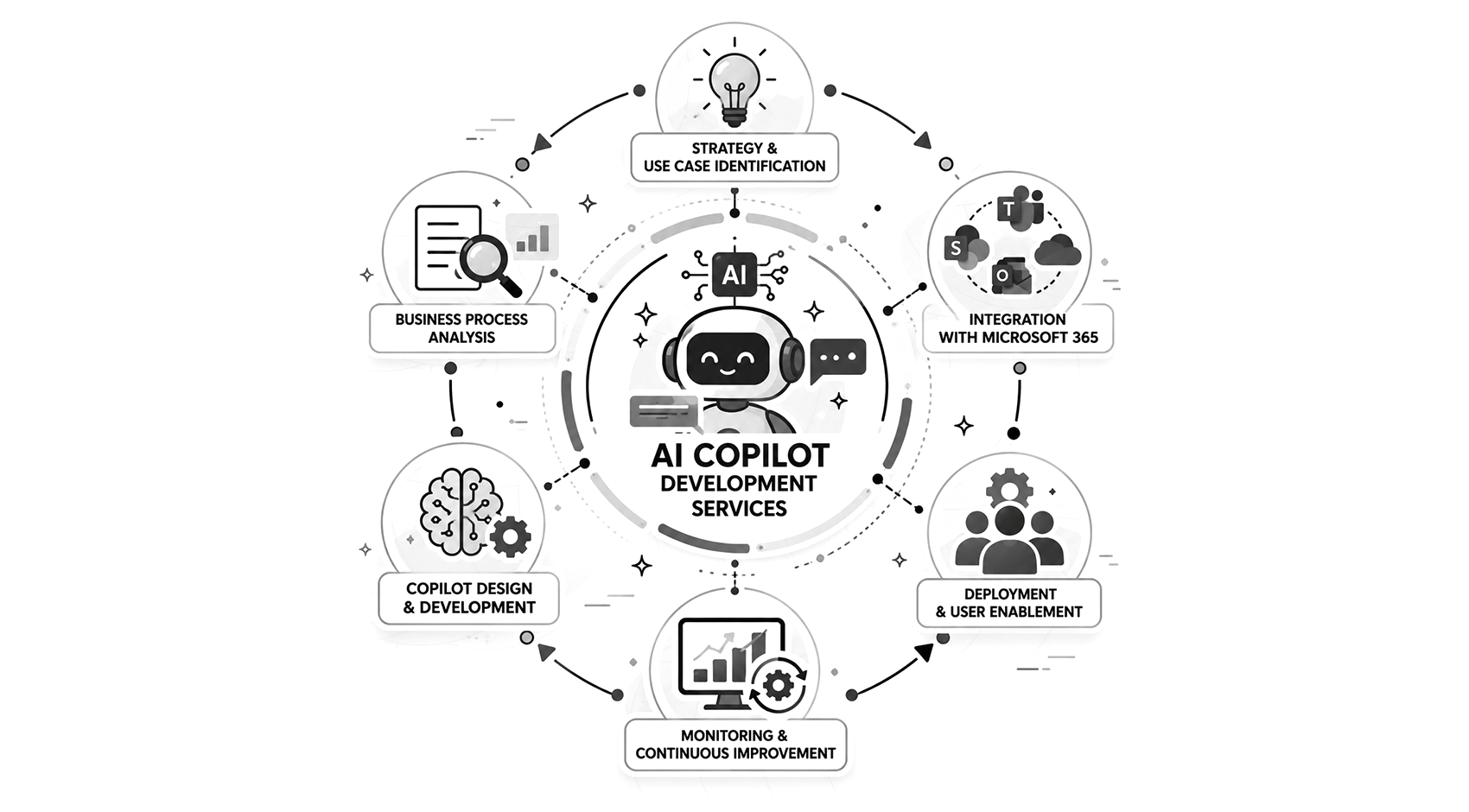
A focused first production copilot often takes 8 to 12 weeks. Data quality, integration scope, and required approvals affect the final schedule. Our 6-stage process makes those dependencies visible before release.

Step 1: Discovery and Copilot Use Case Definition

We define the user, task, workflow, and success measures with your stakeholders. Engineers inspect the systems, data access, exceptions, and approval needs. This establishes a production use case that can be scoped and tested.

Step 2: Knowledge Architecture and Solution Design

We design retrieval, integrations, and permissions before development begins. The design identifies knowledge sources, search choices, connected systems, and allowed actions. It also specifies how citations and approvals should appear to users.

Step 3: Data Preparation and System Integration

Engineers parse content, remove duplicates, and map metadata and permissions. They connect the required systems through available APIs and integration methods. The copilot is placed in Teams, Outlook, or the application where the task occurs.

Step 4: Copilot Development and Orchestration

Developers build the conversation, instructions, and sequence of tool calls. They define context handling, source citations, feedback capture, and approval gates for write actions. Each action has a purpose and an allowed boundary.

Step 5: Testing, Security, and Accuracy Validation

We test expected questions, ambiguous requests, permissions, PII handling, and prompt-injection attempts. Accuracy evaluation checks whether responses faithfully reflect the retrieved sources. System owners and users validate the resulting behavior before release.

Step 6: Deployment, Adoption, and Continuous Optimization

Production release follows your approval and change controls. We document ownership, monitor usage and answer quality, and support user adoption. Real questions and feedback guide subsequent prompt and retrieval improvements.

Industry Recognition

Why Businesses Choose Ansi ByteCode LLP for AI Copilot Development Services

A production copilot needs usable data, system integration, permission controls, and support after launch. Ansi ByteCode LLP combines Microsoft platform experience with enterprise software delivery to address those requirements throughout the project.

Microsoft Solutions Partner

Ansi ByteCode holds Microsoft Solutions Partner designations for Data & AI, Digital & App Innovation (Azure), and Infrastructure (Azure). These credentials reflect assessed Microsoft capabilities relevant to the project.

Copilots Built Inside Your Existing Tenant

For Microsoft-based deployments, we can use Azure OpenAI, Azure AI Search, and Microsoft Entra ID within your Azure environment. This allows security review against existing identity and access requirements.

Experience Beyond Prototypes

Our team has delivered assistants in Teams and Outlook for HR and healthcare communication workflows. Those projects inform decisions about placement, permissions, adoption, and support after release.

Accuracy Evaluated Against Real Questions

We test retrieval quality and whether answers reflect their sources against an agreed question set. Documented results give your team a baseline for review and later improvements.

Permissions Included From the Start

We consider document-level access, PII handling, and audit logging from the initial design. Defining these controls early helps security teams assess retrieval and actions before rollout.

10+ Years in Enterprise Software and Data

Ansi ByteCode brings 10+ years in enterprise software and data. That experience helps address document quality and system access, which often determine whether a copilot works beyond a demo.

Handover of the Copilot and Code

We provide prompts, integrations, evaluation materials, infrastructure code, and documentation as agreed in the contract. This gives your team the information needed to operate and extend the copilot.

Azure OpenAI Service

GPT

Phi

Anthropic Claude

Google Gemini

Llama

Mistral

Azure Machine Learning

Hugging Face Transformers

PyTorch

LangChain

LlamaIndex

Semantic Kernel

Azure AI Foundry

LangGraph

Haystack

Azure AI Search

Pinecone

Weaviate

Qdrant

Chroma

FAISS

pgvector

spaCy

Unstructured.io

NLTK

Azure Data Factory

Azure AI Document Intelligence

Microsoft Fabric

RAGAS

TruLens

LangSmith

Azure AI Evaluation SDK

Phoenix

Azure Kubernetes Service

Azure Container Apps

Azure Functions

Docker

Terraform

GitHub Actions

Microsoft Entra ID

Azure Key Vault

Microsoft Purview

Azure AI Content Safety

Private Endpoints

Case Studies

See how we’ve helped businesses across industries solve real challenges with AI, from strategy and integration to full-scale deployment and measurable results.

What our Clients say About us

Don't just take our word for it. Here's what businesses across the US say about working with Ansi ByteCode LLP as their AI consulting partner.

FAQs About AI Copilot Development Services

These answers cover what a business copilot does, how it differs from an agent, and the practical choices around cost, integration, and security.

AI copilot development services cover planning, building, integrating, testing, and supporting assistants for specific business workflows. A copilot can answer using approved company information and help users complete tasks inside existing applications, subject to permissions and human review.

A copilot typically assists a person within a workflow, while an agent can carry out a defined sequence of actions. The distinction depends on design, not the label: either system may use tools, require approvals, or operate with limited autonomy.

A custom AI copilot may cost $15,000 to $200,000+ to build, depending on its scope. Data preparation, integrations, security, and deployment drive the estimate. Model usage, hosting, licenses, and ongoing support add operating costs.

Extend Microsoft 365 Copilot when users already work in Microsoft applications and the required data and actions fit its extension options. A custom copilot may suit specialized workflows, interfaces, or integrations. Compare permissions, licensing, flexibility, and support needs before deciding.

Often, yes, if the systems offer suitable connectors or APIs. A copilot can retrieve permitted information or perform defined actions across CRM, ERP, ITSM, and document platforms. Each connection needs authentication, access controls, error handling, and testing.

Security starts with identity and permissions applied to retrieved data and allowed actions. Designs may also require encryption, PII controls, content filtering, and audit logs. The exact controls depend on the information involved and your organization’s security requirements.

Our Blogs

Explore our latest insights, guides, and expert perspectives on AI. This will help you stay informed and make smarter business decisions.

What Is Predictive Maintenance? How It Works and Why It Matters

Critical equipment doesn’t fail on schedule. A motor overheats without warning.

Agentic AI vs Generative AI: Which One Is Right Fit for You?

If you’ve been comparing Agentic AI vs Generative AI, you’re probably wondering which one can actually make a bigger difference to your business

Let’s build your dream together.