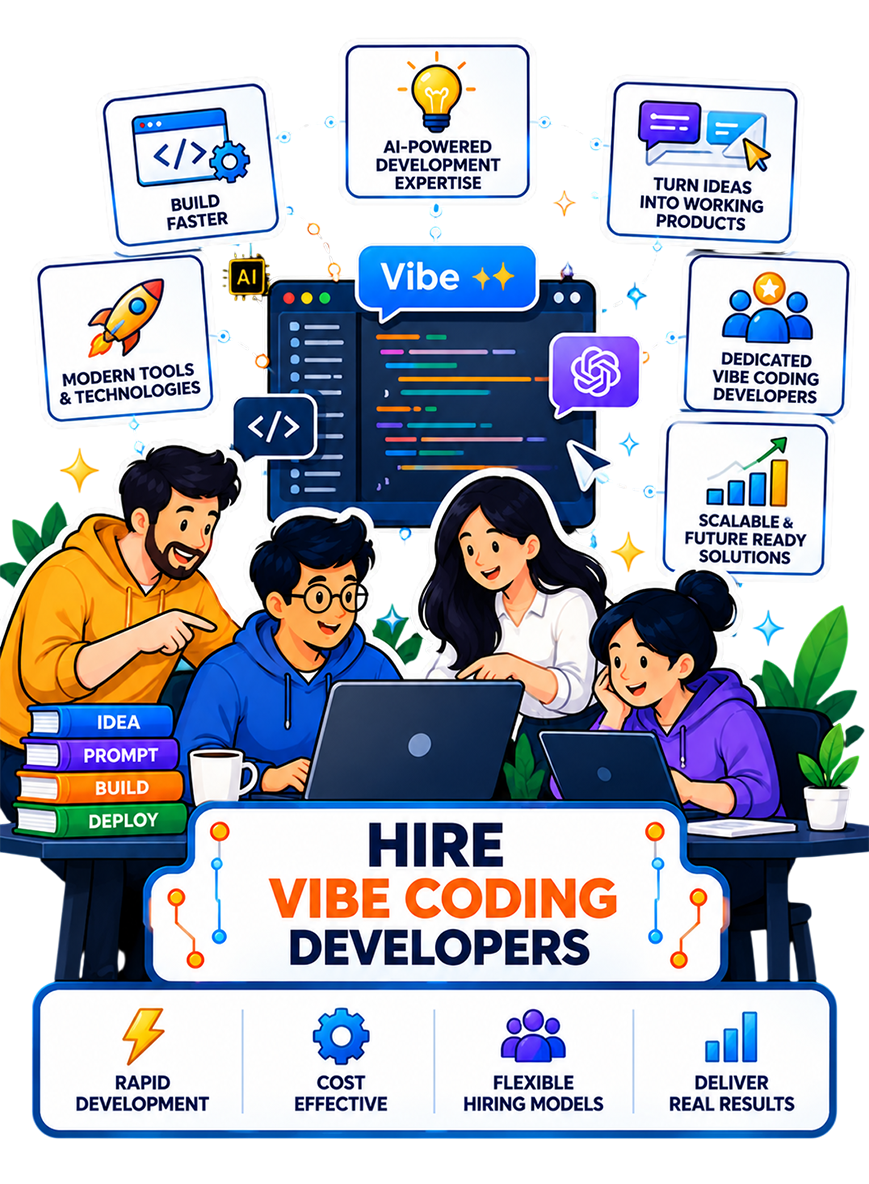
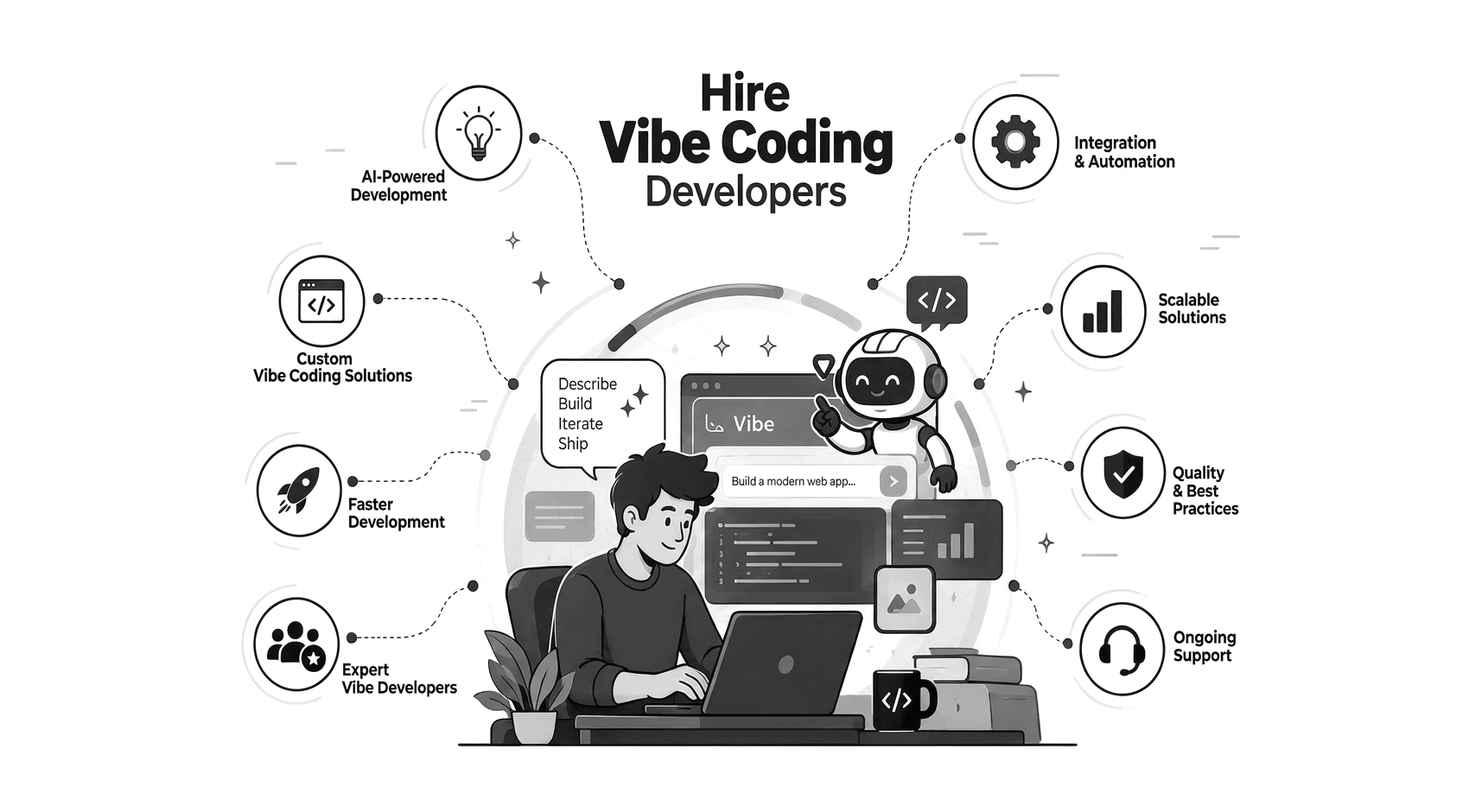
Hire Vibe Coding Developers

Build software with AI-assisted implementation and engineering oversight.
Keep architecture, security, and release decisions in human hands.

Your AI-built app works perfectly until real users start testing its limits. A workflow breaks, a security gap appears, or generated code fails to handle an important business rule. Suddenly, the speed of building no longer matters as much as the quality of the software. 

When you hire vibe coding developers from Ansi ByteCode LLP, engineers guide the tools and review their output. We design the architecture, test critical workflows, and assess generated code before release. We are a Microsoft Solutions Partner in Data & AI, Digital & App Innovation (Azure), and Infrastructure (Azure).
+
Years in AI & Software Development
+
AI & Software Projects Delivered
+
Certified AI & Technology Experts
%
Client Retention Rate

Vibe Coding Services Our Developers Deliver

Different projects call for different levels of AI assistance. We identify where it speeds up delivery, then apply engineering review where decisions carry greater risk.

Vibe Coding Consulting

AI tools are not equally useful across every codebase or workflow. We review your application stack, development process, and business requirements before recommending an approach. You receive a written plan showing where AI-assisted development saves time, where engineers should work directly, and which safeguards the project needs.

MVP and Prototype Development

A product idea needs working software before users can evaluate it. We use AI tools to speed up development, while engineers shape the application and review its code. You receive a testable MVP with extendable source code, so early validation can inform further development rather than require a rebuild.

AI-Assisted Web App Development

Generated features become difficult to maintain without a coherent design. Senior engineers define the architecture, database structure, and application behavior before development expands. Our developers use AI tools to build features, test key paths, and assess performance as traffic grows. The result is a production application your team can continue developing.

Internal Tool Development

Spreadsheets and manual handoffs can obscure the status of operational work. We build dashboards, admin panels, and back-office tools that put those processes in one place. For a client, we built an AI-powered accounting automation solution that replaced manual invoice matching with exception dashboards and approval workflows, cutting month-end close from seven days to two.

API Development and Integration

Applications need dependable ways to exchange data with existing systems and third-party services. We build authenticated REST or GraphQL APIs and connect them to the tools your teams already use. Access controls protect sensitive information, while validation, error handling, and monitoring help identify failed requests before they interrupt business workflows.

AI Agent Development

An AI agent needs boundaries before it can act across business systems. We build agents that plan tasks, call approved tools or internal APIs, and complete multistep workflows. Engineers define permissions, review decision points, and add checks for actions that need human approval. That keeps the agent useful and accountable.

Legacy Code Modernization

Older applications often contain business rules that documentation misses. Context-aware AI tools can help engineers trace existing logic and refactor or translate it into modern frameworks. Our developers validate each change against current behavior and tests, so modernization does not quietly break a process people still depend on.

Code Review and Hardening

Already have a prototype built with AI? We review its code, dependencies, architecture, security, and database queries to identify what needs work before launch. Our engineers fix priority issues and add appropriate tests and deployment checks. You get a clearer path from promising prototype to software your team can maintain.

Maintenance and Support

Software needs attention after its first release. We monitor performance, fix defects, update dependencies, and adapt features as business requirements change. Agreed support terms define responsibilities and response expectations. Ongoing engineering helps the application remain useful as users, integrations, and workloads grow beyond the original prototype.

The Vibe Coding Stack Our Developers Use

Our developers choose AI tools and frameworks based on your codebase, delivery needs, and deployment environment. Engineers remain responsible for the resulting software.

Claude Code

Gemini CLI

Phi

Anthropic Claude

Google Gemini

Llama

Mistral

Claude

Hugging Face Transformers

PyTorch

Angluar Logo

Angular

ReactJS Logo

React

TypeScript

Azure AI Foundry

LangGraph

Haystack

.Net Core Logo

.NET / ASP.NET Core Web API

MS SQL

PostgreSQL

MongoDB

Chroma

FAISS

pgvector

Azure

Unstructured.io

NLTK

Azure Data Factory

Azure AI Document Intelligence

Microsoft Fabric

RAGAS

TruLens

LangSmith

Azure AI Evaluation SDK

Phoenix

How to Hire Vibe Coding Developers from Ansi ByteCode LLP

Hiring a developer should make technical fit and working expectations clear before work begins. We review your requirements, introduce suitable engineers, and agree on how the team will collaborate, deliver, and support the project.

Step 1: Define Project Requirements

Share the features, existing systems, preferred technologies, timeline, and skills your project needs. Our technical team reviews the scope and identifies where AI-assisted development can help, along with decisions requiring direct engineering work.

Step 2: Get Matched With Developers

We match your project specifications against our in-house engineering team, identifying developers with relevant domain and technical experience. You receive curated candidate profiles within 48 hours for your internal review.

Step 3: Review Profiles and Portfolios

Review each developer’s background, relevant projects, and available work samples. Look for experience with your stack, architecture needs, and integration challenges, then identify the candidates whose approach you want to discuss further.

Step 4: Interview Developers

Speak directly with shortlisted developers about architecture, coding decisions, review practices, and communication. The interview helps both teams test technical fit and clarify how the developer would work within your existing process.

Step 5: Select an Engagement Model

Choose a dedicated team, staff augmentation, or a fixed-price project based on your scope. We agree on who manages delivery, how work is reviewed, and what each team is responsible for before starting.

Step 6: Onboard and Begin Work

We arrange access, repository permissions, confidentiality paperwork, and working routines. Once the developer understands your priorities and review process, the team can begin delivery against agreed milestones and communication expectations.

Select the Right Engagement Model to Hire Vibe Coders

Choose an engagement model based on your project scope and internal capacity. The main difference is how the developers join your team and how delivery is managed.

Dedicated Team

A dedicated team of developers works on your product backlog over a sustained engagement. This model supports continuity when features share architecture, business rules, and integrations across several delivery cycles.

Staff Augmentation

Add a developer to your existing engineering team when you need more capacity. Your team sets priorities and retains its established management, code review, and release process.

Fixed-Price Projects

A defined application or prototype can be delivered against agreed scope, milestones, and acceptance criteria. This model works best when requirements are clear enough to estimate and manage changes.

Hire Vibe Coders for Your Next Project

Have a project in mind? Hire vibe coding developers who can help turn your ideas into functional software.

Industries We Serve

Applications must reflect the data, integrations, and operating constraints of their industry. These examples show where our developers can apply AI-assisted delivery under engineering review.

Healthcare

We build patient communication portals, scheduling tools, and diagnostic workflow dashboards. Access controls and data handling are designed around applicable healthcare privacy requirements and existing clinical systems.

EdTech

We develop learning platforms, grading utilities, and student assessment tools. Architecture accounts for concurrent users, educator workflows, and the need to protect student information across connected systems.

Fintech and Banking

We build reporting portals, loan workflows, and reconciliation tools. Transaction logs, audit trails, and access controls support review of sensitive financial activity and data exchanged between systems.

Retail and E-Commerce

We develop inventory synchronization, supplier portals, and multichannel checkout tools. Integrations help teams keep stock and order information consistent across storefronts, warehouses, and other business systems.

Manufacturing

We build plant-floor dashboards, equipment tracking tools, and maintenance scheduling tools. These applications bring current operational data to production teams and help them coordinate work across shifts.

Logistics and Supply Chain

We develop shipment portals, dispatch systems, and invoice verification tools. Shared records help warehouse teams, carriers, and customers track status and resolve exceptions across operational handoffs.

Industry Recognition

Benefits of Hiring Vibe Coders from Ansi ByteCode LLP

The value of AI-assisted development depends on the engineering around it. Our developers use these tools to move faster, while people remain responsible for code quality, delivery decisions, and support after launch.

Faster Time to Market

AI tools can shorten implementation work and help teams test a prototype sooner. Engineers review the result before release, so speed does not leave your team with unusable code.

Reviewed Code

Every AI-assisted change passes review by a senior engineer before it is merged. We check business logic, dependencies, security-sensitive behavior, and architectural fit. Testing then confirms that critical workflows behave as expected in the application.

Microsoft Solutions Partner Expertise

Our Microsoft Solutions Partner designations cover Data & AI, Digital & App Innovation (Azure), and Infrastructure (Azure). We bring relevant Azure and application expertise when your software must integrate with Microsoft systems.

Full Intellectual Property Ownership

You own everything we deliver: custom code, architecture, and documentation, including code generated with AI tools under our supervision. Ownership transfers under your contract, and open-source components keep their own licenses.
Flexible Team Capacity

Start with one developer, then add specialists as the project grows. You can adjust capacity between delivery cycles according to your backlog, milestones, and available budget.

Ongoing Support and Optimization

Development continues beyond the first release. Monitoring, fixes, updates, and refactoring help the application adapt as usage grows, rather than leaving the team with a prototype nobody can maintain.

Case Studies

See how we’ve helped businesses across industries solve real challenges with AI, from strategy and integration to full-scale deployment and measurable results.

What our Clients say About us

Don't just take our word for it. Here's what businesses across the US say about working with Ansi ByteCode LLP as their AI consulting partner.

FAQs About Hiring Vibe Coding Developers

These answers explain how AI-assisted development works, what developers remain responsible for, and what to consider when planning a project or hiring a team.

Vibe coding uses AI tools to generate or revise code from written instructions. A developer still needs to define requirements, check the output, and test the application. For production software, generated code needs the same engineering review as other code.

A vibe coding developer directs AI tools during implementation and takes responsibility for the result. They make architecture decisions, inspect generated code, fix errors, review dependencies, and test important workflows before changes become part of the application.

Vibe coding developers use AI-assisted tools to accelerate repetitive implementation, validate ideas faster, and streamline development. They combine these tools with software development expertise to build solutions that meet your product requirements, security standards, and long-term maintenance needs.

Agency pricing depends on project complexity, required expertise, and engagement scope. A simple prototype typically costs $3,000–8,000 and takes 2–3 weeks. A standard MVP with multiple features and integrations can cost $5,000–15,000 and take 3–5 weeks. Complex MVPs may cost $12,000–30,000 and take 5–8 weeks.

Dedicated developer and team augmentation engagements typically follow monthly pricing. Your final estimate depends on developer allocation, integrations, testing, security, and deployment requirements.

Developers may use assistants such as Cursor, Claude Code, GitHub Copilot, or Windsurf. The choice depends on the codebase, data policies, and team workflow. Building the application also requires suitable frameworks, databases, testing tools, and deployment infrastructure.

They can build MVPs, web applications, internal tools, administration panels, integrations, and AI agents. Suitability depends on the systems involved and the consequences of an error. Complex or sensitive features need more design, testing, and human oversight.

You can review vetted candidate profiles within 48 hours of sharing your technical requirements. Following your interview and selection, we complete onboarding and begin project execution within three to five business days.

Our Blogs

Explore our latest insights, guides, and expert perspectives on AI. This will help you stay informed and make smarter business decisions.

What Is Predictive Maintenance? How It Works and Why It Matters

Critical equipment doesn’t fail on schedule. A motor overheats without warning.

Agentic AI vs Generative AI: Which One Is Right Fit for You?

If you’ve been comparing Agentic AI vs Generative AI, you’re probably wondering which one can actually make a bigger difference to your business

Let’s build your dream together.