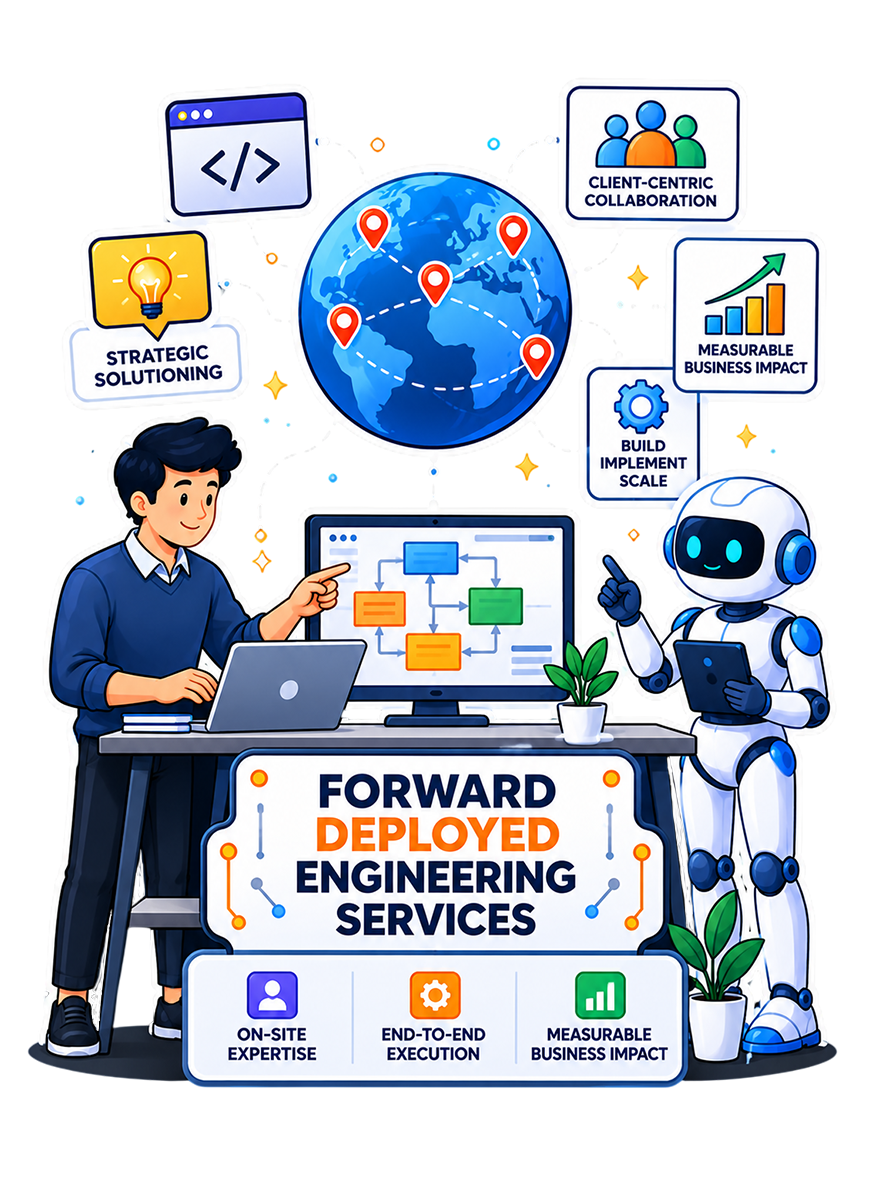
Forward-Deployed Engineering Services

Turn complex AI, integration, and modernization initiatives into production systems
with embedded, outcome-led forward-deployed engineering services.

Many promising AI and modernization pilots demonstrate value but fail to reach day-to-day operations. Unresolved data access, security, workflow, integration, and ownership requirements often block the final move into production.

Ansi ByteCode LLP provides forward-deployed engineering services that embed senior engineers alongside users and technical teams to resolve these last-mile barriers. With 12+ years of experience in enterprise software development, Ansi ByteCode takes complex initiatives through engineering, integration, production release, and handover.
+
Years in AI & Software Development
+
AI & Software Projects Delivered
+
Certified AI & Technology Experts
%
Client Retention Rate

What is Forward-Deployed Engineering?

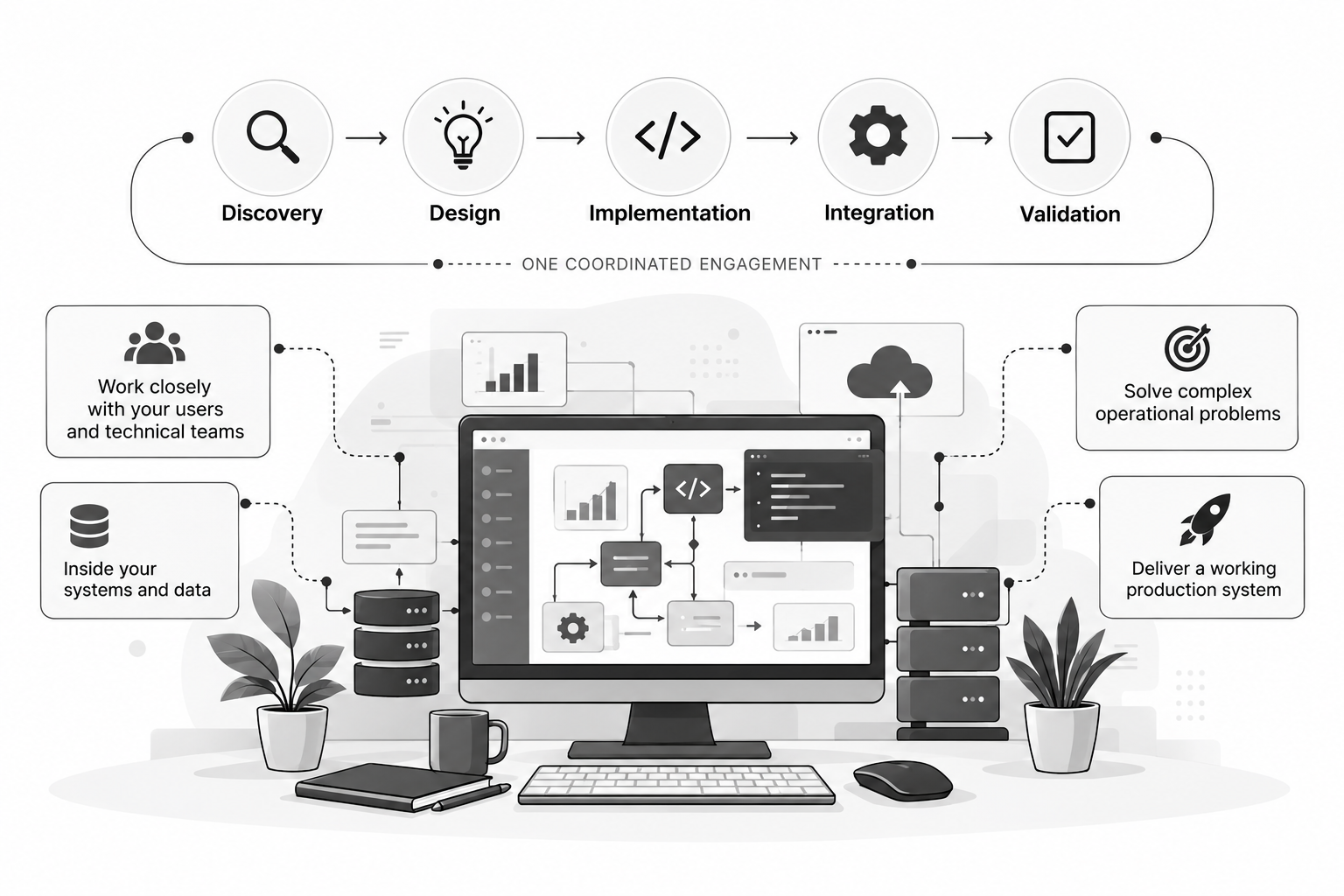
Forward-deployed engineering (FDE) is a delivery model in which experienced engineers work closely with a client’s users and technical teams, inside its systems and data, to take a complex operational problem through to a working production system.

Discovery, design, implementation, integration, and validation take place within one coordinated engagement rather than across disconnected handoffs. Engineers stay involved as technical and operational constraints surface, then support production release and knowledge transfer. The model combines customer-facing problem discovery with hands-on engineering, continuous iteration, and shared accountability for a production outcome.

Forward-Deployed Engineering Services to Solve Complex Challenges

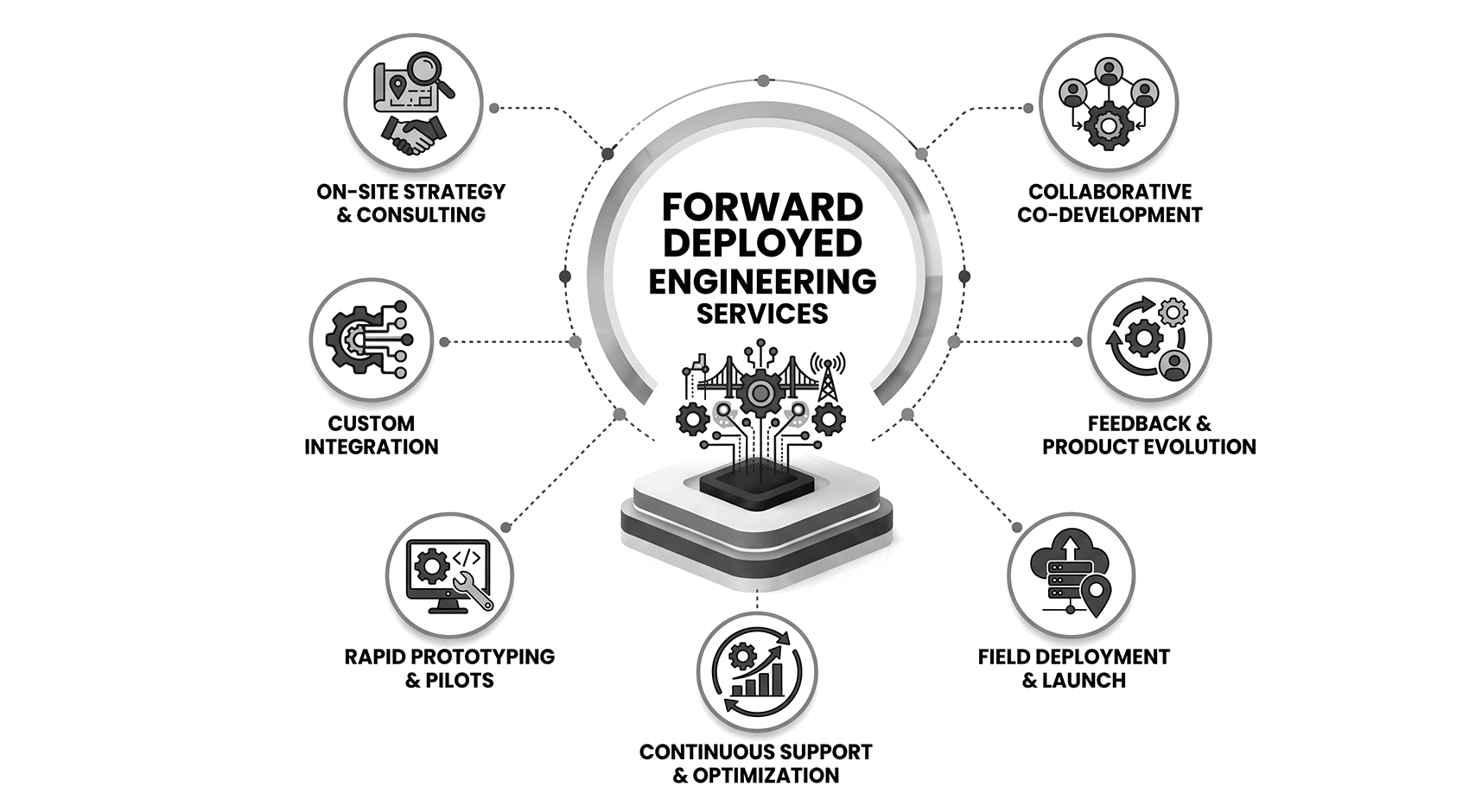
Our forward-deployed engineering services connect discovery, prototype validation, integration, production deployment, adoption, and handover through one coordinated delivery model.

Embedded Forward-Deployed Engineering Teams

Our senior engineers bring specialist skills directly into your team. Their expertise spans the technologies and systems your project requires. They work with your developers to build features and troubleshoot. That support continues through testing and release, expanding delivery capacity.

AI Pilot to Production Delivery

Our forward-deployed AI engineering services prepare pilots for production. Engineers check accuracy, safety, speed, cost, and access permissions. They add monitoring and error handling to support reliable operation. Release planning defines deployment steps and assigns ongoing support responsibilities.

Agentic System and Copilot Deployment

We design, integrate, and deploy agents and copilots that support defined business workflows. The work covers tool and action design, permission boundaries, human review, escalation paths, confidence thresholds, monitoring, and approved system integration. Depending on the use case, the capability can be integrated into Microsoft Teams, internal applications, or purpose-built interfaces.

Enterprise Knowledge and Retrieval System Integration

We connect AI applications to approved enterprise documents, records, and knowledge sources. We handle source ingestion, chunking, indexing, permission-aware retrieval, grounding, traceability, and answer-quality checks based on representative business questions. The retrieval capability respects access controls so users see information aligned with their existing permissions.

Systems and Data Integration Engineering

Our engineers build integrations that connect your systems and data. This includes ERP, CRM, and line-of-business applications. We define integration requirements with system owners before development begins. Early checks identify access needs, dependencies, and delivery risks. The build uses APIs, connectors, on-premises as well as cloud gateways, data factory, and data pipelines. Event-driven integrations support workflows that respond to system changes.

Platform Engineering and Deployment Enablement

We define the technical foundation needed to deploy, operate, and scale the solution. Scope may include cloud infrastructure, CI/CD pipelines, environment promotion, secrets management, monitoring, alerting, reliability practices, and usage or cost controls. The architecture fits your environment, security model, and operating requirements.

Custom Application and Workflow Development

Users need a practical way to use the new capability during daily work. We build modern web applications, Power Platform apps, workflow automation, internal portals, Microsoft Teams apps, or features inside existing systems. Placing the capability inside familiar workflows can improve adoption and reduce tool switching.

Adoption, Enablement and Knowledge Transfer

Knowledge transfer starts during delivery rather than waiting until the final handover. Our engineers pair with internal teams, explain architecture and design decisions, and provide hands-on enablement. This gives the people inheriting the solution practical knowledge of how it works and how it can be extended.

Post-Deployment Support and Capability Handover

After release, we stabilize the solution, resolve early operational issues, and transition responsibilities under the agreed support plan. Clear runbooks, escalation paths, access handover, and optional ongoing support help your internal team take control without creating avoidable long-term vendor dependency.

Bring Engineering Into Your Team

Add experienced engineers directly to your team to solve integration challenges and deliver production-ready solutions.

Industries We Serve

FDE works well when systems, data access, regulatory expectations, and daily workflows shape how a solution must be designed, approved, and released.

Healthcare and Life Sciences

We support teams operating in HIPAA-regulated environments, where data access, privacy, auditability, security, and clinical workflows shape solution design from the beginning.

Finance and Banking

We work within financial environments that require controlled change processes, clear traceability, strict access management, and defined separation of duties.

Insurance

We help connect new applications and AI capabilities to the legacy platforms and business rules behind claims, underwriting, and policy administration.

Manufacturing

We build solutions linking plant systems, ERP platforms, and supply chain data, while accounting for device connectivity and infrastructure differences across sites.

Retail and Ecommerce

We integrate order management, inventory, customer, and fulfillment systems while supporting performance during peak demand periods and tightly controlled release windows.

Logistics and Supply Chain

We connect transport, warehouse, and planning platforms, giving operations teams the data they need for routing, dispatch, and inventory decisions.

Forward-Deployed Engineering vs. Traditional Consulting: What Sets the FDE Model Apart

Traditional advisory consulting helps define direction, architecture, or modernization priorities. Forward-deployed engineering fits when you need close, hands-on engineering through discovery, implementation, and production release.

Criteria Traditional Advisory Consulting Forward-Deployed Engineering
Primary Purpose Define strategy, architecture, priorities, or a modernization roadmap Solve and deploy a defined but technically complex business capability
Typical Outcome Recommendations, designs, a roadmap, or other agreed consulting deliverables An integrated production capability, supporting documentation, and knowledge transfer
Working Model Analysis, stakeholder consultation, workshops, and structured project delivery Engineers work closely with users, technical teams, and operational stakeholders throughout delivery
Handling Uncertainty Investigated and incorporated into the consulting scope and recommendations Addressed through discovery, implementation feedback, and iterative engineering
Integration and Data Access Requirements and dependencies are identified as part of the advisory or design scope Integration and access constraints are tested and addressed during hands-on delivery
Client Involvement Stakeholders provide information, review recommendations, and approve direction Client teams participate in decisions, reviews, validation, and capability transfer
When the Model Fits The organization needs strategic direction, specialist advice, or an implementation roadmap The organization needs a complex solution taken through implementation, integration, and production release

The Value of Our Forward-Deployed Engineering Team

Close collaboration, early technical validation, and continuity from discovery to release can reduce avoidable delays while keeping the solution tied to business use.

From Recommendation to a Working System

The engagement continues past problem definition and architecture into implementation, integration, and deployment. The goal is an operational capability your team uses, within the scope agreed at the start.

Shorter Path From Pilot to Production

Continuity across discovery, engineering, and deployment reduces handoffs and rework. Security, data, access, and operating needs are considered as the solution develops.

Integration Risk Identified Early

Environment, data, access, and dependency reviews happen early. This helps teams address integration concerns before design decisions become difficult or expensive to change.

Internal Teams Prepared to Extend the Build

Pairing, documentation, clear design decisions, and hands-on enablement help your team understand, operate, and extend the delivered capability under the agreed support model.

Fewer Handoffs Between Discovery and Delivery

Engineers who help define the problem stay involved in design, build, and validation. Context is retained as requirements and constraints become clearer.

A Clear Handover and Support Model

Responsibilities, documentation, operating procedures, intellectual property terms, and support needs are defined during the engagement. This reduces unnecessary dependency while allowing continued support when useful.

Our Forward-Deployed Engineering Process

Our structured process keeps the engagement focused while allowing the solution to evolve as technical and operational requirements become clearer. Each step supports collaboration, measurable outcomes, controlled access, and production readiness.

Step 1: Define the Problem and Success Criteria

We start by defining the business problem, intended users, operating workflow, and measurable success criteria. The discussion stays focused on the outcome you need, not a predetermined technology choice or tool.

Step 2: Environment, Data and Access Assessment

We map relevant systems, data sources, integration dependencies, access controls, security requirements, and approval processes. We also identify system owners and client stakeholders needed to keep delivery decisions moving at the right pace.

Step 3: Embed the Team and Establish the Working Agreement

The forward-deployed engineering team starts working with your product, engineering, security, operations, and business stakeholders. We define communication channels, cadence, responsibilities, decision authority, review processes, and release approvals before delivery moves forward.

Step 4: Build and Iterate Within the Client Environment

We build and test the solution against approved systems, representative data, and real business scenarios. Users and technical stakeholders provide ongoing feedback, so the design can adapt as constraints appear.

Step 5: Integration, Validation and Security Review

We test integrations, functional behavior, performance, access rules, security controls, and operational readiness. The goal is to validate the system against the operating conditions it is expected to face in production.

Step 6: Production Release, Adoption and Knowledge Transfer

We support controlled production release, stabilization, user adoption, documentation, runbooks, training, and transition into the agreed support model. The handover approach reflects your internal capability and any ongoing support needs.

Industry Recognition

Why Leading Businesses Trust
Ansi ByteCode LLP for
Forward-Deployed Engineering

An FDE provider often works closely with business-critical systems, proprietary data, and internal teams. Ansi ByteCode LLP brings Microsoft platform expertise, enterprise engineering experience, and a cross-functional delivery model to each engagement.

Microsoft Solutions Partner Capabilities

We hold Microsoft Solutions Partner credentials in Data & AI, Digital & App Innovation (Azure), and Infrastructure (Azure). This expertise guides how we build and deploy solutions.

Senior Engineers Involved From Discovery to Release

Experienced engineers stay involved from problem discovery through technical decisions, build, and release support. This preserves important technical and business context as the solution moves from discovery into implementation and release.

Full-Stack Delivery Across AI, Cloud and Applications

Our team can combine AI, data, cloud infrastructure, integration, and application engineering when the solution needs it. Scope stays aligned with the client environment and project goals.

Built Around Enterprise Constraints

Security, access controls, auditability, change management, dependencies, and operating needs shape design decisions from the start. Model quality and enterprise readiness are treated together.

Knowledge Transfer and a Defined Handover

We prepare documentation, runbooks, technical enablement, operational transition, and support responsibilities. The goal is usable knowledge and control, with optional ongoing support when needed.

12+ Years in Enterprise Software and Data

With 12+ years in enterprise software and data engineering and 250+ delivered projects, our team spots integration, security, and operational constraints earlier in delivery.

Forward-Deployed Engineering Technology Stack

The technology stack must fit your architecture, security requirements, internal capabilities, and long-term operating model. These are representative technologies used across our delivery work.

Azure OpenAI

OpenAI API

Anthropic Claude

LangChain

LangChain

Semantic Kernel

Hugging Face

PyTorch

TensorFlow

scikit-learn

Azure SQL Database

Azure Data Lake Storage

Microsoft Fabric

Dataverse

PostgreSQL

MongoDB

Snowflake

Azure AI Search

Pinecone

Azure Logo

Microsoft Azure

Docker

Kubernetes

Terraform

Azure Functions

Azure Container Apps

REST and OData APIs

Azure API Management

Azure Logic Apps

standard and custom connectors

on-premises data gateway

.Net Core Logo

.NET

C#

Python

TypeScript

ReactJS Logo

React

Angluar Logo

Angular

Power Apps

Power Automate

Microsoft Teams

Azure DevOps

GitHub Actions

MLflow

MLflow

Microsoft Entra ID

Azure Key Vault

Microsoft Purview

Conditional Access

Case Studies

See how we’ve helped businesses across industries solve real challenges with AI, from strategy and integration to full-scale deployment and measurable results.

What our Clients say About us

Don't just take our word for it. Here's what businesses across the US say about working with Ansi ByteCode LLP as their AI consulting partner.

FAQs About Forward-Deployed Engineering Services

These FAQs answer practical questions buyers ask before choosing an FDE engagement, including delivery model, team collaboration, ownership, and suitable use cases.

Forward-deployed engineering (FDE) brings experienced engineers into your working environment to solve specific business problems. They work directly with your users and technical teams, using your systems and data to build and integrate solutions. They support the process from defining requirements to release and handover.

Traditional consulting usually helps define strategy, architecture, or a roadmap. Forward-deployed engineering stays closer to delivery. Engineers continue through discovery, build, integration, validation, and production release when the problem needs hands-on technical execution.

Yes. Forward-deployed engineers can work with your internal developers, product owners, security teams, system owners, and business users. The collaboration can include shared tools, agreed workflows, technical reviews, documentation, and knowledge transfer.

Your organization keeps control of its data and environments. Your agreement assigns custom code and deliverables before work starts, so ownership is settled up front. After release, we hand over under the support model you chose.


No. AI is a common use case, especially when pilots need production controls. The same model also fits modernization, data integration, workflow automation, enterprise application delivery, platform engineering, and complex system integration work.

An FDE engagement usually starts with focused discovery and an assessment of your environment. The team then builds, integrates, and releases the solution in short cycles, refining it through feedback. The duration and team structure depend on project complexity, system access, security reviews, integration requirements, and target outcomes.

Our Blogs

Explore our latest insights, guides, and expert perspectives on AI. This will help you stay informed and make smarter business decisions.

What Is Predictive Maintenance? How It Works and Why It Matters

Critical equipment doesn’t fail on schedule. A motor overheats without warning.

Agentic AI vs Generative AI: Which One Is Right Fit for You?

If you’ve been comparing Agentic AI vs Generative AI, you’re probably wondering which one can actually make a bigger difference to your business

Let’s build your dream together.