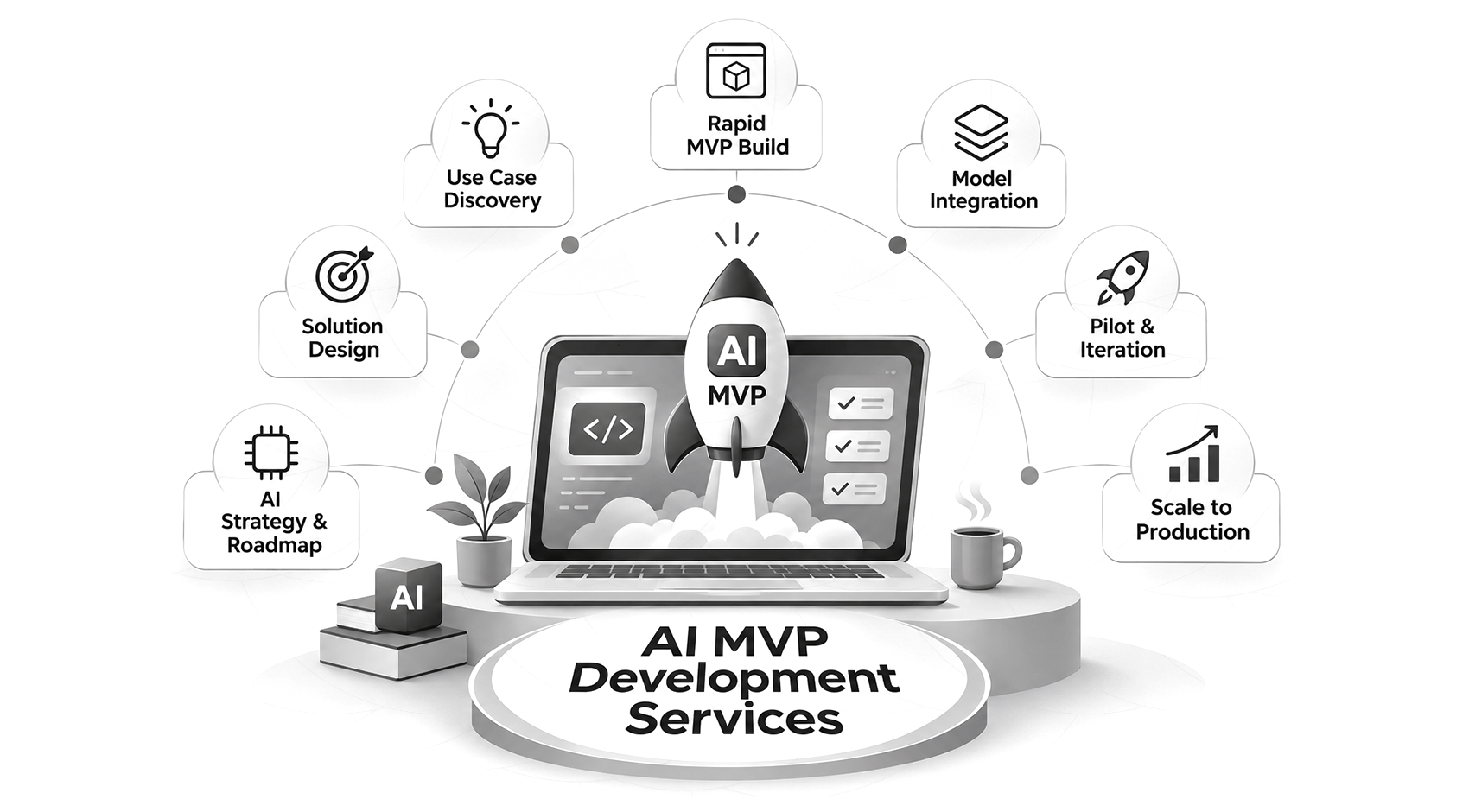
AI MVP Development Services

Test your AI idea against real data, real users, and
measurable performance before full development.

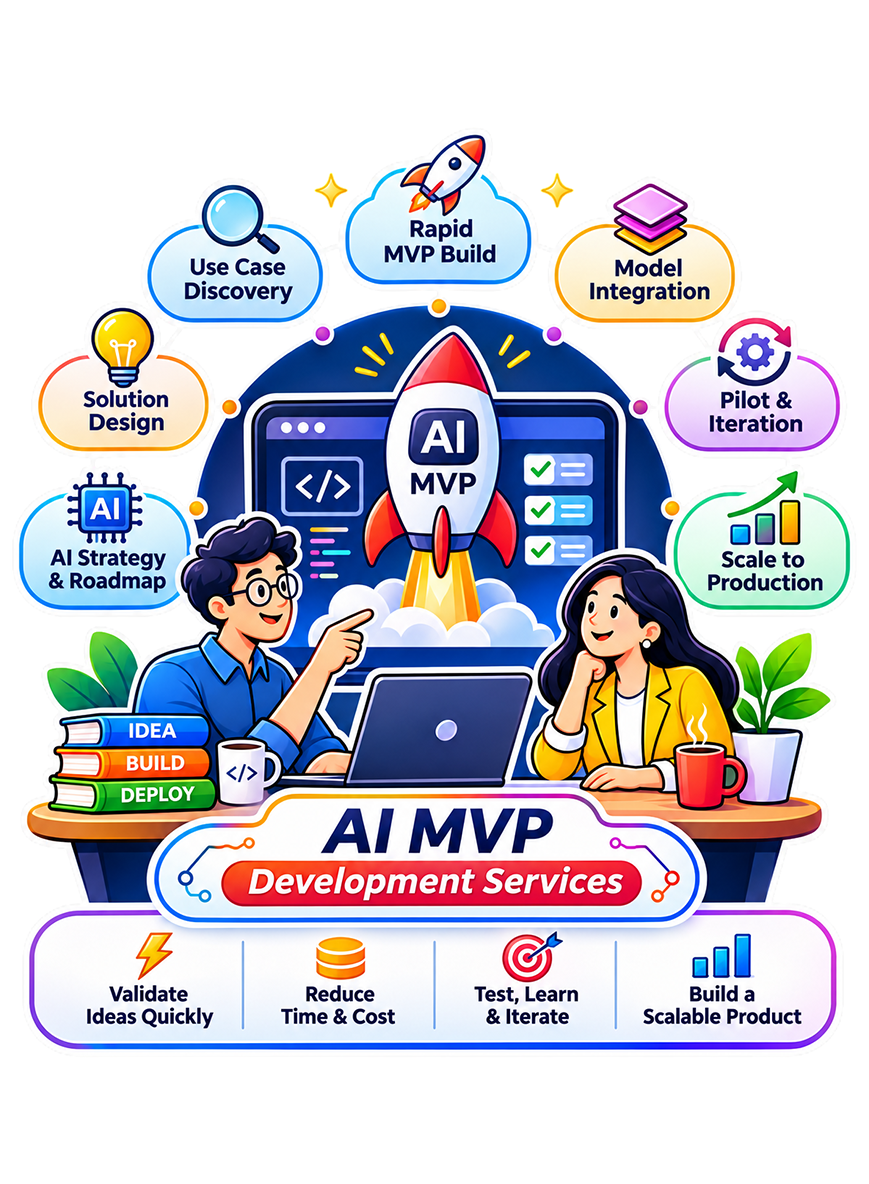
An AI MVP is a working, testable version of an AI-powered product. It tests demand and whether the AI meets agreed performance thresholds on real data before a full build begins.

AI pilots can look convincing in demos but fail on messy data, integration constraints, or unclear economics. Ansi ByteCode LLP provides AI MVP development services that test those assumptions early and turn viable ideas into products users can evaluate.

+
Years in AI & Software Development
+
AI & Software Projects Delivered
+
Certified AI & Technology Experts
%
Client Retention Rate

AI MVP vs. Traditional MVP: What Makes the Difference?

AI MVPs must prove product demand and technical feasibility together. That changes what teams validate before committing to a larger product build.

Validate the AI Approach Early

A traditional MVP mainly tests whether users want the product. An AI MVP must also assess data quality, model fit, and output performance before larger engineering decisions make the approach expensive to change.

Build for Real-World AI Performance

Models can perform well on curated examples and fail when inputs become incomplete, inconsistent, or unfamiliar. Testing production-like data exposes weak retrieval, classification, extraction, or prediction behavior before those issues reach a wider user base.

Plan for Sustainable Growth

Model calls, vector search, storage, compute, monitoring, and integration choices affect operating cost as usage grows. Estimating those costs early helps teams decide whether the economics support further development or require a different architecture.

Our AI MVP Development Services

Reduce guesswork before committing to a larger AI project. We help you build and test a focused MVP to understand what works and what needs improvement.

AI Feasibility Assessment and MVP Planning

We review the use case, available data, success criteria, integration constraints, and model options before development starts. Azure OpenAI, Claude, open-weight, or custom models are assessed against the task. The MVP plan then defines what must be proved before more budget is committed.

Rapid AI Prototyping

We build a focused prototype around the core AI interaction, such as chat, search, extraction, recommendation, or prediction. Engineers test the behavior with representative inputs, expose obvious technical limits, and gather enough evidence to decide whether full MVP engineering should proceed.

Model, Data, and System Integration

We select models by accuracy, latency, and cost per interaction. We connect the selected model to production-like data and systems such as CRM, ERP, SharePoint, APIs, or internal databases, then test latency, permissions, data flow, and failure behavior.

AI MVP Application Development

A usable MVP needs more than a model endpoint. We build the interface, application logic, authentication, user workflows, and required system integrations around the AI capability. Real users can then complete the intended task and provide meaningful, actionable product feedback.

Evaluation, Testing, and Guardrails

We build a test set from your real data and measure output quality, task completion, latency, and cost per use against it. Sensitive flows get thresholds, fallbacks, and human review. This is the step that turns ‘it worked in the demo’ into a number you can trust.

Deployment and Post-MVP Support

Once the MVP meets the agreed criteria, we deploy it into a secure Azure environment in your own tenant or on your intranet to ensure your security parameters are maintained. Our team also ensures monitoring, logging, and documentation are in place, so your data never leaves your control. Post-MVP planning then covers integrations, usage, infrastructure costs, and the path to full product development.

Validate Your AI Idea With a Custom MVP

Build a focused AI MVP that helps you test real-world performance, understand user needs, and make informed product decisions.

Industries We Serve

AI MVP priorities change with the data, workflows, and controls used in each sector. We scope validation around those operating conditions before wider investment.

Healthcare

Clinical documentation, workflow assistant, and patient communication MVPs, built with HIPAA-aware access controls and human review so you can prove value before a wider rollout.

Finance and Banking

Fraud detection, KYC document review, and research assistant MVPs are tested against representative transaction and policy data, with accuracy, exceptions, and reviewer oversight assessed before scaling.

Insurance

An MVP tests claims triage or policy interpretation against representative documents, exceptions, and adjuster notes, showing where results are useful and where human review remains necessary.

Retail and Ecommerce

Search, recommendation, and support MVPs are tested against product, order, return, and customer data, helping teams assess usefulness before expanding across more channels or traffic.

Manufacturing

We test maintenance and knowledge MVPs against equipment manuals, SOPs, and operational records to assess retrieval or prediction performance before wider deployment in real working conditions.

Logistics and Supply Chain

Operational assistant and predictive MVPs are tested against shipment and carrier records, including exceptions, before the capability expands across additional routes, sites, or fleet operations.

AI MVP Solutions for Startups and Enterprises

The types of AI MVPs we build address specific business problems, test AI performance with realistic inputs, and provide foundations for future product development.

AI Chatbot MVP Development

We build focused chatbots for customer support, internal knowledge, or sales. Where needed, answers are grounded in approved documents. We measure response quality and user demand before expanding the chatbot’s capabilities.
AI Document Processing MVP Development

Invoices, contracts, and reports rarely follow one clean format. We build document-processing MVPs that extract, classify, summarize, or organize their contents, then run real documents through them. The results help identify where accuracy holds and where exceptions need another approach.

AI Agent MVP Development

Before expanding an agentic system, prove that one agent can complete one job consistently. We build agents for focused tasks such as resolving requests, finding information, or triggering workflow actions, then evaluate completion rates, failures, and required human intervention.

Predictive Analytics and Recommendation MVP Development

Historical data can show whether a predictive idea has enough signal to justify further investment. We develop MVPs for demand forecasting, churn prediction, and product recommendations, then compare predictions with known outcomes to show whether the model is accurate enough to justify expansion.

Computer Vision MVP Development

Lighting, camera quality, viewing angles, and image variation can change computer vision results. We use operating inputs to evaluate quality inspection, object detection, or visual classification use cases, identifying accuracy limits before engineering a wider image or video processing pipeline.

SaaS MVP Development

For an AI-enabled SaaS idea, the model is only one part of the product. We build enough of the application, user access, workflow, APIs, and AI features to test usage, technical behavior, and operating costs before expanding the product scope.

What You Walk Away With

You leave with more than a demo. You own the working product, the evidence behind it, and a cost plan for what comes next.

A Working AI MVP

A functional AI product tested with representative inputs and intended users, with the core workflow implemented far enough to evaluate both user value and AI behavior.

Model Evaluation Report

A documented view of model or retrieval performance, failure cases, latency, and cost per use against agreed test data and success criteria.

Source Code and Infrastructure

You own the application source code, configuration, and Azure infrastructure definitions outright. No proprietary platform, no license fees, no lock-in. Your team can run and extend the MVP without us.

Data and Integration Pipeline

The data and integration flow connecting the AI capability to approved sources, APIs, databases, or business systems, with key dependencies and access requirements documented.

Deployment Environment & Scale Roadmap

A running deployment environment, plus a roadmap covering architecture changes, integrations, expected usage, infrastructure needs, and budget considerations for progressing toward a full production system.

Investor or Stakeholder-Ready Demo

A working product supported by evaluation results, giving founders, sponsors, or internal stakeholders something concrete to review during funding, budget, or go-forward decisions.

AI MVP Development Process at Ansi ByteCode LLP

Every AI MVP moves through the same decision points, but data readiness, integration effort, risk, and compliance requirements change the work inside each stage. We proceed only when the evidence supports the next level of investment.

Step 1: Discovery and AI Feasibility Assessment

We define the business problem, intended users, success criteria, available data, and system constraints. The team then tests whether the proposed AI approach is feasible enough to justify scoping an MVP.

Step 2: MVP Scoping and Roadmap

For viable ideas, we define the smallest MVP that can test product value and AI performance. The roadmap fixes the scope, required integrations, evaluation thresholds, ownership, budget assumptions, and a realistic delivery timeline.

Step 3: Prototype and Data Validation

A focused prototype tests the highest-risk AI assumption against representative data. Results show whether the model, retrieval method, or prediction approach needs adjustment and whether the project should continue before application engineering expands.

Step 4: MVP Development and AI Integration

Once the approach passes early validation, engineers build the user-facing MVP and connect required data, APIs, and business systems. Authentication, workflow logic, model calls, and operational logging are implemented together.

Step 5: Evaluation, Guardrails and Testing

We run agreed test cases across normal, edge, and failure conditions. Accuracy, task completion, latency, cost, permissions, and guardrails are reviewed before the MVP is approved for pilot use with broader users.

Step 6: Deployment and Scale Planning

The validated MVP moves into an environment with monitoring, access controls, and release documentation. We then estimate scale requirements, technical backlog, integration work, and operating costs before recommending the next development phase.

Industry Recognition

Why Businesses Choose Ansi ByteCode LLP for AI MVP Development

Choosing an AI MVP development company means trusting its team to test assumptions, expose weak approaches, and leave usable assets behind. Our delivery model combines Microsoft expertise, data engineering, application development, evaluation, and post-launch ownership.

Microsoft Solutions Partner

Ansi ByteCode LLP holds Microsoft Solutions Partner designations for Data & AI, Digital & App Innovation (Azure), and Infrastructure (Azure), reflecting Microsoft-validated capability across data, applications, and cloud infrastructure.

Azure-Native From Day One

MVPs run on Azure OpenAI Service and Azure AI services inside your tenant, under the identity, access, and governance rules your security team already approved.

Accuracy Measured, Not Claimed

Every MVP includes agreed evaluation criteria and a fixed test set. Stakeholders can review measured output quality, retrieval behavior, latency, and cost against representative inputs.

Data Engineering Depth Behind the Model

AI performance depends on source quality, pipelines, and data access. Our enterprise software and data experience helps identify readiness gaps before they become model problems or late-stage integration rework.

Built to Scale, Not Rebuild

We make early decisions around APIs, data boundaries, deployment, monitoring, and infrastructure with later expansion in mind. Validated components can carry forward instead of forcing the product to start again.

Ownership From Strategy Through Support

One team can remain involved across feasibility, data work, application development, evaluation, deployment, documentation, and post-MVP planning. That keeps project context intact as the product moves into its next phase.

12+ Years of Enterprise Software Delivery

Ansi ByteCode LLP has delivered enterprise software since 2014 and completed 250+ projects. That experience matters when an AI MVP must move through integrations, testing, deployment, handover, and ongoing support.

AI MVP Technology Stack

The MVP stack depends on the use case, existing systems, model requirements, and deployment environment. We select each component for the job it must perform.

GPT (OpenAI)

Claude

Gemini

Llama

Mistral

DeepSeek

Cohere Command

Qwen

LangChain

LangGraph

LlamaIndex

CrewAI

AutoGen

Semantic Kernel

OpenAI Agents SDK

DSPy

Microsoft Copilot Studio

LlamaIndex

LangChain

Haystack

Unstructured

Apache Tika

Pinecone

Weaviate

Milvus

Chroma

Qdrant

FAISS

Redis Vector

Elasticsearch

DALL·E

Stable Diffusion

Whisper

ElevenLabs

Azure AI Speech

Google Vertex AI Vision

CLIP

Python

TypeScript

JavaScript

C# Logo

C#

Java

Go

vLLM

Ollama

NVIDIA Triton Inference Server

TensorRT-LLM

Ray Serve

BentoML

Azure AI Foundry

LangSmith

Langfuse

Arize AI

TruLens

Guardrails AI

NVIDIA NeMo Guardrails

OpenTelemetry

Docker

Kubernetes

Helm

Terraform

GitHub Actions

Case Studies

These projects show how AI capabilities move beyond isolated models and into applications, integrations, and workflows people can use.

What our Clients say About us

Don't just take our word for it. Here's what businesses across the US say about working with Ansi ByteCode LLP as their AI consulting partner.

FAQs About AI MVP Development Services

AI MVP decisions usually come down to scope, data readiness, integration effort, evaluation, cost, and what happens after validation. These answers cover the most common planning questions.

An AI MVP adds an AI capability to a usable product. Unlike a traditional MVP, it also tests uncertain outputs. For example, a support assistant must handle real questions and route unreliable answers to staff.

For early budgeting, a focused AI MVP may cost $25,000-$80,000. Integrations, data preparation, and custom model work can increase costs. This indicative build range excludes ongoing model usage, hosting, and support. We confirm pricing after scoping.

A focused AI MVP may take 4-8 weeks. Projects with extensive data preparation, integrations, or custom model work can take longer. We confirm the schedule after assessing scope, data access, evaluation needs, and user testing.

We make early choices around APIs, data pipelines, deployment, monitoring, and component boundaries so validated parts can carry forward. Scale planning also estimates model usage, infrastructure demand, wider integrations, and expected operating cost.

Yes. Support can continue through monitoring, issue resolution, model or prompt changes, new integrations, usage review, and production planning. The post-MVP roadmap defines which work is needed before a broader product release.

Our Blogs

Explore our latest insights, guides, and expert perspectives on AI. This will help you stay informed and make smarter business decisions.

What Is Predictive Maintenance? How It Works and Why It Matters

Critical equipment doesn’t fail on schedule. A motor overheats without warning.

Agentic AI vs Generative AI: Which One Is Right Fit for You?

If you’ve been comparing Agentic AI vs Generative AI, you’re probably wondering which one can actually make a bigger difference to your business

Let’s build your dream together.