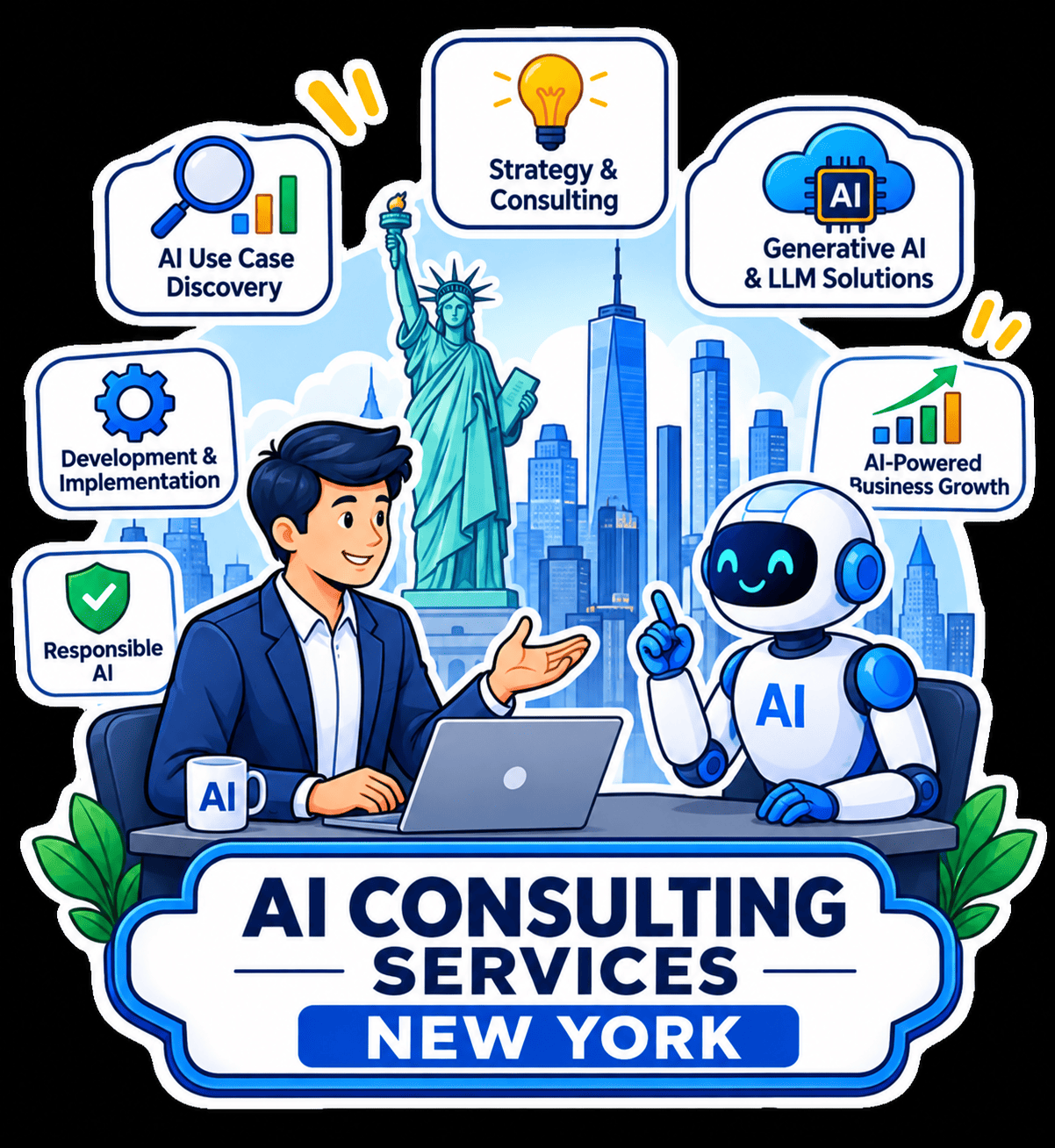
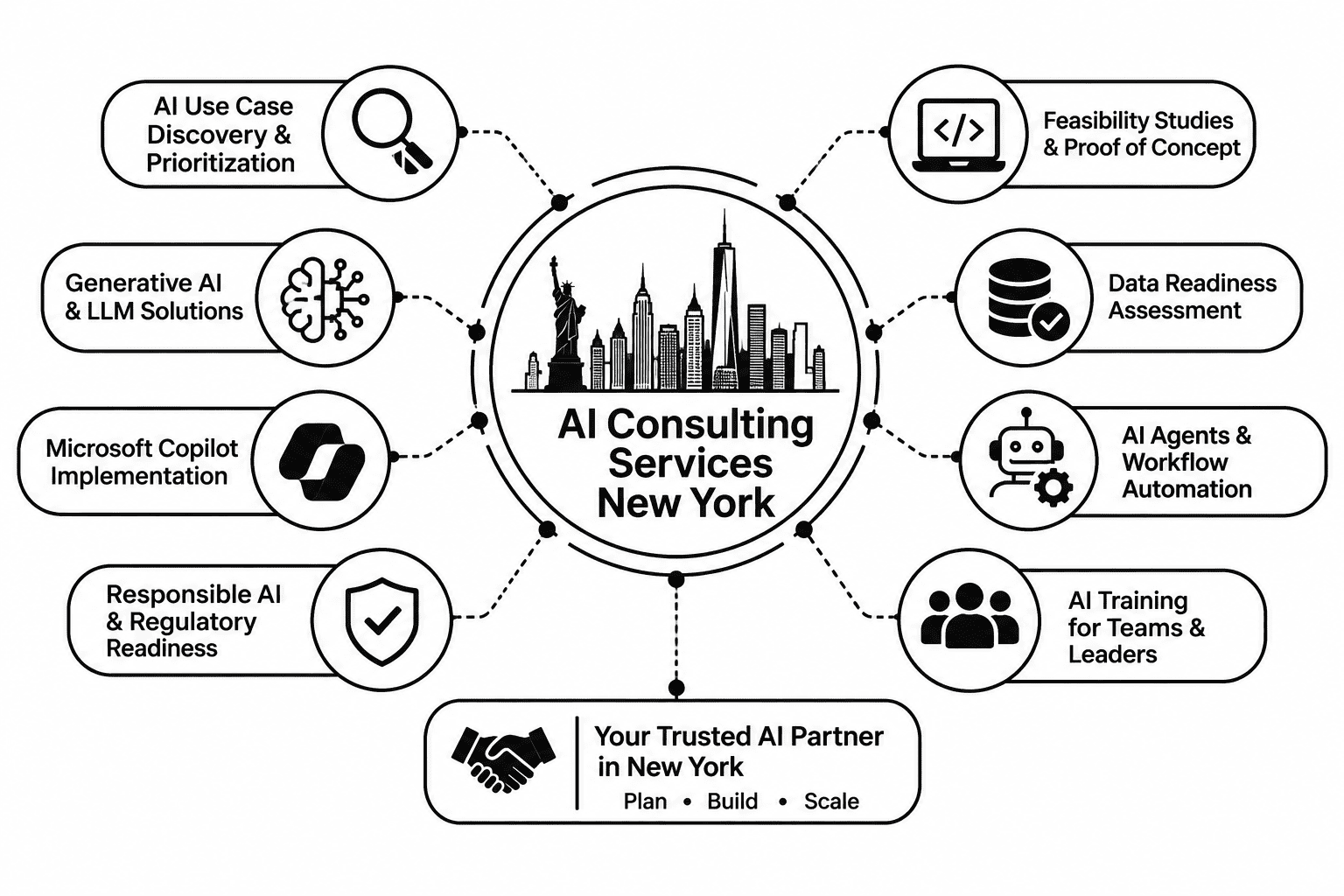
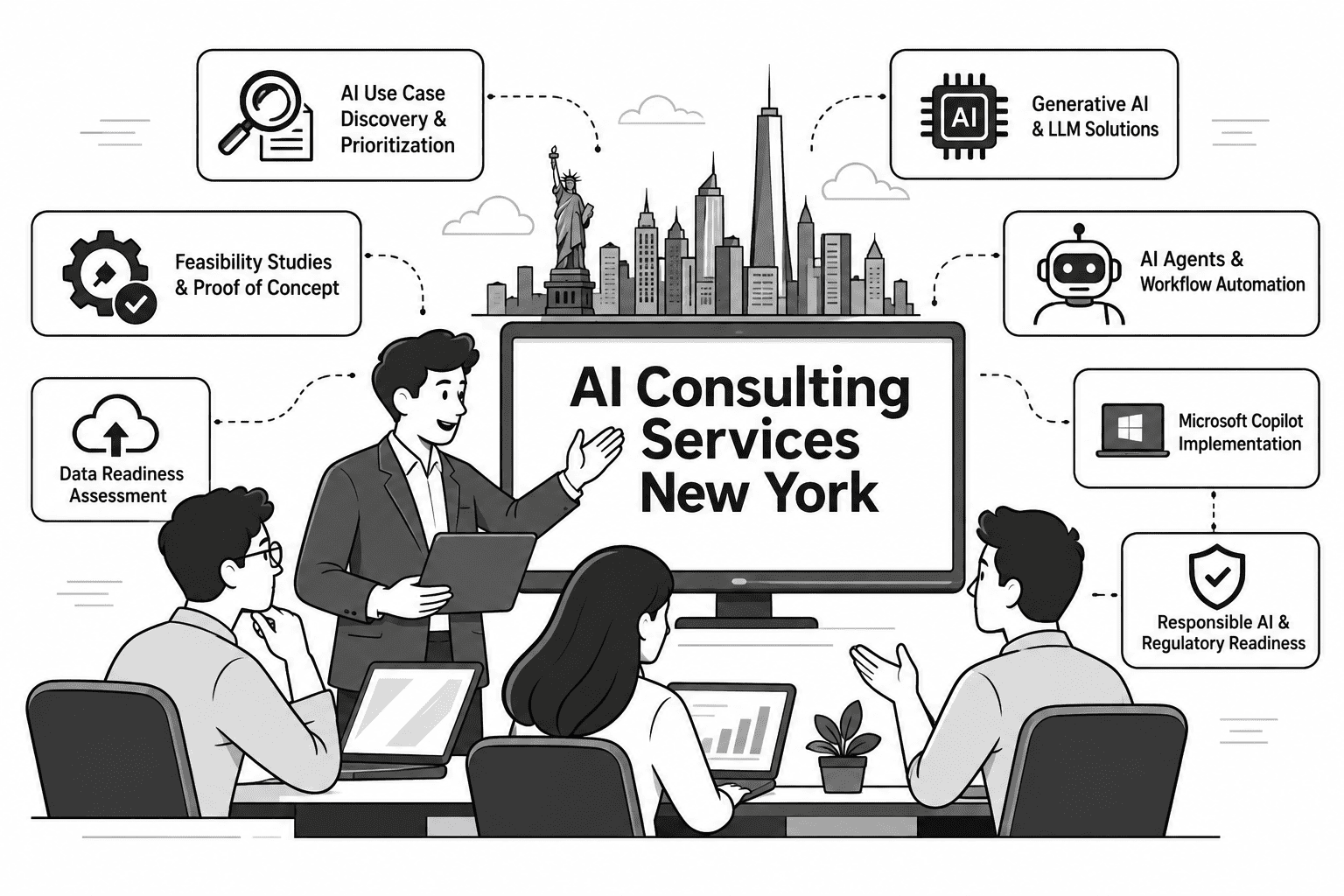
AI Consulting Services New York

Turn research, documents, and business data into useful AI applications
your teams can review and manage.

AI consulting services New York help finance, insurance, media, healthcare, and real estate teams turn information into useful decisions. A successful demo is only the beginning. Teams need reliable outputs, appropriate access, and measurable business results.

Ansi ByteCode LLP connects that planning with engineering. Our Houston office supports collaboration during agreed New York business hours. Since 2014, we have delivered 250+ projects, supported by Microsoft Solutions Partner capabilities across data, applications, and Azure infrastructure.
+
Years in AI & Software Development
+
AI & Software Projects Delivered
+
Certified AI & Technology Experts
%
Client Retention Rate

Why AI Matters for New York Businesses Now

A research summary, lease review, or customer response is useful only when the team can trust and act on it. New York’s financial and real estate businesses handle information that requires accuracy, context, and oversight.

AI can help organize that information and reduce repetitive work. Ansi ByteCode LLP helps identify suitable applications, test outputs against real examples, and connect validated capabilities to existing processes. The objective is a measurable improvement in how work gets done.

Comprehensive AI Consulting Services for New York Businesses

Our services cover discovery, validation, development, and adoption. New York teams can start with one defined requirement, then extend the engagement as findings support further investment.

AI Use Case Discovery and Prioritization

We identify where research, document checks, and reporting consume time or delay decisions. Interviews map the current process and its review requirements. Candidate use cases are ranked by expected payback, effort, and risk, giving leadership a reasoned choice about the first investment.

Feasibility Studies and Proof of Concept

We test a proposed application using representative company data before recommending a larger build. Evaluation criteria are agreed upfront and may cover accuracy, task completion, review effort, or cost. The findings show what worked, what failed, and whether further development is justified. Most proofs of concept run three to four weeks.

AI Vendor and Platform Selection

Choosing a platform means comparing operational fit as well as features. We assess existing AI products against custom development, then compare Azure OpenAI, Claude, and open-weight options. Recommendations address quality, usage costs, data processing, deployment choices, and dependencies that could affect future changes.

Data Readiness Assessment

We inspect the sources an AI application would rely on, including document collections, transaction records, and internal databases. The assessment checks quality, ownership, permissions, and update processes. A prioritized preparation list identifies issues to resolve before connecting models or testing outputs against business requirements.

Generative AI and LLM Solutions

We develop drafting, summarization, and research assistants grounded in approved company information. Applications can surface supporting passages, distinguish source material from generated text, and route uncertain outputs for review. Evaluation uses representative documents and questions to check usefulness, factual support, and limits before rollout.

AI Agents and Workflow Automation

We build agents for client onboarding, document checks, and report preparation across email, CRM, and core applications. Workflows define permitted actions, required evidence, and staff approval points. Testing includes missing records, conflicting information, and failed integrations so exceptions reach the right person before action.

Microsoft Copilot Implementation

We prepare Microsoft 365 permissions, content ownership, and sensitivity labels before introducing Copilot by team. Where generic features do not cover a task, we develop custom Teams assistants. Role-specific guidance, pilot feedback, and usage reporting help teams adopt the tools within agreed access boundaries.

AI Training for Teams and Leaders

We deliver practical sessions for leaders and staff using tasks from their own roles. Training covers suitable use cases, prompt techniques, source checking, sensitive information, and escalation. Leaders also learn how to assess proposals and adoption results, while staff practice reviewing AI outputs responsibly.

Responsible AI and Regulatory Readiness

We design access controls, logging, evaluation, and documentation around the proposed application and applicable obligations. For relevant financial-sector engagements, this can support NYDFS cybersecurity review. Employment-related AI requires separate consideration of applicable rules, including NYC Local Law 144 where its scope is met.

Make Your Next AI Investment Easier to Evaluate

Start with a defined business problem, test the approach on your information, and understand what a reliable rollout requires.

AI Solutions for New York’s Key Industries

New York’s economy runs on finance, insurance, media, healthcare, real estate and retail, and AI looks different in each. Here is how AI can support different workflows in each sector.

Banking and Capital Markets

Home to the NYSE and major financial institutions, New York handles extensive market research and regulatory documentation. We build research-summary, document-checking, and surveillance-triage tools, with source references and audit trails.

Insurance

We extract information from submissions and loss runs, summarize claims notes, and search policy endorsements. Underwriters and adjusters retain review over interpretations, exceptions, and consequential decisions.

Media and Publishing

We develop archive search, content tagging, editorial drafting, and advertising forecasts. We also build rights and licensing lookups, with source checks and editorial approval before anything is published.

Healthcare

We build patient message drafts, referral and intake workflows, and clinical document search. HIPAA-aware access and logging support information safeguards, with staff reviewing sensitive outputs before they are used.

Real Estate

We develop lease abstraction, rent-roll analysis, tenant-request triage, and market comparisons. Extracted details link back to source records so property teams can verify findings before they act.

Retail and Fashion

We build demand and size-curve forecasts, product drafting tools, service assistants, and promotion analysis. Evaluation considers merchandising needs, available sales history, brand requirements, and review workflows.

Our Six Step Path to Production AI

Our full delivery lifecycle follows six stages, with review points between major investments. Teams can engage for selected stages, while findings determine whether an idea progresses, changes scope, or requires additional preparation before development.

Step 1: Leadership Alignment Session

We clarify the business objective, decision owners, and expected value. Discussions also establish budget assumptions, risk tolerance, and review responsibilities, giving the project a shared purpose before the team selects tools or designs functionality.

Step 2: Process and Data Discovery

The team maps how information enters the workflow, who uses it, and where decisions occur. We assess source quality, permissions, dependencies, and exceptions to identify what the proposed AI application must handle reliably.

Step 3: Business Case for Each Use Case

We compare expected benefits with delivery effort, operating costs, and oversight needs. Each business case identifies assumptions and measurable targets, helping stakeholders distinguish a useful first application from work that needs stronger supporting evidence.

Step 4: Proof of Concept With Clear Exit Criteria

A contained build tests the main technical uncertainty against representative inputs. Agreed exit criteria define acceptable results. We document failures, review requirements, and costs so the decision to proceed reflects evidence from the proposed workflow.

Step 5: Secure Deployment and Integration

For approved use cases, engineers complete application development, system connections, and access controls. Testing checks user journeys, exception handling, and release readiness. Deployment follows the agreed environment, with operating documentation and responsibilities prepared before launch.

Step 6: Adoption Tracking and Iteration

We assess how staff use the application and where outputs need correction or escalation. Monitoring covers quality, latency, failures, and cost. Findings guide training, workflow changes, and technical improvements before the solution expands further.

Engagement Options for New York Teams

New York teams can begin with fixed-scope discovery or a PoC, then add engineering capacity as needed. Our engagement models define pricing, delivery responsibilities, and reporting expectations. Explore our engagement models.

Fixed Price Model

Defined discovery, validation, or development work can use an agreed project price. Deliverables, assumptions, acceptance criteria, and change procedures establish what the engagement includes.

Time and Material Model

For work with evolving requirements, we agree rates and bill actual effort. Regular reviews connect spending to completed work, unresolved questions, and priorities for the next stage.

Hourly Price Model

Hourly engagements support focused advice, architecture reviews, or limited enhancements. We define the question or task upfront, then report effort and findings against that requirement.

Dedicated Team

A dedicated team supports a continuing roadmap across application engineering, data, and AI. Retained project knowledge helps successive releases address the same business and oversight requirements.

Agile Development Model

Short iterations let stakeholders review working features and adjust priorities. Regular feedback informs delivery, while the agreed commercial model determines how effort and changes are billed.

Forward-Deployed Engineers

Engineers collaborate with business and technical teams to resolve workflow and integration challenges. Access, working arrangements, responsibilities, and any onsite activity are agreed before delivery begins.

Industry Recognition

Why Choose Our AI Consulting Firm in New York

Choosing an AI partner involves more than comparing demonstrations. Businesses need practical advice, accountable engineering, and usable evidence. We connect these responsibilities so decisions remain grounded in the workflow, its risks, and expected value.

Real-Time Collaboration During New York Business Hours

Our Houston office is one hour behind New York. We agree on overlap for meetings and reviews, with support coverage and response expectations defined for the engagement.

Microsoft Solutions Partner

We hold Microsoft Solutions Partner designations for Data & AI, Infrastructure (Azure), and Digital & App Innovation (Azure), reflecting capabilities across data, application delivery, and cloud infrastructure.
Consultants Who Also Build

The team assessing your opportunity stays connected to engineering. Recommendations account for implementation constraints, while development remains tied to the business objectives and review requirements.

Proof Before Scale

We test important assumptions against agreed criteria before recommending wider investment. Results include limitations, expected running costs, and the work needed to support a broader release.
Clean Handover and Documented Dependencies

You receive agreed project-specific code, prompts, pipelines, applicable model artifacts, and documentation. Third-party dependencies and licensing terms are recorded so your team can plan ongoing ownership.

250+ Projects Delivered Since 2014

Ansi ByteCode LLP has delivered 250+ projects for clients in the US and worldwide. Enterprise software experience informs how we approach integration, testing, deployment, and support.

Case Studies

These projects show how AI capabilities move beyond isolated models and into applications, integrations, and workflows people can use.

What our Clients say About us

Don't just take our word for it. Here's what businesses across the US say about working with Ansi ByteCode LLP as their AI consulting partner.

FAQs About AI Consulting Services New York

AI projects raise questions about budgets, delivery scope, industry fit, and oversight. These answers explain how we assess requirements and establish a practical starting point for your team.

As a planning guide, focused AI assessments may cost $2,500-$5,000. Development and rollout are quoted separately. Data preparation, integrations, and security reviews affect pricing. Model usage, hosting, and support add recurring costs.

Services include use-case assessment, feasibility testing, platform selection, data readiness, generative AI, agents, Copilot implementation, training, and governance. You can engage for a specific decision or combine services to develop, introduce, and improve an AI application.

Our services address use cases in banking, insurance, media, healthcare, real estate, and retail. Suitability depends on the workflow and available data. We assess domain requirements, review responsibilities, and expected benefits before recommending a solution.

We can help implement technical controls and documentation supporting applicable NYDFS cybersecurity requirements. Scope is agreed with your security and compliance teams. Our work supports their review; it does not replace legal advice or regulatory accountability.

Contact us with the business problem, intended users, and systems involved. The first call is free and takes 30 minutes. You’ll hear from us within two business days. An initial discussion will establish priorities, data availability, and constraints. We then recommend an assessment, focused validation, or delivery plan with defined scope and next steps.

Our Blogs

Explore our latest insights, guides, and expert perspectives on AI. This will help you stay informed and make smarter business decisions.

What Is Predictive Maintenance? How It Works and Why It Matters

Critical equipment doesn’t fail on schedule. A motor overheats without warning.

Agentic AI vs Generative AI: Which One Is Right Fit for You?

If you’ve been comparing Agentic AI vs Generative AI, you’re probably wondering which one can actually make a bigger difference to your business

Let’s build your dream together.