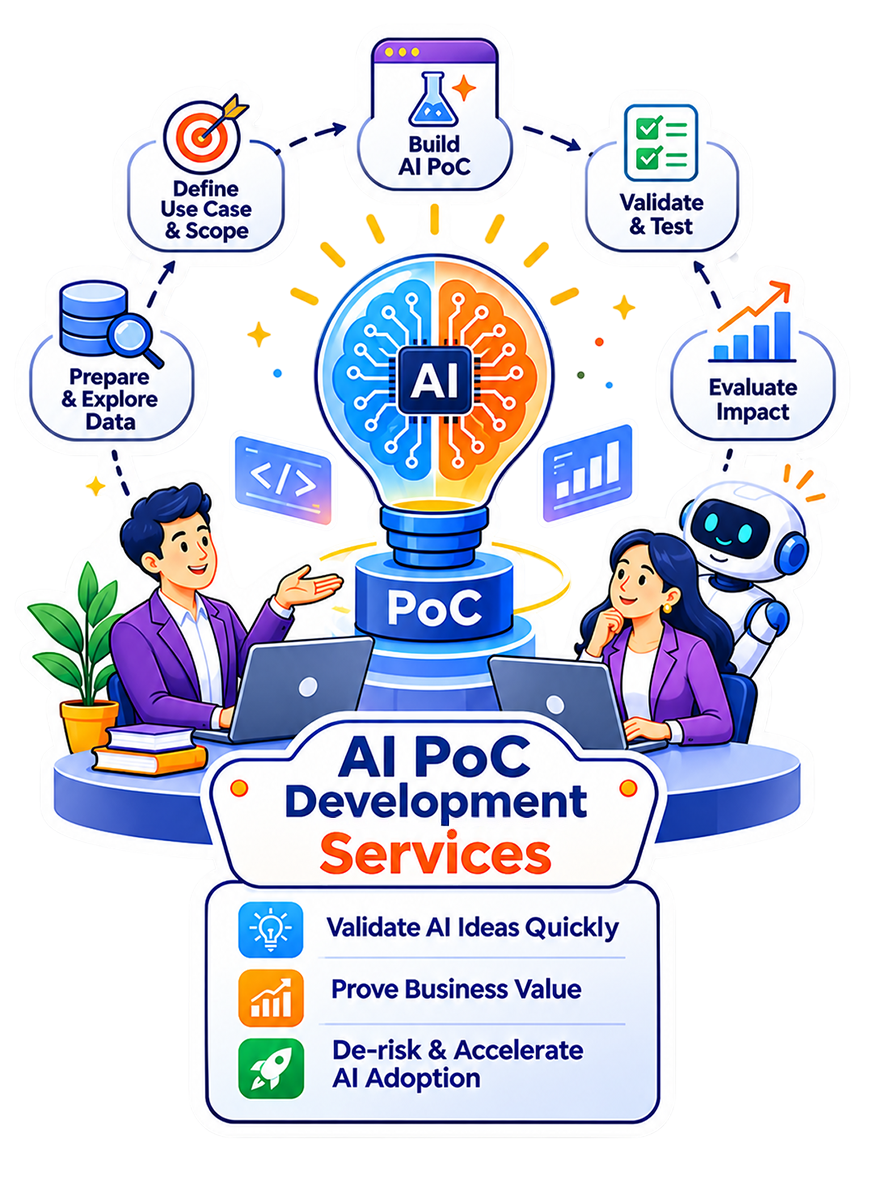
AI PoC Development Services

Test the technical assumptions behind your AI idea
before committing to a larger build.

An impressive AI demo is not enough to justify investment. You need evidence that it works on your data. An AI proof of concept measures performance against agreed criteria, exposing limitations before you fund development.

Ansi ByteCode LLP provides AI PoC development services for US enterprises. We combine 12+ years of enterprise software experience with AI expertise. Our team builds focused prototypes and evaluates whether the results support further investment.
+
Years in AI & Software Development
+
AI & Software Projects Delivered
+
Certified AI & Technology Experts
%
Client Retention Rate

Why Enterprises Invest in AI PoC Development

Leadership teams approve AI budgets with incomplete evidence. A proof of concept answers those open questions on your data and systems, so the final call rests on results, not persuasion.

Quicker, Lower-Risk Decisions

A focused PoC may produce useful evidence in 2–6 weeks. This indicative range depends on data readiness, system access, integration complexity, and evaluation scope. We confirm the schedule after reviewing your requirements.

Cost Optimization Before Full Investment

Instead of funding several ideas at once, teams can test the strongest candidates first. Early evidence helps compare model choices, data demands, likely operating costs, and expected return before committing full development resources.
Testing on Real Data and Conditions

Public demos rarely reflect the data a business actually owns. We test models against representative company records and operating scenarios, so performance findings reflect the conditions the proposed solution would face.
Stakeholder Confidence and Buy-In

A working PoC gives sponsors something they can inspect, question, and measure. That evidence makes budget discussions more concrete than a slide deck or vendor demonstration built outside the organization’s environment.

Avoiding Costly Mid-Build Mistakes

A short validation cycle can expose weak data, missing integrations, or unrealistic performance targets before they become expensive architecture decisions. Teams can then change the approach while the build is still contained.

A Defensible Go or No-Go Decision

We agree on evaluation criteria before development starts, then measure the PoC against them. The final recommendation rests on recorded results, giving stakeholders a clearer basis for a go or no-go decision.

Our AI PoC Development Services

Our services test feasibility, performance, and integration fit. Where a PoC succeeds, separate product development and MLOps engagements can take the validated approach into production.

AI Use Case Discovery & Feasibility Assessment

Workshops surface candidate use cases and compare business impact, expected ROI, data availability, and technical constraints. We then narrow the list to the ideas with enough value and evidence to justify a PoC, rather than spreading engineering effort across weaker opportunities.

AI Strategy & Roadmap

A useful PoC needs a clear technical hypothesis. We review available data, compare model approaches, map system dependencies, and define milestones, risks, and evaluation criteria. The roadmap keeps validation focused on the questions that must be answered before further investment.

Custom AI PoC Development

We build contained machine learning, generative AI, or predictive analytics prototypes around agreed success criteria. Testing uses the client’s own data where available, so the team can measure performance, integration feasibility, and scaling concerns without treating the PoC as a production product.

Rapid PoC Development

When one technical assumption carries most of the risk, we isolate it and build a functional prototype within a short, fixed scope and timeframe. The result produces real outputs, not a mockup, while the architecture avoids blocking later development if the idea proves viable.

AI Agent PoC Development

We test agentic workflows in a controlled environment before they reach operational users. Engineers validate decision logic, tool calls, multi-agent coordination, and failure handling. Selected workflows connect to ERP, CRM, healthcare, or legacy systems. These tests reveal integration constraints before wider investment.

AI Integration & Implementation

Integration validation checks whether the proven AI approach can work with existing applications, APIs, CRMs, internal tools, or data warehouses. We test authentication, data movement, observability, and CI/CD compatibility. Full enterprise implementation remains a separate production engagement after technical validation.

AI Product Development

If the PoC meets its agreed criteria, product development can follow as a separate engagement. That work may cover frontend and backend engineering, APIs, CI/CD pipelines, model tuning, and production ownership. The PoC itself only establishes whether that larger investment is justified.

MLOps Services

During the PoC, we validate the operational requirements a machine learning solution would need later, including preprocessing, model versioning, deployment patterns, and pipeline dependencies. Production MLOps implementation remains optional follow-on work after the prototype clears its technical and business criteria.

AI Governance & Ethics Consulting

Technical feasibility also depends on how the organization governs AI. We assess the PoC against audit and data-use requirements. Testing covers fairness, bias, explainability, and human review. We document control gaps and required changes so stakeholders understand what needs attention before wider deployment.

Move From AI Concept to Working Prototype

Test your AI use case against measurable criteria and understand the technical, cost, and deployment requirements for production.

Industries We Serve

The technical question changes with the environment. We shape each PoC around the data, controls, workflows, and review requirements that influence feasibility in that industry.

Healthcare

Healthcare PoCs can test clinical documentation or scheduling workflows against representative data. We also validate role-based access and HIPAA-aware controls before recommending any broader implementation.

Finance and Banking

Fraud detection, credit risk, and claims automation need measurable accuracy and traceable decisions. We test representative financial data and review regulatory constraints before considering wider deployment.

Insurance

We validate claims intake and underwriting against policy documents, claim records, and adjuster notes. The results show where automation works and where human review must continue.

Retail and Ecommerce

We test recommendation and demand forecasting models with the retailer’s own sales, catalog, and customer data. Measured results show whether the approach can support real commercial decisions.

Manufacturing

We evaluate predictive maintenance and defect detection using equipment logs, sensor readings, and inspection data. This testing shows whether the model performs consistently under actual plant conditions.

Logistics and Supply Chain

We test route optimization and demand forecasting against shipment history, inventory records, and operating constraints. The results help teams decide whether the model can support real planning decisions.

SaaS Applications and Technology

We validate AI copilots and workflow automation using product activity, support tickets, and application logic. The PoC reveals response, integration, and workflow issues before teams expand the feature.

Legal and Compliance

We test contract review and clause extraction against representative agreements and defined review criteria. Attorneys can verify the outputs and determine where professional review must remain.

Types of AI PoC We Build

Different PoCs answer different technical questions. We select the format that isolates the main uncertainty, then measure it against agreed criteria using representative data and workflows.

Generative AI PoC

Generative AI PoCs use scored examples from the client’s domain to measure output quality, tone, and accuracy. This shows whether the model meets the required standard across representative prompts, not only a few polished demonstrations.

RAG and Knowledge Retrieval PoC

A RAG PoC tests the full retrieval path using the client’s documents. We evaluate chunking, embeddings, search quality, and grounded answers to see whether the system can retrieve useful evidence and avoid unsupported responses.

AI Agent and Automation PoC

Agent PoCs test whether an AI agent can complete a defined multi-step workflow across connected systems. We exercise tool calls, handoffs, and failure paths to see where the agent needs retries, guardrails, or human intervention.

LLM PoC

An LLM PoC evaluates a limited, domain-tuned language model against one defined use case. The team measures whether specialized behavior improves enough to justify the cost and complexity of broader custom LLM development.

Predictive and ML Model PoC

Historical data does not always contain enough predictive signals for automation. We train and test a focused model, compare results with the agreed accuracy threshold, and determine whether predictions can support the intended decision.

AI Integration PoC

A model can perform well and still fail inside the target environment. We test connections with CRM, ERP, SharePoint, Teams, or other systems to uncover authentication, data flow, latency, and interface constraints before full integration.

What You Get From Us

A useful PoC ends with evidence you can act on. The final package shows what worked, what did not, and whether the idea deserves further investment.

Working Prototype

You receive a functional prototype built around one narrow success metric and tested against your own representative data, rather than a generic public benchmark or scripted demonstration.

Accuracy and Evaluation Report

The evaluation report records model performance against the threshold agreed before development. You can see the measured result, test conditions, and key failure patterns behind the recommendation.

Cost Model

We estimate production operating costs at your expected usage, including compute, model or API consumption, and supporting infrastructure. This gives budget owners an early view of likely run costs.

Security and Deployment Blueprint

You receive a deployment blueprint showing the proposed security boundaries, identity approach, data flows, and infrastructure path. Your security team can review those controls before production work begins.

Production Roadmap

The roadmap gives a clear go or no-go recommendation, then outlines build phases, integration points, dependencies, and an indicative timeline if the evidence supports moving toward a full solution.

Scalability Assessment

We assess how higher user counts, data volumes, requests, or workloads could affect the validated design. The findings identify technical changes that may be required before production scaling.

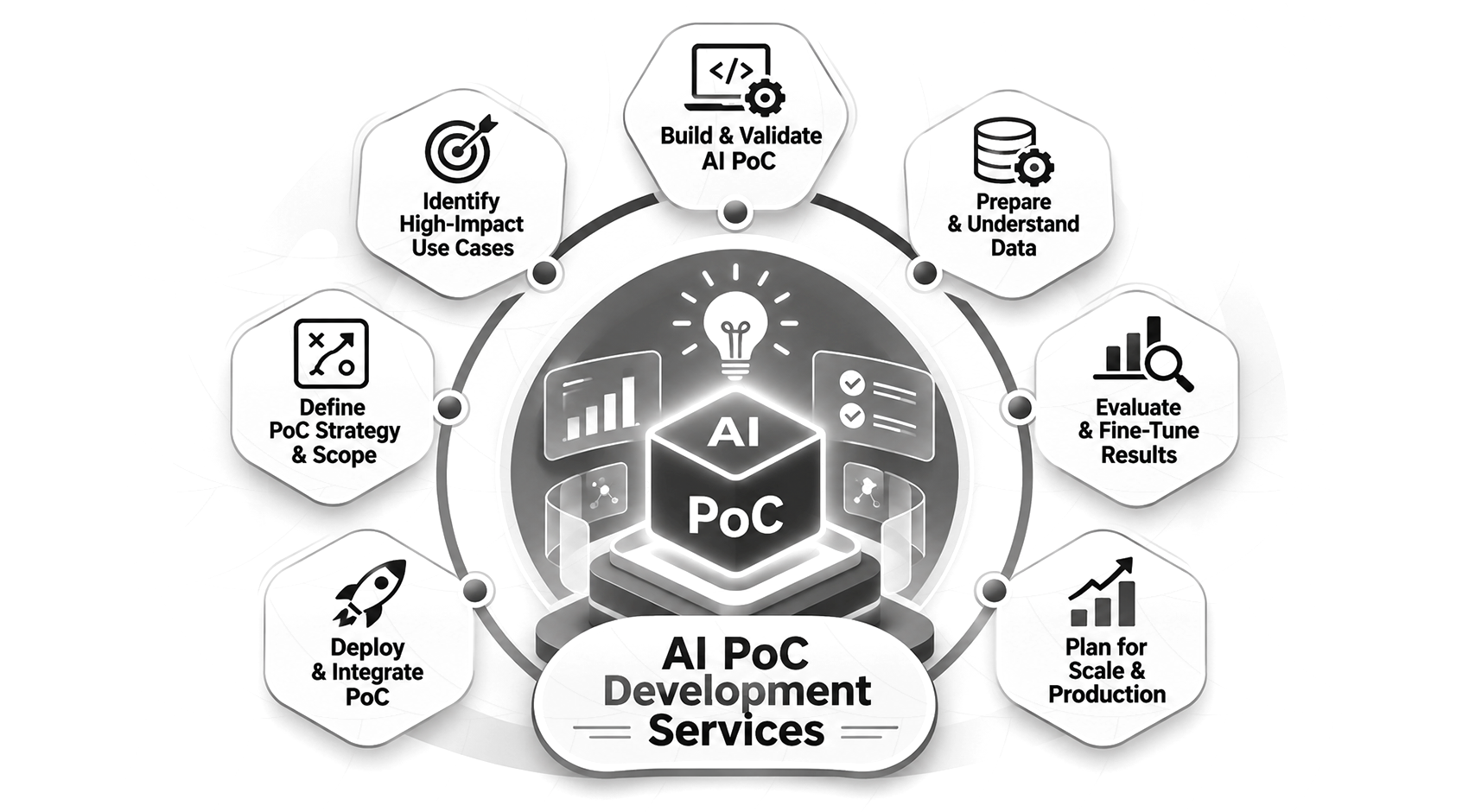
AI PoC Development Process at Ansi ByteCode LLP

Every PoC starts with a different data condition and performance target. We set the success criteria first, then use each stage to reduce uncertainty before the team reaches a measured go or no-go recommendation.

Step 1: Discovery, Scope, and Success Criteria

We define the business question, technical hypothesis, scope, users, and success threshold with stakeholders. The team also records constraints and exclusions so everyone agrees on what the PoC must prove before development starts.

Step 2: Data Assessment and Architecture Design

Engineers inspect data quality, volume, access, and ownership, then map the minimum architecture needed for validation. This step identifies gaps that could distort results or block the proposed technical approach.

Step 3: Building the Riskiest Path First

We build the path most likely to invalidate the idea first, whether that is retrieval, model accuracy, integration, or agent behavior. Testing the highest-risk assumption early prevents effort from accumulating around an unproven foundation.

Step 4: Testing, Evaluation, and Stress-Testing the Edges

The team measures normal cases, edge cases, failures, and representative workloads against the agreed criteria. We record where performance drops, where controls fail, and which limitations would matter in production.

Step 5: Refinement and Optimization

Where results show promise, we refine prompts, model settings, retrieval logic, data preparation, or integration choices. Changes stay tied to the original success criteria so optimization does not turn into open-ended product development.

Step 6: Go or No-Go Readout and Production Roadmap

We present the measured results, unresolved constraints, expected operating costs, and recommendation. If the PoC clears the threshold, the production roadmap defines the next required build phases, dependencies, and decisions.

Industry Recognition

Why Businesses Choose Ansi ByteCode LLP for AI PoC Development

A PoC is valuable only when the result can withstand technical and commercial scrutiny. Our approach combines measurable evaluation, Microsoft capability, enterprise engineering experience, and clear ownership of the evidence produced.

Microsoft Solutions Partner

Ansi ByteCode LLP holds Microsoft Solutions Partner designations for Data & AI, Digital & App Innovation (Azure), and Infrastructure (Azure), supporting PoC work across data, applications, and cloud infrastructure.

PoCs Measured Against an Agreed Threshold

We agree on an evaluation set and measurable threshold before development starts. The final readout shows whether the PoC cleared that bar and where it fell short.

Built Inside Your Existing Microsoft Tenant

For Microsoft environments, we can test Azure OpenAI Service and Azure AI services inside the client’s existing tenant, identity model, and approved governance boundaries.

A Recommendation Not to Proceed Is a Valid Outcome

A PoC does not need to justify a larger build to succeed. If the data, performance, or economics fall short, we document that result and recommend stopping or changing direction.

Real Delivery Experience Behind It

Our 12+ years of enterprise software experience, combined with AI development expertise, helps us assess the integration, deployment, and ownership questions that determine whether a promising PoC can move forward.

Your Data Stays Yours

You retain ownership of the code, prompts, and architecture delivered under the agreed engagement terms. We do not use client project data to train a public model.

AI PoC Technology Stack

PoC technology should match the question being tested. We use the same models, frameworks, data platforms, and deployment tools as our AI development work.

GPT (OpenAI)

Claude

Gemini

Llama

Mistral

DeepSeek

Cohere Command

Qwen

LangChain

LangGraph

LlamaIndex

CrewAI

AutoGen

Semantic Kernel

OpenAI Agents SDK

DSPy

Microsoft Copilot Studio

LlamaIndex

LangChain

Haystack

Unstructured

Apache Tika

Pinecone

Weaviate

Milvus

Chroma

Qdrant

FAISS

Redis Vector

Elasticsearch

DALL·E

Stable Diffusion

Whisper

ElevenLabs

Azure AI Speech

Google Vertex AI Vision

CLIP

Python

TypeScript

JavaScript

C# Logo

C#

Java

Go

vLLM

Ollama

NVIDIA Triton Inference Server

TensorRT-LLM

Ray Serve

BentoML

Azure AI Foundry

LangSmith

Langfuse

Arize AI

TruLens

Guardrails AI

NVIDIA NeMo Guardrails

OpenTelemetry

Docker

Kubernetes

Helm

Terraform

GitHub Actions

Case Studies

See how we’ve helped businesses across industries solve real challenges with AI, from strategy and integration to full-scale deployment and measurable results.

What our Clients say About us

Don't just take our word for it. Here's what businesses across the US say about working with Ansi ByteCode LLP as their AI consulting partner.

FAQs About AI PoC Development Services

AI PoC planning usually raises questions about timing, cost, data, ownership, and what happens after validation. These answers cover the decisions teams need to make before starting.

An AI PoC is a small, time-boxed technical build used to test whether an AI approach can meet agreed criteria on representative data. It is designed to answer feasibility questions before a larger product investment.

A focused PoC may take 2 to 6 weeks, but that range is indicative. Timing changes with data readiness, system access, integration complexity, evaluation scope, and the number of technical assumptions being tested.

For early budgeting, a focused AI PoC may cost $10,000-$25,000. Complex data preparation, integrations, or evaluation requirements can increase the budget. We provide a project-specific estimate after agreeing on the scope, data needs, and success criteria.

A PoC tests technical feasibility. A pilot tests a solution in a limited operational setting. An MVP is a usable product version that also tests user value. Each stage answers a different question and requires different engineering depth.

Project-specific deliverables are assigned according to the engagement terms. Third-party models, software, and licensed components retain their existing ownership. Handover includes source code, prompts, architecture documentation, and evaluation findings so your team can understand and extend the work.

We need enough representative data to test the technical hypothesis credibly. The exact requirement depends on the use case, model approach, data quality, access rules, and whether historical outcomes are available for evaluation.

A PoC that misses its success criteria still provides useful evidence. We document the failure points and recommend whether to change the data, model, integration approach, or stop before more budget is committed.

Our Blogs

Explore our latest insights, guides, and expert perspectives on AI. This will help you stay informed and make smarter business decisions.

What Is Predictive Maintenance? How It Works and Why It Matters

Critical equipment doesn’t fail on schedule. A motor overheats without warning.

Agentic AI vs Generative AI: Which One Is Right Fit for You?

If you’ve been comparing Agentic AI vs Generative AI, you’re probably wondering which one can actually make a bigger difference to your business

Let’s build your dream together.